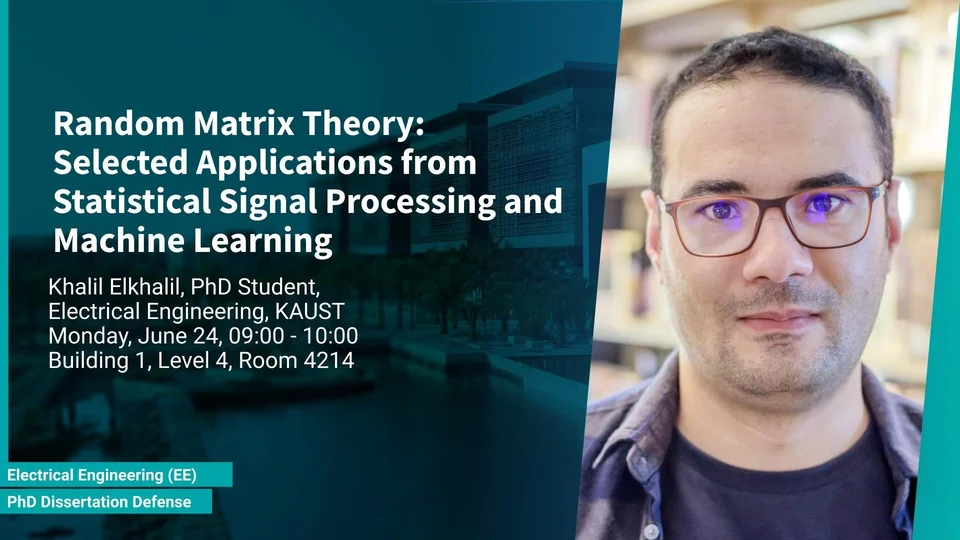
About Khalil Elkhalil Khalil Elkhalil Postdoctoral Research Fellow, Electrical and Computer Engineering machine learning high dimensional statistics data science Random Matrix Theory Selected Applications statistical signal processing Supervised Learning Algorithms Feedback Reduction in Multiuser and Relay Networks PhD degree candidate of the Electrical Engineering, King Abdullah University of Science and Technology. Events Presented Events Jun 23 - Jun 29, 2019 Random Matrix Theory: Selected Applications from Statistical Signal Processing and Machine Learning Khalil Elkhalil, Postdoctoral Research Fellow, Electrical and Computer Engineering Jun 24, 09:00 - 10:00 B1 L4 R4214 Random Matrix Theory machine learning high dimensional statistics data science Random matrix theory is an outstanding mathematical tool that has demonstrated its usefulness in many areas ranging from wireless communication to finance and economics. The main motivation behind its use comes from the fundamental role that random matrices play in modeling unknown and unpredictable physical quantities. In many situations, meaningful metrics expressed as scalar functionals of these random matrices arise naturally. Along this line, the present work consists in leveraging tools from random matrix theory in an attempt to answer fundamental questions related to applications from statistical signal processing and machine learning.
Random Matrix Theory: Selected Applications from Statistical Signal Processing and Machine Learning Khalil Elkhalil, Postdoctoral Research Fellow, Electrical and Computer Engineering Jun 24, 09:00 - 10:00 B1 L4 R4214 Random Matrix Theory machine learning high dimensional statistics data science Random matrix theory is an outstanding mathematical tool that has demonstrated its usefulness in many areas ranging from wireless communication to finance and economics. The main motivation behind its use comes from the fundamental role that random matrices play in modeling unknown and unpredictable physical quantities. In many situations, meaningful metrics expressed as scalar functionals of these random matrices arise naturally. Along this line, the present work consists in leveraging tools from random matrix theory in an attempt to answer fundamental questions related to applications from statistical signal processing and machine learning.
Engage ORCID LinkedIn KAUST Academic Portal IEEE Xplore GitHub ShareClipboard Related Sites Electrical and Computer Engineering (ECE) Information Science Lab (ISL) Related Content Articles 4 Events 1 Related Links Also view Publications on ORCID Also view Publications on Scopus Google Scholar