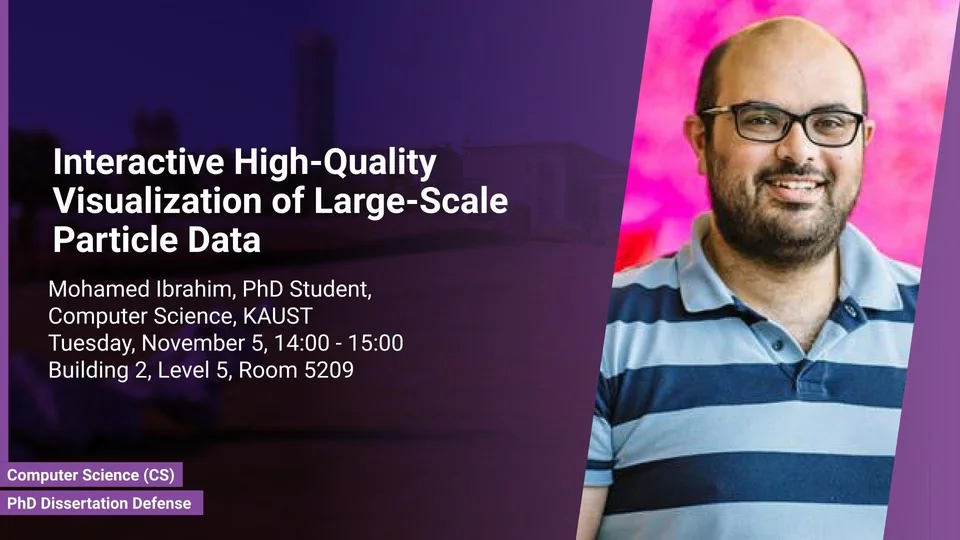
About Mohamed Ibrahim Mohamed Ibrahim Postdoctoral Research Fellow, Computer Science Molecular Dynamics 3D Shape Manipulation Scientific Visualization computer graphics 3D Shape Creation visualization Mohamed Ibrahim is a Postdoctoral Research Fellow in High-Performance Visualization Group (VCCVIS) working with Prof. Markus Hadwiger at King Abdullah University of Science and Technology (KAUST). Education and Early Career He earned his Bachelor’s degree in Computer Engineering from the American University in Cairo (AUC) in 2010. Later on, he obtained a Master’s degree in Computer Science from KAUST in 2012. He graduated from KAUST with a Ph.D. in Computer Science in 2019. Research Interest Mohamed Ibrahim's research is concerned with Large-Scale data visualization. He's especially interested Events Presented Events Nov 3 - Nov 9, 2019 Interactive High-Quality Visualization of Large-Scale Particle Data Mohamed Ibrahim, Postdoctoral Research Fellow, Computer Science Nov 5, 14:00 - 15:00 B2 L5 R5209 visualization high-quality rendering large-scale simulation particle data aliasing artifact sampling visible particles Large-scale particle data sets, such as those computed in molecular dynamics (MD) simulations, are crucial to investigating important processes in physics and thermodynamics. The simulated atoms are usually visualized as hard spheres with Phong shading, where individual particles and their local density can be perceived well in close-up views. However, for large-scale simulations with 10 million particles or more, the visualization of large fields-of-view usually suffers from strong aliasing artifacts, because the mismatch between data size and output resolution leads to severe under-sampling of the geometry.
Interactive High-Quality Visualization of Large-Scale Particle Data Mohamed Ibrahim, Postdoctoral Research Fellow, Computer Science Nov 5, 14:00 - 15:00 B2 L5 R5209 visualization high-quality rendering large-scale simulation particle data aliasing artifact sampling visible particles Large-scale particle data sets, such as those computed in molecular dynamics (MD) simulations, are crucial to investigating important processes in physics and thermodynamics. The simulated atoms are usually visualized as hard spheres with Phong shading, where individual particles and their local density can be perceived well in close-up views. However, for large-scale simulations with 10 million particles or more, the visualization of large fields-of-view usually suffers from strong aliasing artifacts, because the mismatch between data size and output resolution leads to severe under-sampling of the geometry.
Related Sites High Performance Visualization Group (VCCVIS) Computer Science (CS) Related Content Events 1 Related Links High Performance Visualization Group