About Panagiotis Kalnis Panagiotis Kalnis Professor, Computer Science supercomputing infoclouds Professor Panos Kalnis is a leading researcher in big data, cloud computing, parallel and distributed systems and computing privacy for data mining and bioinformatics. Events Presented Events Nov 28 - Dec 4, 2021 DeepReduce: A Sparse-tensor Communication Framework for Distributed Deep Learning Panagiotis Kalnis, Professor, Computer Science Nov 29, 12:00 - 13:00 B9 R2322 H1 Sparse tensors appear frequently in distributed deep learning, either as a direct artifact of the deep neural network's gradients, or as a result of an explicit sparsification process. Most communication primitives are agnostic to the peculiarities of deep learning; consequently, they impose unnecessary communication overhead. Oct 25 - Oct 31, 2020 Compressed communication in Distributed Deep Learning - A Systems perspective Panagiotis Kalnis, Professor, Computer Science Oct 26, 12:00 - 13:00 KAUST Deep learning Network communication is a major bottleneck in large-scale distributed deep learning. To minimize the problem, many compressed communication schemes, in the form of quantization or sparsification, have been proposed. We investigate them from the Computer Systems perspective, under real-life deployments. We identify discrepancies between the theoretical proposals and the actual implementations, and analyze the impact on convergence. Oct 13 - Oct 19, 2019 Use Mathematics and get a SPARQL Query Engine (almost) for Free! It’s MAGiQ! Panagiotis Kalnis, Professor, Computer Science Oct 14, 12:00 - 13:00 B9 L2 H1 R2322 sparse matrix algebra RDF engine MAGIQ SPARQL queries RDF graphs optimization CPU GPU Existing RDF engines are designed for specific hardware architectures; porting to a different architecture (e.g., GPUs) entails enormous implementation effort. We explore sparse matrix algebra as an alternative for designing a portable, scalable and efficient RDF engine.
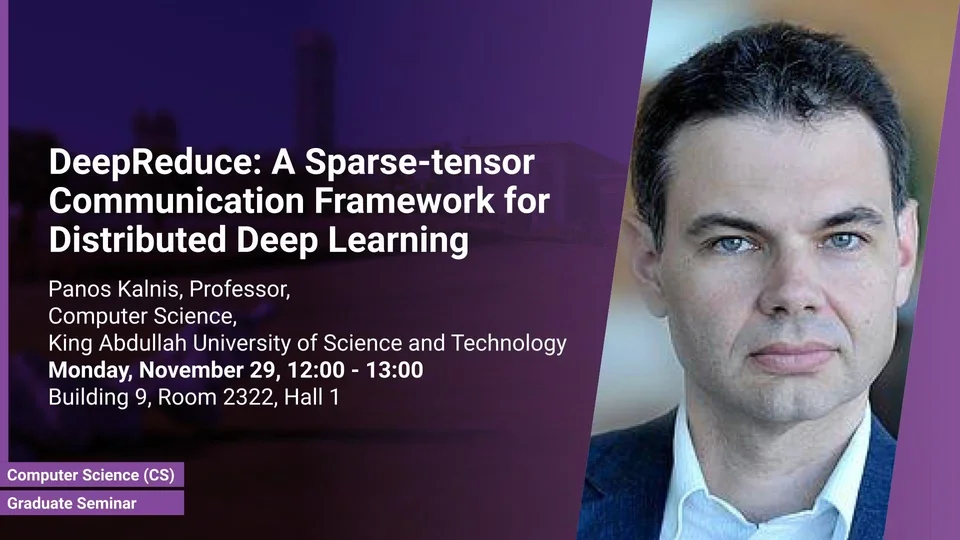
DeepReduce: A Sparse-tensor Communication Framework for Distributed Deep Learning Panagiotis Kalnis, Professor, Computer Science Nov 29, 12:00 - 13:00 B9 R2322 H1 Sparse tensors appear frequently in distributed deep learning, either as a direct artifact of the deep neural network's gradients, or as a result of an explicit sparsification process. Most communication primitives are agnostic to the peculiarities of deep learning; consequently, they impose unnecessary communication overhead.
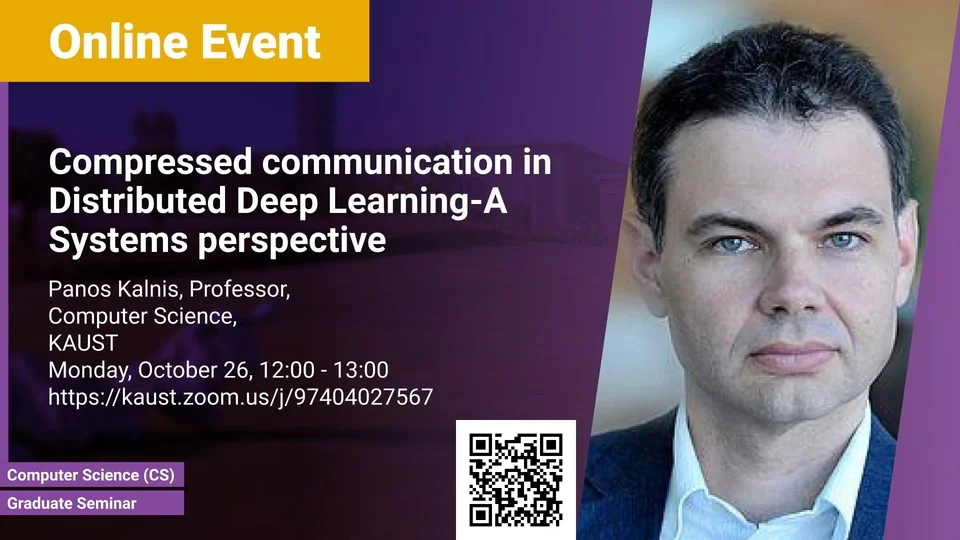
Compressed communication in Distributed Deep Learning - A Systems perspective Panagiotis Kalnis, Professor, Computer Science Oct 26, 12:00 - 13:00 KAUST Deep learning Network communication is a major bottleneck in large-scale distributed deep learning. To minimize the problem, many compressed communication schemes, in the form of quantization or sparsification, have been proposed. We investigate them from the Computer Systems perspective, under real-life deployments. We identify discrepancies between the theoretical proposals and the actual implementations, and analyze the impact on convergence.
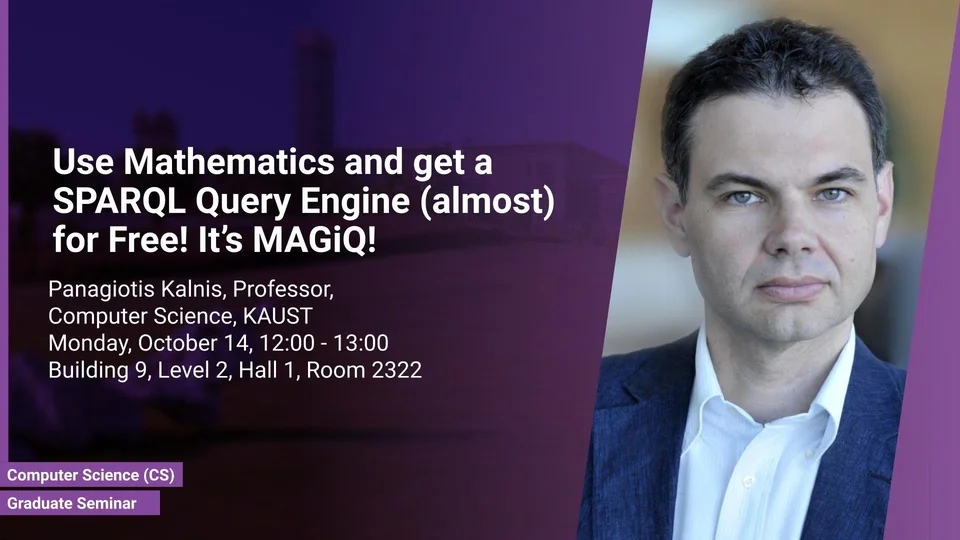
Use Mathematics and get a SPARQL Query Engine (almost) for Free! It’s MAGiQ! Panagiotis Kalnis, Professor, Computer Science Oct 14, 12:00 - 13:00 B9 L2 H1 R2322 sparse matrix algebra RDF engine MAGIQ SPARQL queries RDF graphs optimization CPU GPU Existing RDF engines are designed for specific hardware architectures; porting to a different architecture (e.g., GPUs) entails enormous implementation effort. We explore sparse matrix algebra as an alternative for designing a portable, scalable and efficient RDF engine.
Engage ORCID KAUST Repository KAUST Academic Portal Scopus ShareClipboard Related Sites Computer Science (CS) InfoCloud (CLOUD) Related Content Articles 24 Events 3