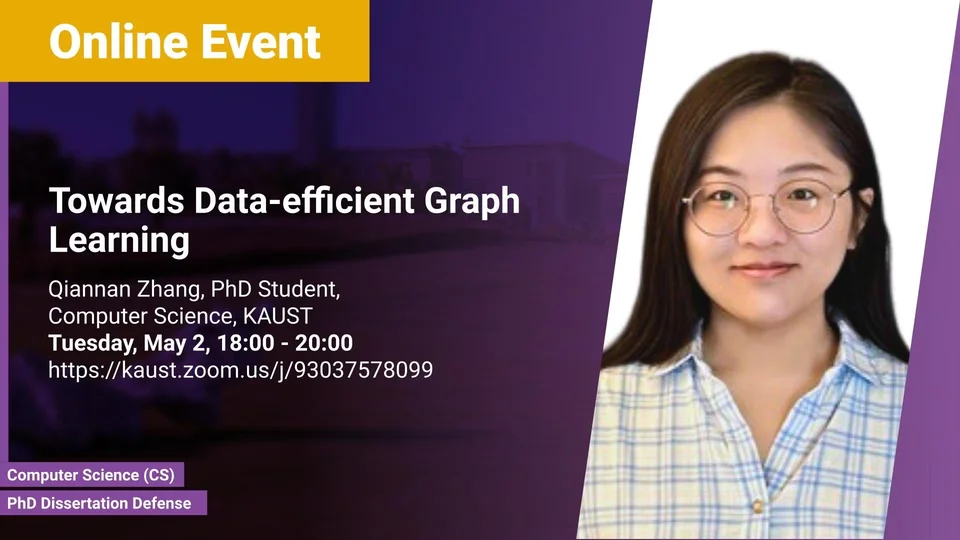
About Qiannan Zhang Qiannan Zhang Ph.D. Student, Computer Science machine learning data mining Qiannan Zhang is a Ph.D. student in Computer Science program at Machine Intelligence and Knowledge Engineering (MINE) Laboratory under the supervision of Professor Xiangliang Zhang at King Abdullah University of Science and Technology (KAUST). Research interests Qiannan's research interests include Machine learning and data mining. Education Profile B. E., Communication Engineering, Tianjin University, China, 2010-2014. M. E., Communication Engineering, Tianjin University, China, 2014-2017. Research Intern, KAUST, 2017. Events Presented Events Apr 30 - May 6, 2023 Towards Data-efficient Graph Learning Qiannan Zhang, Ph.D. Student, Computer Science May 2, 18:00 - 20:00 KAUST This dissertation focuses on the challenge of learning with small amounts of annotated data in graph machine learning. The scarcity of annotated data can severely degrade the performance of graph learning models, and the ability to learn with small amounts of data, known as data-efficient graph learning, is essential for achieving strong generalization in low-data regimes. The dissertation proposes three methods to address the challenges of graph learning in low-data scenarios, including a graph meta-learning framework, a solution for few-shot graph classification, and a cross-domain knowledge transfer model. Experimental results demonstrate the effectiveness of the proposed methods in improving model generalization for data-efficient graph learning.
Towards Data-efficient Graph Learning Qiannan Zhang, Ph.D. Student, Computer Science May 2, 18:00 - 20:00 KAUST This dissertation focuses on the challenge of learning with small amounts of annotated data in graph machine learning. The scarcity of annotated data can severely degrade the performance of graph learning models, and the ability to learn with small amounts of data, known as data-efficient graph learning, is essential for achieving strong generalization in low-data regimes. The dissertation proposes three methods to address the challenges of graph learning in low-data scenarios, including a graph meta-learning framework, a solution for few-shot graph classification, and a cross-domain knowledge transfer model. Experimental results demonstrate the effectiveness of the proposed methods in improving model generalization for data-efficient graph learning.
Related Sites Extensions of Dynamic Programming, Machine Learning, Discrete Optimization (TREES) Computer Science (CS) Related Content Events 1 Related Links Publications on ResearchGate Publications list on dblp