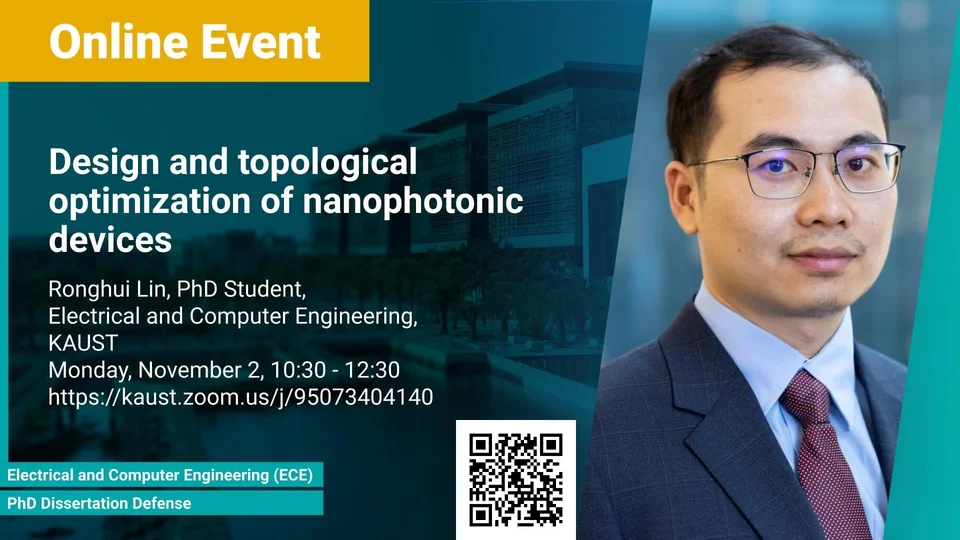
About Ronghui Lin Ronghui Lin Ph.D. Student, Electrical and Computer Engineering Ronghui Lin is a Ph.D. student at the Advanced Semiconductors Laboratory under the supervision of Prof. Xiaohang Li at King Abdullah University of Science and Technology (KAUST). He received his Master of Science in Mechanical Engineering from the University of Science and Technology of China (USTC), China, 2016. Research Interest Ronghui's research interests include Electromagnetics and optoelectronics, Fluid mechanics, Microfluidics, Solar Energy and Sensors. Education Profile Ph.D. in Electrical Engineering, King Abdullah University of Science and Technology (KAUST), Saudi Arabia, Summer Events Presented Events Nov 1 - Nov 7, 2020 Design and topological optimization of nanophotonic devices Ronghui Lin, Ph.D. Student, Electrical and Computer Engineering Nov 2, 10:30 - 12:30 KAUST Nanophotonic research has a huge influence on various aspects of modern society, such as communication, commercial products, biochemistry, and information processing. A central topic in the research of nanophotonics is the geometrical optimization of the nanostructures since the geometries are deeply related to the Mie resonances and the localized surface plasmon resonances in dielectric and metallic nanomaterials. When many nanostructures are assembled to form a metamaterial, the tuning of the geometrical parameters can bring even more profound effects, such as bound states in the continuum (BIC) with infinite quality factors (Q factors). Moreover, with the development of nanofabrication technologies, there is a trend of integrating nanostructures in the vertical direction, which provides more degrees of freedom for controlling the device performance and functionality. In this dissertation, we explore how the geometrical changes of the nanostructures influence the nanophotonic devices, furthermore, we utilize machine learning techniques to actively control the topologies of the devices to enhance their performances.
Design and topological optimization of nanophotonic devices Ronghui Lin, Ph.D. Student, Electrical and Computer Engineering Nov 2, 10:30 - 12:30 KAUST Nanophotonic research has a huge influence on various aspects of modern society, such as communication, commercial products, biochemistry, and information processing. A central topic in the research of nanophotonics is the geometrical optimization of the nanostructures since the geometries are deeply related to the Mie resonances and the localized surface plasmon resonances in dielectric and metallic nanomaterials. When many nanostructures are assembled to form a metamaterial, the tuning of the geometrical parameters can bring even more profound effects, such as bound states in the continuum (BIC) with infinite quality factors (Q factors). Moreover, with the development of nanofabrication technologies, there is a trend of integrating nanostructures in the vertical direction, which provides more degrees of freedom for controlling the device performance and functionality. In this dissertation, we explore how the geometrical changes of the nanostructures influence the nanophotonic devices, furthermore, we utilize machine learning techniques to actively control the topologies of the devices to enhance their performances.
Engage ORCID ShareClipboard Related Sites Electrical and Computer Engineering (ECE) Advanced Semiconductor Laboratory (ASL) Related Content Articles 8 Events 1 Related Links Publications on ResearchGate Publications on Semantic Scholar Publications on KAUST Repository Publications on OrciD