About Sahika Inal Sahika Inal Associate Professor, Bioengineering bioelectronics Biosensors biostimulation organic electronics conjugated polymers Professor Sahika Inal's research bridges the fields of organic electronics and biology, focusing on the development of bioelectronic materials for real-time health monitoring and intervention. Events Presented Events Oct 13 - Oct 19, 2019 Engineering Organic Electronics for Biology - 2019-10-13 Sahika Inal, Associate Professor, Bioengineering Oct 13, 12:00 - 13:00 B9 L2 H1 R2322 bioelectronics Implantable devices soft conducting polymers organic electrochemical transistors The field of bioelectronics combines the worlds of electronics and biology with the aim of developing new tools for biomedical research and healthcare. The majority of implantable devices are mechanically stiff and the mechanical properties mismatch with soft tissue causes an immune response which results in their rejection from the body. Another limitation is associated with the fact that most devices utilize metal electrodes to record from/stimulate tissue. These electrodes offer limited coupling with ion fluxes used by cells to communicate with each other, resulting in low efficiency. Such challenges can be overcome with the integration of soft, conducting polymers displaying mixed (ionic and electronic) conduction. In this talk, I will present approaches that leverage the properties of organic conducting materials in order to develop bioelectronic devices interfacing with the body. These devices include organic electrochemical transistors for measuring metabolites, neural activity and integrity of cellular layers.
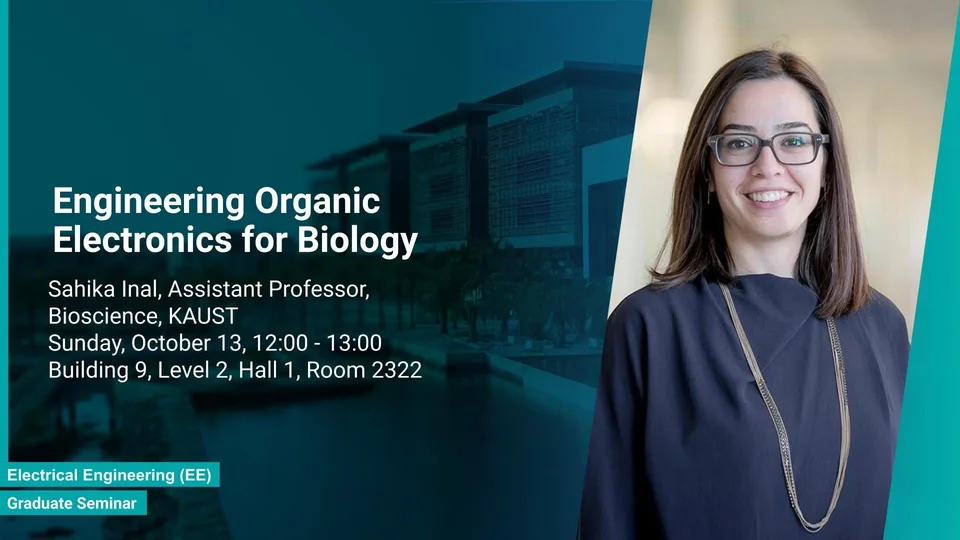
Engineering Organic Electronics for Biology - 2019-10-13 Sahika Inal, Associate Professor, Bioengineering Oct 13, 12:00 - 13:00 B9 L2 H1 R2322 bioelectronics Implantable devices soft conducting polymers organic electrochemical transistors The field of bioelectronics combines the worlds of electronics and biology with the aim of developing new tools for biomedical research and healthcare. The majority of implantable devices are mechanically stiff and the mechanical properties mismatch with soft tissue causes an immune response which results in their rejection from the body. Another limitation is associated with the fact that most devices utilize metal electrodes to record from/stimulate tissue. These electrodes offer limited coupling with ion fluxes used by cells to communicate with each other, resulting in low efficiency. Such challenges can be overcome with the integration of soft, conducting polymers displaying mixed (ionic and electronic) conduction. In this talk, I will present approaches that leverage the properties of organic conducting materials in order to develop bioelectronic devices interfacing with the body. These devices include organic electrochemical transistors for measuring metabolites, neural activity and integrity of cellular layers.
Engage ORCID KAUST Academic Portal Scopus ShareClipboard Related Sites Biological and Environmental Science and Engineering (BESE) Bioscience (B) Material Science and Engineering (MSE) Electrical and Computer Engineering (ECE) Organic Bioelectronics Laboratory (BIOEL) Related Content Articles 6 Events 1 Related Links List of Publications on Google Scholar Organic Bioelectronics Laboratory