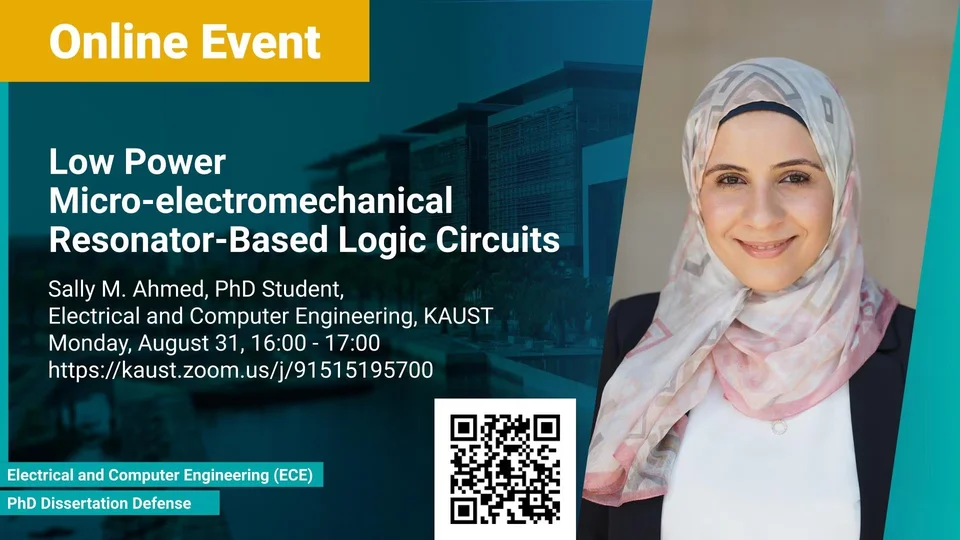
About Sally Ahmed Sally Ahmed Ph.D. Student, Electrical and Computer Engineering MEMS device fabrication digital logic design cadence Comsol Multiphysics Sally Ahmed was a Ph.D. student in Electrical Engineering in the Computer, Electrical and Mathematical Science & Engineering division of King Abdullah University of Science and Technology. She was a member of the Integrated Circuits and Systems research group (ICS) from May 2016 to December 2020 and her thesis was supervised by Prof. Hossein Fariborzi. Sally obtained her Master's degree in Electrical Engineering from KAUST in 2013 and has a Bachelor's degree in Electronics Engineering from American University in Cairo (AUC). Research Interests Sally's research interests include MEMS Devices Events Presented Events Aug 30 - Sep 5, 2020 Low Power Micro-electromechanical Resonator-Based Logic Circuits Sally Ahmed, Ph.D. Student, Electrical and Computer Engineering Aug 31, 16:00 - 17:00 KAUST Abstract The notion of mechanical computation has been revived in the past few years, with the advances of nanofabrication techniques. Although electromechanical devices are inherently slow, they offer zero or very low off-state current, which reduces the overall power consumption compared to the fast complementary-metal-oxide-semiconductor (CMOS) counterparts. This energy efficiency feature is the most crucial requirements for most of the stand-alone battery-operated gadgets, biomedical devices and the internet of things (IoT) applications, which do not require the fast processing speeds
Low Power Micro-electromechanical Resonator-Based Logic Circuits Sally Ahmed, Ph.D. Student, Electrical and Computer Engineering Aug 31, 16:00 - 17:00 KAUST Abstract The notion of mechanical computation has been revived in the past few years, with the advances of nanofabrication techniques. Although electromechanical devices are inherently slow, they offer zero or very low off-state current, which reduces the overall power consumption compared to the fast complementary-metal-oxide-semiconductor (CMOS) counterparts. This energy efficiency feature is the most crucial requirements for most of the stand-alone battery-operated gadgets, biomedical devices and the internet of things (IoT) applications, which do not require the fast processing speeds
Engage ORCID ShareClipboard Related Sites Electrical and Computer Engineering (ECE) Related Content Articles 1 Events 1 Related Links Google Scholar Citations Publications on ResearchGate Publications on IEEE Xplore Publications on Kaust Repository LinkedIn