About Shinkyu Park Shinkyu Park Assistant Professor, Electrical and Computer Engineering robotics intelligent systems Professor Park advances robotic science by building on individual robots’ core sensing, actuation and communication capabilities in distributed information processing, decision-making and manipulation. Events Presented Events Nov 20 - Nov 26, 2022 Principles and Algorithms for Multi-Agent Decision Making Shinkyu Park, Assistant Professor, Electrical and Computer Engineering Nov 20, 12:00 - 13:00 B9 L2 R2322 H1 Multi-Agent Decision Making A multi-agent system consists of individual agents sharing information and coordinating for collective decision making. The study of multi-agent decision making has important implications in conceiving networked engineering systems - a team of mobile robots or a fleet of drones - that can effectively coordinate to carry out assigned missions. Modeling such system as feedback interconnections of many smaller units allows us to examine its long-term behavior using analytical tools from feedback control theory, such as Lyapunov stability and bifurcation analysis. In this presentation, we discuss how such tools can be used to predict asymptotic behavior of the agents' decision making process and also to design computational models of the decision making process. Apr 24 - Apr 30, 2022 Feedback system design for tuning cooperative behavior in multi-agent games Shinkyu Park, Assistant Professor, Electrical and Computer Engineering Apr 24, 12:00 - 13:00 B9 L2 R2322 H1 Feedback system design In social dilemmas, a class of multi-agent games, agents' rationality-based strategic interactions to learn a payoff-maximizing strategy would result in diminishing returns. Such games include the prisoner's dilemma and public goods game where individually rational decision making reults in all decision-making agents receiving smallest rewards. In this presentation, I will explain a new decision-making model that elicits cooperative behavior in social dilemmas. The model enables the social interaction (reciprocity) between agents in their decision making, which allows cooperative behavior to emerge. We discuss how methods for feedback system design and analysis can be applied to explain the emergence of cooperative behavior and how we can tune such behavior. Oct 31 - Nov 6, 2021 Social Decision Making for Robot Navigation Shinkyu Park, Assistant Professor, Electrical and Computer Engineering Oct 31, 12:00 - 13:00 KAUST Social robot navigation Robot navigation typically comprises of decision making at two different levels - global planning to compute a viable trajectory to the robot's destination and strategic (local) interaction to elicit cooperation and resolve any conflicts with other robots/pedestrians that would arise while navigating along the trajectory. Robot navigation in crowded environments is particularly challenging as the robot needs to exhibit navigation behaviors that are conceived as socially compliant by human pedestrians or vehicles they maneuver at both of the levels. In this presentation, I will introduce some of relevant works from my research group. Apr 18 - Apr 24, 2021 KL Divergence Regularized Learning Model for Multi-Agent Decision Making Shinkyu Park, Assistant Professor, Electrical and Computer Engineering Apr 18, 12:00 - 13:00 KAUST The large population game framework has been widely adopted in biology, economics, and engineering fields to model and analyze strategic interactions among decision-making agents. In this framework, a population of agents select strategies of interaction with one another and repeatedly revise their strategy choices using revisions defined by a decision-making model. While many of existing works in the literature focus on designing decision-making models that ensure convergence of the agents’ strategy revision to Nash equilibrium, a still open challenge is to establish the convergence when the agents’ strategy revision is subject to time delay. Such scenarios include multi-agent decision problems in which there is delay in propagation of traffic congestion in congestion games, communication between the electric power utility and demand response agents in demand response games, and information transmission between agents in network games. In this seminar, I’ll introduce our recent work on designing a new decision-making model called the Kullback-Leibler (KL) divergence regularized learning. We will discuss how the new model enables a large population of agents to learn and self-organize to an effective strategy profile in population games subject to time delay and implication of the new model in engineering applications.
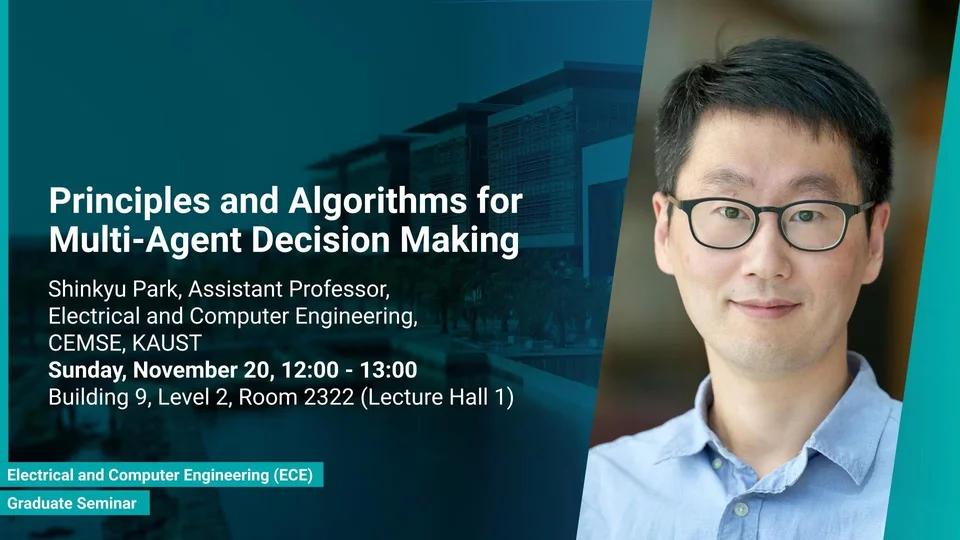
Principles and Algorithms for Multi-Agent Decision Making Shinkyu Park, Assistant Professor, Electrical and Computer Engineering Nov 20, 12:00 - 13:00 B9 L2 R2322 H1 Multi-Agent Decision Making A multi-agent system consists of individual agents sharing information and coordinating for collective decision making. The study of multi-agent decision making has important implications in conceiving networked engineering systems - a team of mobile robots or a fleet of drones - that can effectively coordinate to carry out assigned missions. Modeling such system as feedback interconnections of many smaller units allows us to examine its long-term behavior using analytical tools from feedback control theory, such as Lyapunov stability and bifurcation analysis. In this presentation, we discuss how such tools can be used to predict asymptotic behavior of the agents' decision making process and also to design computational models of the decision making process.
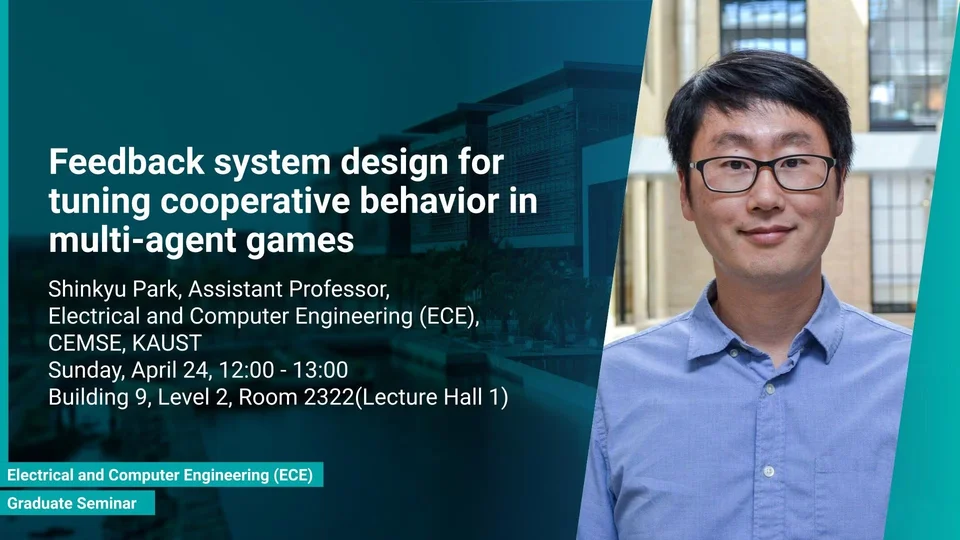
Feedback system design for tuning cooperative behavior in multi-agent games Shinkyu Park, Assistant Professor, Electrical and Computer Engineering Apr 24, 12:00 - 13:00 B9 L2 R2322 H1 Feedback system design In social dilemmas, a class of multi-agent games, agents' rationality-based strategic interactions to learn a payoff-maximizing strategy would result in diminishing returns. Such games include the prisoner's dilemma and public goods game where individually rational decision making reults in all decision-making agents receiving smallest rewards. In this presentation, I will explain a new decision-making model that elicits cooperative behavior in social dilemmas. The model enables the social interaction (reciprocity) between agents in their decision making, which allows cooperative behavior to emerge. We discuss how methods for feedback system design and analysis can be applied to explain the emergence of cooperative behavior and how we can tune such behavior.
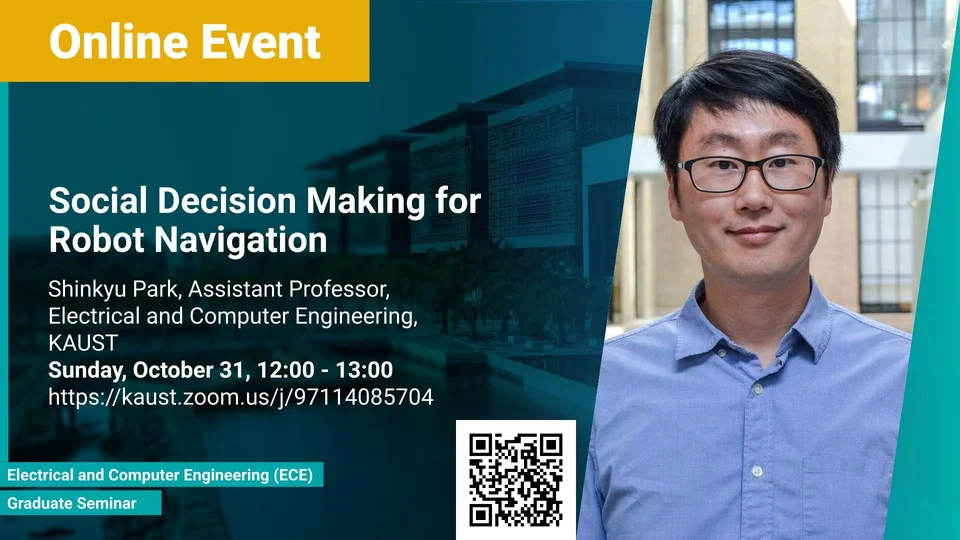
Social Decision Making for Robot Navigation Shinkyu Park, Assistant Professor, Electrical and Computer Engineering Oct 31, 12:00 - 13:00 KAUST Social robot navigation Robot navigation typically comprises of decision making at two different levels - global planning to compute a viable trajectory to the robot's destination and strategic (local) interaction to elicit cooperation and resolve any conflicts with other robots/pedestrians that would arise while navigating along the trajectory. Robot navigation in crowded environments is particularly challenging as the robot needs to exhibit navigation behaviors that are conceived as socially compliant by human pedestrians or vehicles they maneuver at both of the levels. In this presentation, I will introduce some of relevant works from my research group.
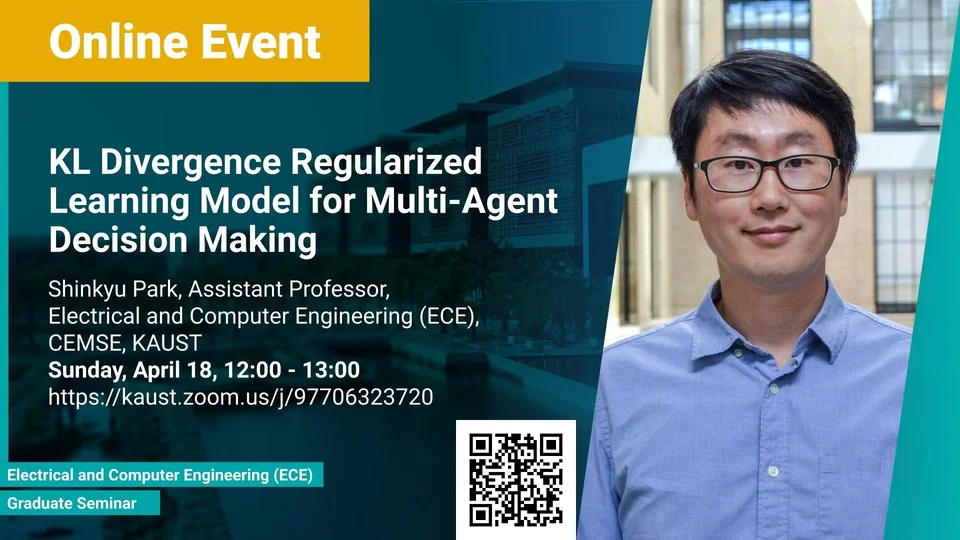
KL Divergence Regularized Learning Model for Multi-Agent Decision Making Shinkyu Park, Assistant Professor, Electrical and Computer Engineering Apr 18, 12:00 - 13:00 KAUST The large population game framework has been widely adopted in biology, economics, and engineering fields to model and analyze strategic interactions among decision-making agents. In this framework, a population of agents select strategies of interaction with one another and repeatedly revise their strategy choices using revisions defined by a decision-making model. While many of existing works in the literature focus on designing decision-making models that ensure convergence of the agents’ strategy revision to Nash equilibrium, a still open challenge is to establish the convergence when the agents’ strategy revision is subject to time delay. Such scenarios include multi-agent decision problems in which there is delay in propagation of traffic congestion in congestion games, communication between the electric power utility and demand response agents in demand response games, and information transmission between agents in network games. In this seminar, I’ll introduce our recent work on designing a new decision-making model called the Kullback-Leibler (KL) divergence regularized learning. We will discuss how the new model enables a large population of agents to learn and self-organize to an effective strategy profile in population games subject to time delay and implication of the new model in engineering applications.
Engage ORCID KAUST Academic Portal ShareClipboard Related Sites Electrical and Computer Engineering (ECE) Center of Excellence for Generative AI (GenAI) KAUST Research Conference on Robotics and Autonomy (RobotoKAUST) Distributed Systems and Autonomy (DSA) Related Content Articles 15 Events 4 Related Links Google Scholar Personal website