About Sidrah Javed Sidrah Javed Ph.D., Electrical and Computer Engineering Hardware constrained communications interference management Cooperative communications vehicular tracking vehicular monitoring solar energy Sidrah Javed is a Ph.D. candidate in Communication Theory Lab (CTL), Computer, Electrical and Mathematical Sciences and Engineering (CEMSE) Division, King Abdullah University of Science and Technology (KAUST). She is supervised by Professor Mohamed-Slim Alouini and co-supervised by Professor Basem Shihada. Education and Early Career Sidrah completed her M.S. in Electrical Engineering under the supervision of Professor Mohamed-Slim Alouini from KAUST in 2016. During her M.S. studies, she has actively participated in setting up the ProtoLab in KAUST Innovation Cluster as a Lab Intern. Sidrah has Events Presented Events Oct 10 - Oct 16, 2021 Asymmetric Signaling: A New Dimension of Interference Management in Hardware Impaired Communication Systems Sidrah Javed, Ph.D., Electrical and Computer Engineering Oct 11, 17:00 - 18:00 KAUST Hardware impairments (HWIs) impose a huge challenge on modern wireless communication systems owing to the characteristics like compactness, least complexity, cost effectiveness and high energy efficiency. Numerous techniques are implemented to minimize the detrimental effects of these HWIs ,however, the residual HWIs may still appear as an additive distortion, multiplicative interference, or an aggregate of both. Numerous studies have commenced efforts to model one or the other forms of hardware impairments in the radio frequency (RF) transceivers. Many presented the widely linear model for in-phase and quadrature imbalance (IQI) but failed to recognize the impropriety induced in the system because of the self-interfering signals. Therefore, we have presented not only a rigorous aggregate impairment model along with its complete impropriety statistical characterization but also the appropriate performance analysis to quantify their degradation effects. Latest advances have endorsed the superiority of incorporating more generalized impropriety phenomenon as opposed to conventional propriety.
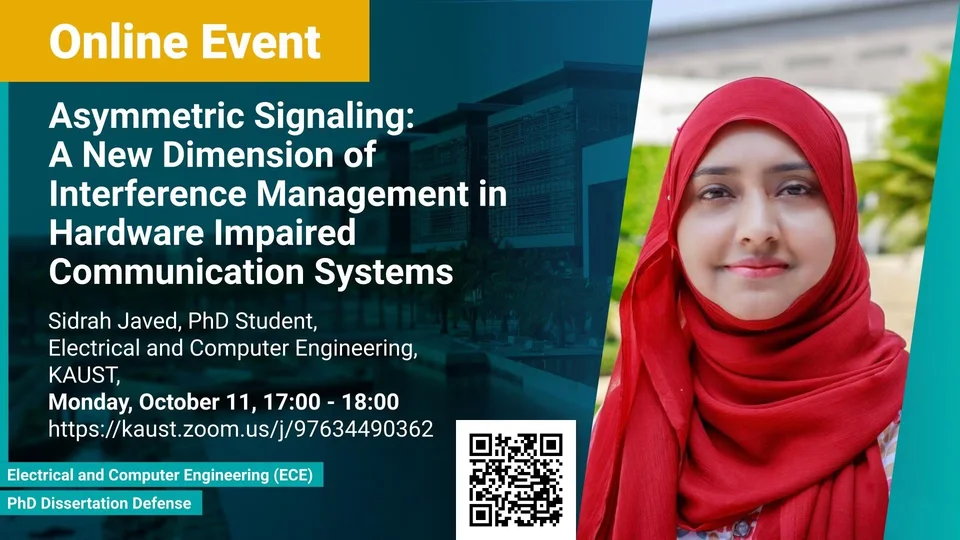
Asymmetric Signaling: A New Dimension of Interference Management in Hardware Impaired Communication Systems Sidrah Javed, Ph.D., Electrical and Computer Engineering Oct 11, 17:00 - 18:00 KAUST Hardware impairments (HWIs) impose a huge challenge on modern wireless communication systems owing to the characteristics like compactness, least complexity, cost effectiveness and high energy efficiency. Numerous techniques are implemented to minimize the detrimental effects of these HWIs ,however, the residual HWIs may still appear as an additive distortion, multiplicative interference, or an aggregate of both. Numerous studies have commenced efforts to model one or the other forms of hardware impairments in the radio frequency (RF) transceivers. Many presented the widely linear model for in-phase and quadrature imbalance (IQI) but failed to recognize the impropriety induced in the system because of the self-interfering signals. Therefore, we have presented not only a rigorous aggregate impairment model along with its complete impropriety statistical characterization but also the appropriate performance analysis to quantify their degradation effects. Latest advances have endorsed the superiority of incorporating more generalized impropriety phenomenon as opposed to conventional propriety.
Related Sites Electrical and Computer Engineering (ECE) Communication Theory Lab (CTL) Networking Research Lab (NETLAB) Related Content Articles 1 Projects 1 Events 1 Related Links LinkedIn Google Scholar dblp Scopus ResearchGate ORCID