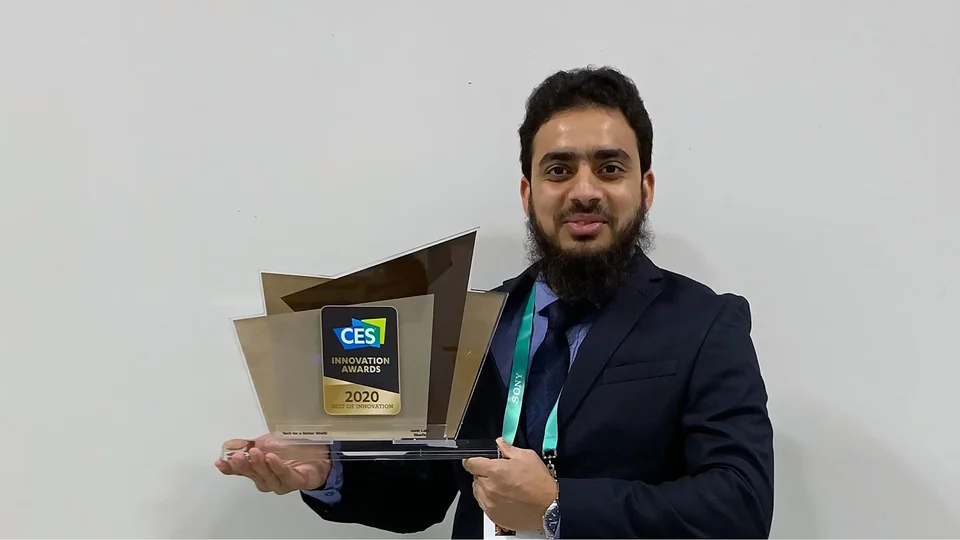
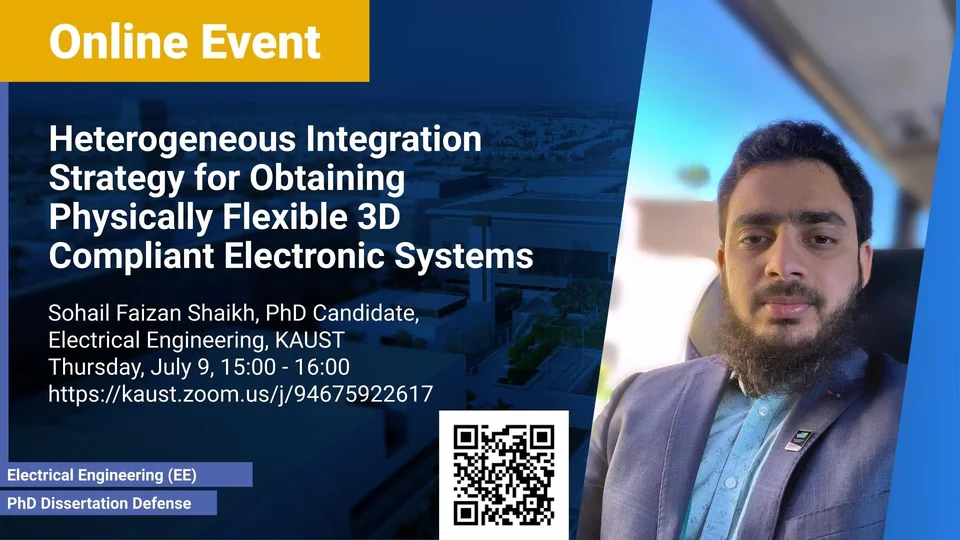
About Sohail Faizan Shaikh Sohail Faizan Shaikh Ph.D. Student, Electrical and Computer Engineering Sohail Faizan Shaikh is a doctoral candidate of MMH Labs in Electrical Engineering at KAUST. He graduated with a master’s degree in Biomedical Engineering from the Indian Institute of Technology (IIT) Hyderabad, India, in 2015, after securing his Bachelor of Technology in Electronics and Telecommunication. His research is focused on Heterogeneous integration strategies for compliant stand-alone 3D electronic systems for IoT and IoE applications specially focused on bio-interface, healthcare, and harsh-environment applications. He will join the world’s largest semiconductor research consortium Events Presented Events Jul 5 - Jul 11, 2020 Heterogeneous Integration Strategy for Obtaining Physically Flexible 3D Compliant Electronic Systems Sohail Faizan Shaikh, Ph.D. Student, Electrical and Computer Engineering Jul 9, 15:00 - 16:00 KAUST In this thesis, we present a pragmatic heterogeneous integration strategy to obtain high-performance 3D electronic systems using existing CMOS technology. Critical challenges addressed during the process are; reliable flexible interconnects, maximum area efficiency, soft-polymeric packaging, and heterogeneous integration compatible with current CMOS technology. First, a modular LEGO approach presents a novel method to obtain flexible electronics in a lock-and-key (plug and play) manner with reliable interconnects. It includes a process to convert standard rigid IC into flexible LEGO without any performance degradation with a high-yield. For the majority of healthcare and environmental monitoring applications, a sensory array is essential for continuous spatiotemporal activity recording. Here we present an ultra- high-density sensory solution (1 million sensors) as an epitome of density and address each of the associated challenges. A generic heterogeneous integration scheme is devised to obtain a physically flexible standalone electronic system using 3D-coin architecture. Lastly, a feather-light non-invasive ‘Marine-Skin’ platform to monitor deep-ocean monitoring is presented using the heterogeneous integration scheme. Electrical and mechanical characterization establish the reliability, integrity, robustness, and ruggedness of the processes, sensors, and multisensory flexible system.
Heterogeneous Integration Strategy for Obtaining Physically Flexible 3D Compliant Electronic Systems Sohail Faizan Shaikh, Ph.D. Student, Electrical and Computer Engineering Jul 9, 15:00 - 16:00 KAUST In this thesis, we present a pragmatic heterogeneous integration strategy to obtain high-performance 3D electronic systems using existing CMOS technology. Critical challenges addressed during the process are; reliable flexible interconnects, maximum area efficiency, soft-polymeric packaging, and heterogeneous integration compatible with current CMOS technology. First, a modular LEGO approach presents a novel method to obtain flexible electronics in a lock-and-key (plug and play) manner with reliable interconnects. It includes a process to convert standard rigid IC into flexible LEGO without any performance degradation with a high-yield. For the majority of healthcare and environmental monitoring applications, a sensory array is essential for continuous spatiotemporal activity recording. Here we present an ultra- high-density sensory solution (1 million sensors) as an epitome of density and address each of the associated challenges. A generic heterogeneous integration scheme is devised to obtain a physically flexible standalone electronic system using 3D-coin architecture. Lastly, a feather-light non-invasive ‘Marine-Skin’ platform to monitor deep-ocean monitoring is presented using the heterogeneous integration scheme. Electrical and mechanical characterization establish the reliability, integrity, robustness, and ruggedness of the processes, sensors, and multisensory flexible system.