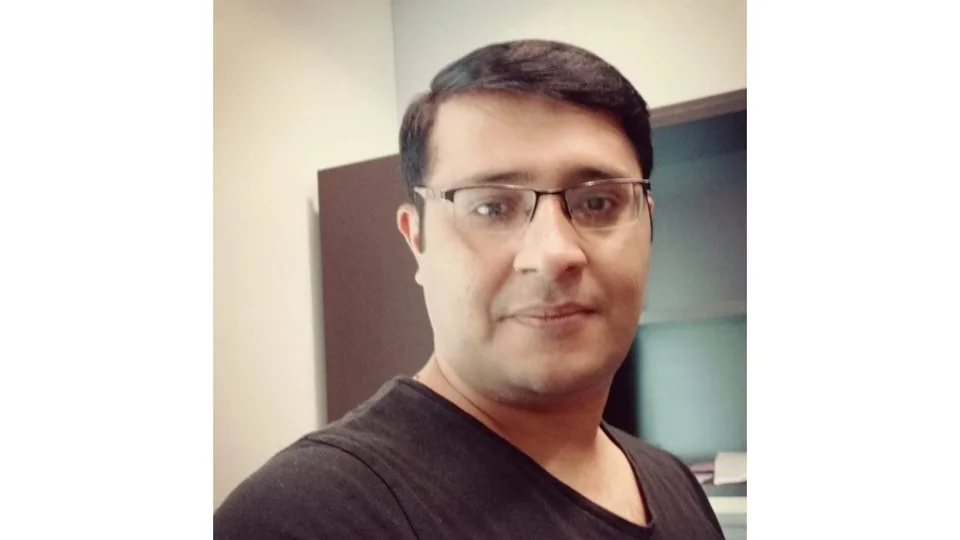
About Waqas Waseem Ahmed Waqas Waseem Ahmed Postdoctoral Research Fellow, Applied Mathematics and Computational Science Non-Hermitian Photonics Nonlinear Optics machine learning laser physics Erasmus Mundus Joint Doctorate in Photonics Engineering, Universitat Politècnica de Catalunya (Spain), Universita degli Studi di Firenze (Italy), Karlsruhe Institute of Technology (Germany), Université Paul Cèzanne Aix Marseille III (France).(2018) MS in Electrical Engineering, King Fahd University of Petroleum and Minerals (KFUPM), Saudi Arabia. (2014) BS in Electronic Engineering, Ghulam Ishaq Khan Institute of Engineering Sciences and Technology (GIKI), Pakistan. (2009) Research Interests Non-Hermitian Photonics, Nonlinear Optics, Machine Learning, Laser Physics. Events Presented Events Mar 6 - Mar 12, 2022 Machine learning assisted forward and inverse design modeling Waqas Waseem Ahmed, Postdoctoral Research Fellow, Applied Mathematics and Computational Science Mar 10, 12:00 - 13:00 KAUST In recent years, machine learning has proven to be efficient in solving various physical problems through data-driven approaches. For example, in wave physics, models based on analytical and numerical schemes employ intensive trial-and-error tuning of material (and geometrical) parameters for 'on demand' wave properties, which require deep understanding of the physics and are computationally expensive. As a result, it is desired to develop intelligent models that learn the bidirectional mapping between different physical quantities and automate technological device design. In this presentation, I will discuss novel generative models for forward and inverse predictions that outperform human performance. In particular, I will show how machine learning can be used to design broadband acoustic cloaks, unidirectional non-Hermitian structures, and for solving the inverse scattering problem of shape recognition.
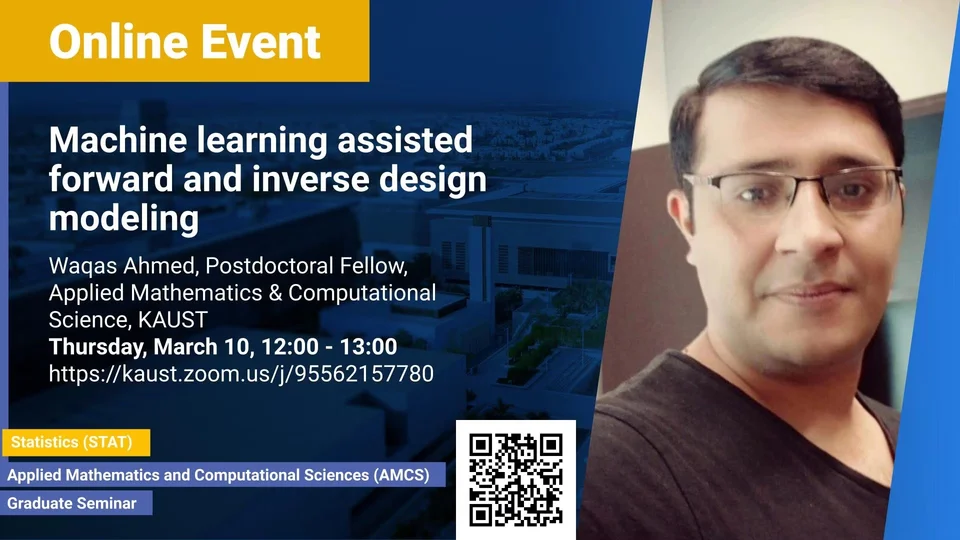
Machine learning assisted forward and inverse design modeling Waqas Waseem Ahmed, Postdoctoral Research Fellow, Applied Mathematics and Computational Science Mar 10, 12:00 - 13:00 KAUST In recent years, machine learning has proven to be efficient in solving various physical problems through data-driven approaches. For example, in wave physics, models based on analytical and numerical schemes employ intensive trial-and-error tuning of material (and geometrical) parameters for 'on demand' wave properties, which require deep understanding of the physics and are computationally expensive. As a result, it is desired to develop intelligent models that learn the bidirectional mapping between different physical quantities and automate technological device design. In this presentation, I will discuss novel generative models for forward and inverse predictions that outperform human performance. In particular, I will show how machine learning can be used to design broadband acoustic cloaks, unidirectional non-Hermitian structures, and for solving the inverse scattering problem of shape recognition.
Related Sites Waves in Complex Media (WCM) Applied Mathematics and Computational Science (AMCS) Related Content Events 1