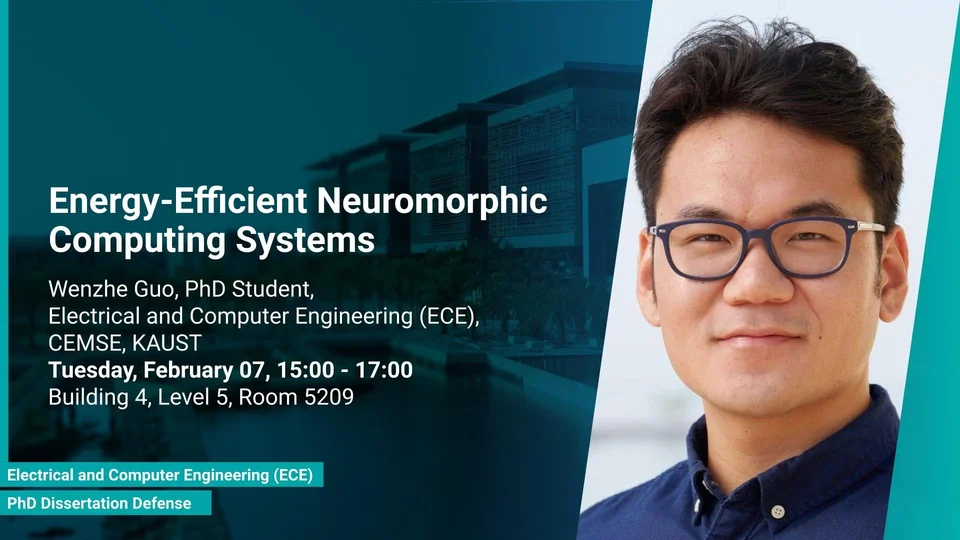
About Wenzhe Guo Wenzhe Guo Ph.D. Student, Electrical and Computer Engineering material based gas sensing brain-inspired computation spiking neural networks Wenzhe Guo is currently a PhD student at the Sensors Lab, in the Electrical Engineering Department, CEMSE, King Abdullah University of Science and Technology (KAUST). Education and Early Career Wenzhe Guo received his B.S. majored in integrated circuits design from University of Electronic Science and Technology of China (UESTC) in 2017. He got admitted to KAUST and obtained MS degree at Electrical Engineering department in KAUST in 2018. Research Interests My research interests lie in design and implementation of brain-inspired computational algorithm, exploration of neuromorphic computing Events Presented Events Feb 5 - Feb 11, 2023 Energy-Efficient Neuromorphic Computing Systems Wenzhe Guo, Ph.D. Student, Electrical and Computer Engineering Feb 7, 15:00 - 17:00 B4 L5 R5209 neuromorphic computing Neuromorphic computing has emerged as a new and promising computing principle that emulates how human brains process information. The underlying spiking neural networks (SNNs) are well-known for having higher energy efficiency than artificial neural networks (ANNs). Neuromorphic systems enable highly parallel computation and reduce memory bandwidth limitations, making hardware performance scalable and sustainable given the ever-increasing complexities of artificial intelligence (AI). Inefficiency in the design of a neuromorphic system generally originates from redundant parameters, nonoptimized models, a lack of computing parallelism, and inefficient training algorithms. This dissertation aims to address these problems and propose effective solutions.
Energy-Efficient Neuromorphic Computing Systems Wenzhe Guo, Ph.D. Student, Electrical and Computer Engineering Feb 7, 15:00 - 17:00 B4 L5 R5209 neuromorphic computing Neuromorphic computing has emerged as a new and promising computing principle that emulates how human brains process information. The underlying spiking neural networks (SNNs) are well-known for having higher energy efficiency than artificial neural networks (ANNs). Neuromorphic systems enable highly parallel computation and reduce memory bandwidth limitations, making hardware performance scalable and sustainable given the ever-increasing complexities of artificial intelligence (AI). Inefficiency in the design of a neuromorphic system generally originates from redundant parameters, nonoptimized models, a lack of computing parallelism, and inefficient training algorithms. This dissertation aims to address these problems and propose effective solutions.
Engage ORCID ShareClipboard Related Sites Communication and Computing Systems Lab (CCSL) Electrical and Computer Engineering (ECE) Sensors (Sensors) Related Content Events 1 Related Links Google Scholar Gethub https://scholar.google.com/citations?user=_zfKZ6QAAAAJ&hl=en