About Yiping Hong Yiping Hong Postdoctoral Research Fellow, Statistics Events Presented Events Jan 30 - Feb 5, 2022 A Non-stationary Autologistic Model for Space-time Data Yiping Hong, Postdoctoral Research Fellow, Statistics Feb 3, 12:00 - 13:00 KAUST Abstract In many research fields such as meteorology, ecology, and epidemiology, the spatio-temporal datasets are binary, describing the existence of particular species or events. The spatial dependence of the binary observations often exhibits nonstationarity. However, most nonstationary models in the literature are based on Gaussian random fields, which may be computational demanding. We propose a nonstationary spatio-temporal autologistic regression model, which allows the spatial covariances to vary in space. We investigate the spatial and temporal correlation of autologistic models with Oct 18 - Oct 24, 2020 Efficiency Assessment of Approximated Spatial Predictions for Large Datasets Yiping Hong, Postdoctoral Research Fellow, Statistics Oct 22, 12:00 - 13:00 KAUST mathematics applied statistics Social Network Analysis Our suggested criteria are more useful for the determination of tuning parameters for sophisticated approximation methods of spatial model fitting. To illustrate this, we investigate the trade-off between the execution time, estimation accuracy, and prediction efficiency for the TLR method with intensive simulation studies and suggest proper settings of the TLR tuning parameters.
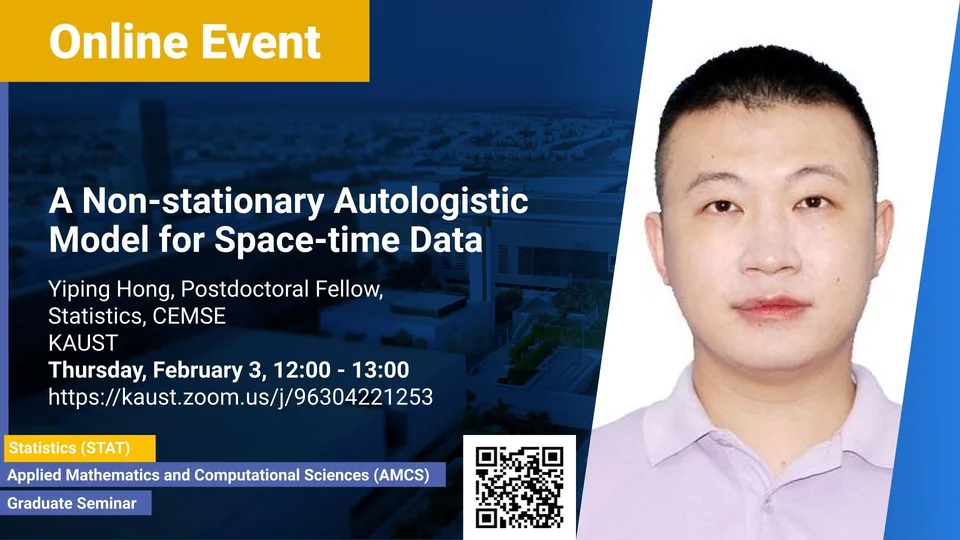
A Non-stationary Autologistic Model for Space-time Data Yiping Hong, Postdoctoral Research Fellow, Statistics Feb 3, 12:00 - 13:00 KAUST Abstract In many research fields such as meteorology, ecology, and epidemiology, the spatio-temporal datasets are binary, describing the existence of particular species or events. The spatial dependence of the binary observations often exhibits nonstationarity. However, most nonstationary models in the literature are based on Gaussian random fields, which may be computational demanding. We propose a nonstationary spatio-temporal autologistic regression model, which allows the spatial covariances to vary in space. We investigate the spatial and temporal correlation of autologistic models with
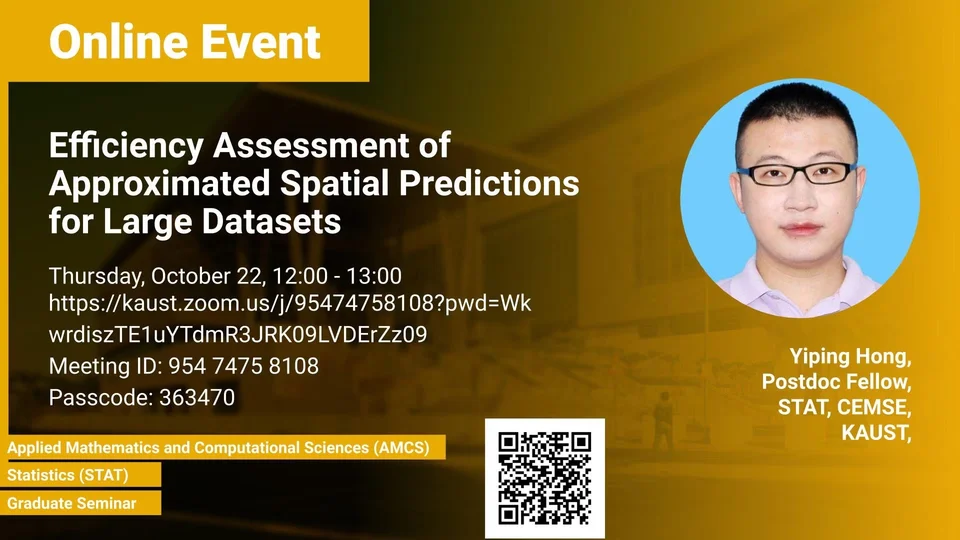
Efficiency Assessment of Approximated Spatial Predictions for Large Datasets Yiping Hong, Postdoctoral Research Fellow, Statistics Oct 22, 12:00 - 13:00 KAUST mathematics applied statistics Social Network Analysis Our suggested criteria are more useful for the determination of tuning parameters for sophisticated approximation methods of spatial model fitting. To illustrate this, we investigate the trade-off between the execution time, estimation accuracy, and prediction efficiency for the TLR method with intensive simulation studies and suggest proper settings of the TLR tuning parameters.