About Zhenwei Tang Zhenwei Tang M.S. Student (former), Computer Science Zhenwei Tang is a M.S./Ph.D. candidate and member of the Machine Intelligence & Knowledge Engineering (MINE) Lab under the supervision of Professor Xianglinag Zhang at King Abdullah University of Science and Technology (KAUST). Prior to joining KAUST, Zhenwei obtained a bachelor's degree in telecommunications from Beijing University of Posts and Telecommunications, China. Research Interests Zhenwei's research interests include computationally exploring information around us and alleviating information overload. Projects Related Projects 2021 IBNSINA-QI: Integrating Biomedical Networks and Semantic Information for Neural network Analysis of Quantitative Information Fri, Jan 1 2021 - Sun, Dec 31 2023 Applied Ontology Neuro-Symbolic AI Rare disease Biological measurements are inherently high-dimensional and heterogeneous: omics platforms produce thousands to millions of features per individual, and they coexist with qualitative information such as diagnoses, phenotype calls, and prescriptions. Biomedical ontologies and knowledge graphs encode rich qualitative background knowledge, but they are largely disconnected from the quantitative measurements that gave rise to the categorical phenotypes in the first place. Conversely, graph neural networks and other methods that handle quantitative data on graphs do not yet exploit the formal
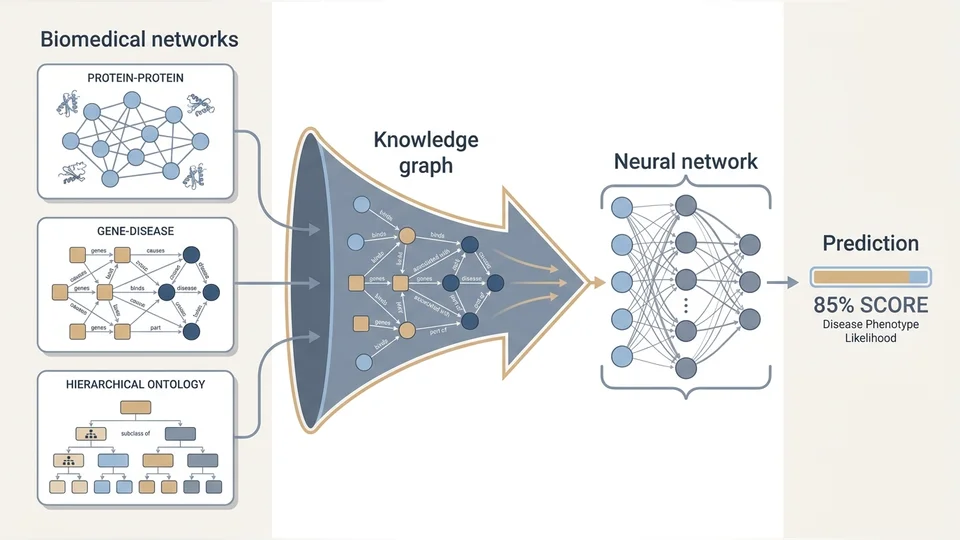
IBNSINA-QI: Integrating Biomedical Networks and Semantic Information for Neural network Analysis of Quantitative Information Fri, Jan 1 2021 - Sun, Dec 31 2023 Applied Ontology Neuro-Symbolic AI Rare disease Biological measurements are inherently high-dimensional and heterogeneous: omics platforms produce thousands to millions of features per individual, and they coexist with qualitative information such as diagnoses, phenotype calls, and prescriptions. Biomedical ontologies and knowledge graphs encode rich qualitative background knowledge, but they are largely disconnected from the quantitative measurements that gave rise to the categorical phenotypes in the first place. Conversely, graph neural networks and other methods that handle quantitative data on graphs do not yet exploit the formal
Related Sites Bio-Ontology Research Group (BORG) Computer Science (CS) Related Content Articles 1 Projects 1