Skip to main content
Computer, Electrical and Mathematical Sciences and Engineering
Computer, Electrical and Mathematical Sciences and Engineering
Home
Study
Prospective Students
Current Students
Internship Opportunities
Research
Research Overview
Research Areas
Research Groups
Programs
Applied Mathematics and Computational Science
Computer Science
Electrical and Computer Engineering
Statistics
People
All People
Faculty
Affiliate Faculty
Research Faculty
Instructional Faculty
Research Scientists
Research Staff
Postdoctoral Fellows
Students
Alumni
Administrative Staff
News
Events
About
Who We Are
Leadership Team
Apply
SAGSIN
KAUST researchers model space–air–ground–sea networks to bring reliable connectivity from the coast to the deep ocean
3 min read ·
Fri, Oct 23 2026
News
SAGSIN
High-Altitude Platform Stations
haps
LEO Satellites
UAVs
Stochastic Geometry
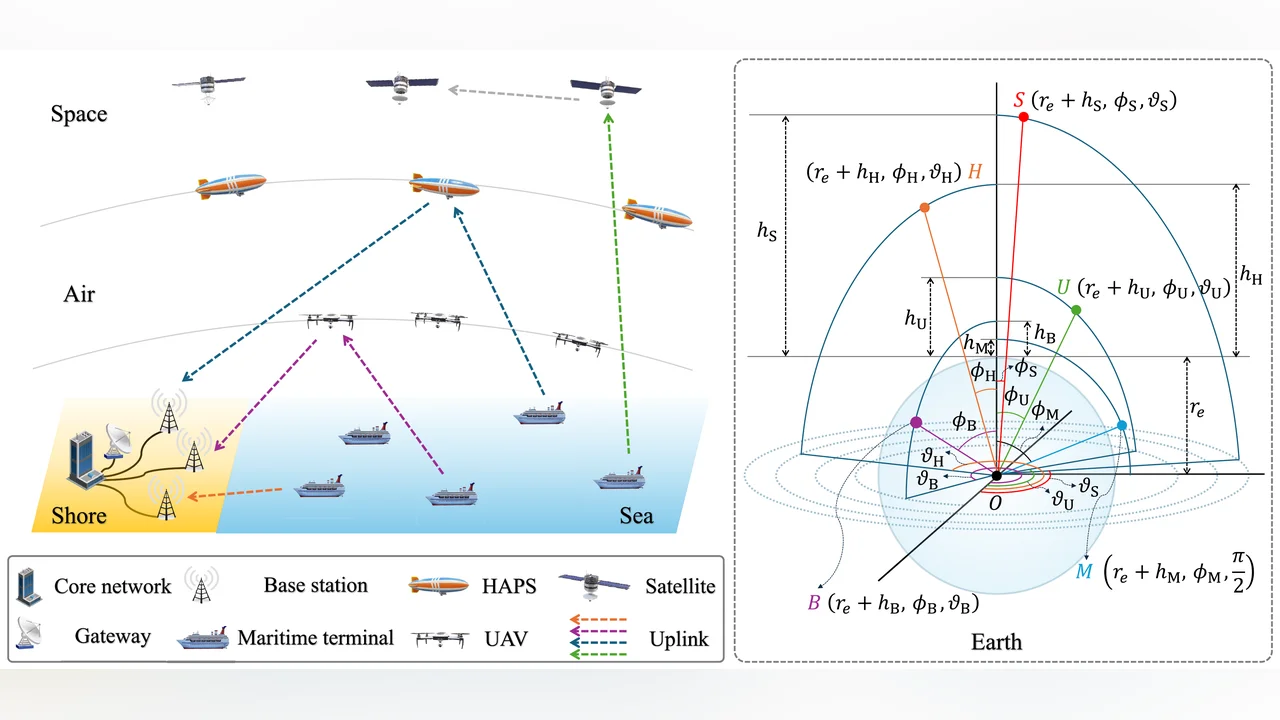
Ships, offshore platforms, and rescue teams need more than a voice channel. Transoceanic freighters rely on data links for navigation, fleet management, and cargo monitoring. Offshore oil and gas platforms send sensor telemetry, video surveillance, and emergency alerts. Yet most of today’s maritime systems, such as GMDSS, NAVTEX, AIS, and VDES, support only text or voice. Shore-based coverage ends about 100 km from the coast, and satellite services bring high latency and limited spectrum. Researchers from the KAUST Communication Theory Lab (CTL) and Heriot-Watt University present an analytical