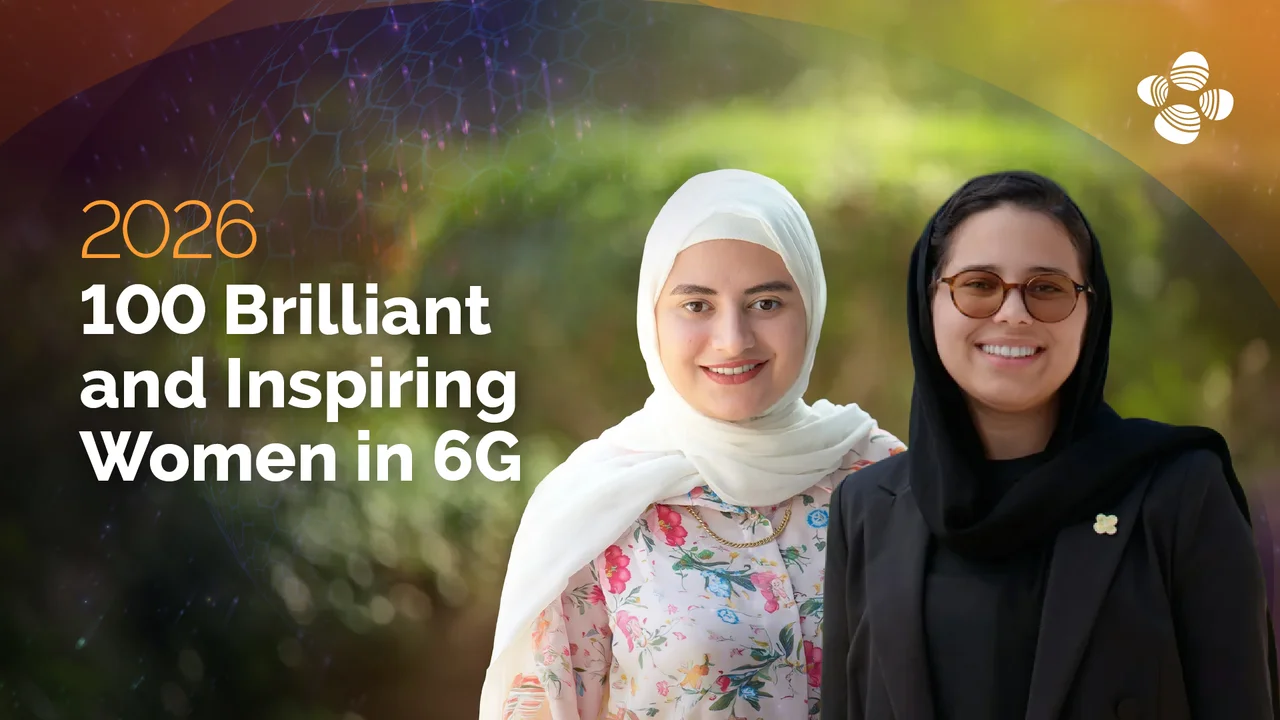
KAUST's Asmaa Abdallah and Rawan Alghamdi included in the “100 Brilliant and Inspiring Women in 6G” List for 2026
CEMSE researchers Dr. Asmaa Abdallah and Rawan Alghamdi recognized among exceptional women shaping the future of 6G communications.
About
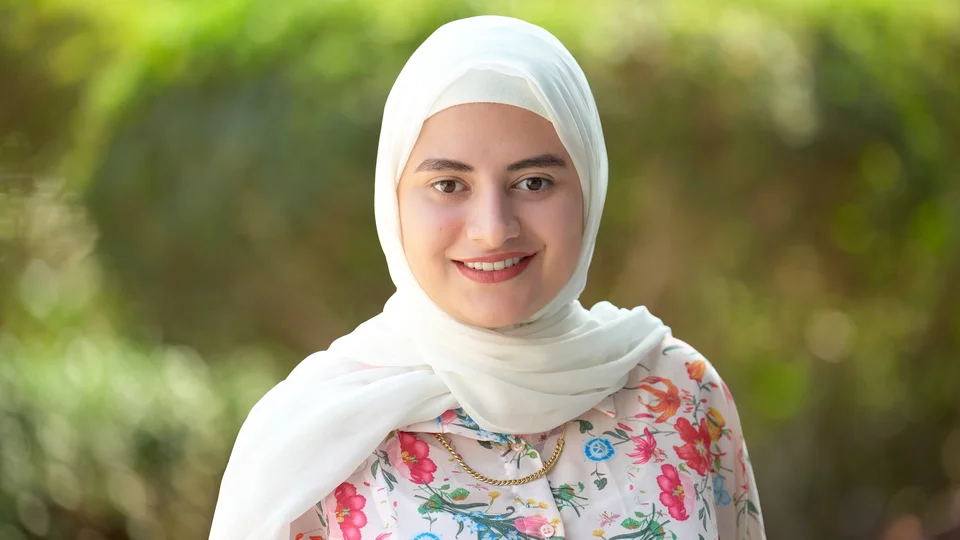
Dr. Asmaa Abdallah, a research scientist in the Communications and Computing Systems Laboratory under Professor Ahmed Eltawil, was named one of the honorees on the Women in 6G “100 Brilliant and Inspiring Women in 6G” list for 2026.
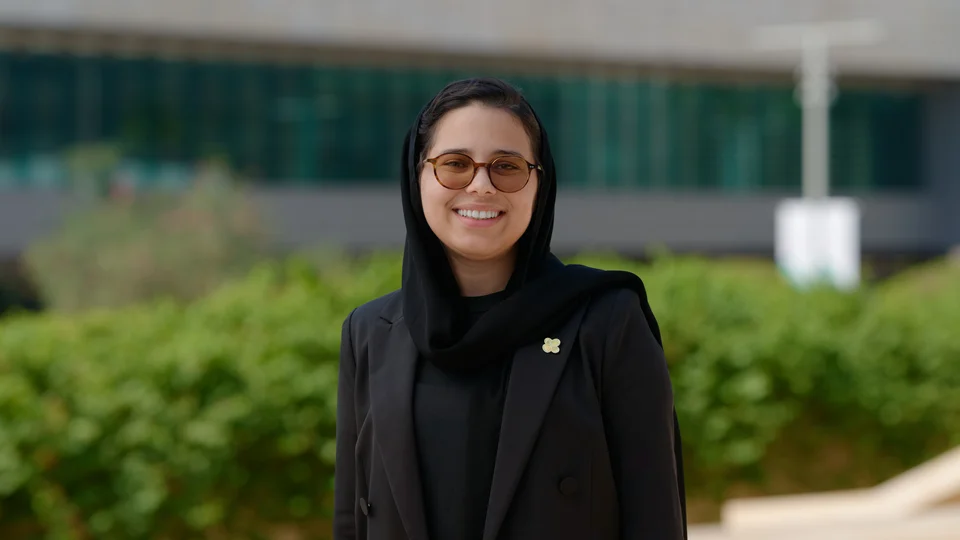
Ph.D. student Rawan Alghamdi was also recognized as a “Rising Star” in the global 6G community. She is jointly affiliated with the KAUST Communication Theory Lab under Professor Mohamed-Slim Alouini and the KAUST Information Science Lab under Professor Tareq Al-Naffouri.
The Women in 6G list, founded in 2024, highlights women making notable contributions to wireless technology and the development of 6G. According to Women in 6G™, this year’s list honors “100 exceptional women making a remarkable impact in the field, pushing the frontiers of wireless communication, and paving the way for a more connected, intelligent and sustainable world.”
“Being included in the Women in 6G™list is deeply humbling and motivating,” Abdallah said. “It is a privilege to be recognized as a contributor to the global community defining 6G’s foundations. It is also especially meaningful to be recognized in a field where female representation remains limited.”
“This recognition by Women in 6G is encouraging and made me feel very rewarded and seen for the work that I have been doing,” Alghamdi said. “I feel particularly honored as my name appears alongside many researchers whom I have looked up to since the early days of my graduate studies. Appearing on [the list] as a rising star gives me the confidence that I am on the path to follow their lead.”
Advancing wireless communications
Abdallah’s research spans artificial intelligence, machine learning, communication theory and array signal processing, with an emphasis on energy- and spectrally-efficient algorithms for advanced wireless networks.
In 2023, she was named one of the “15 Leading Innovators Under 35” in the MENA region by MIT Technology Review Arabia.
“My research advances intelligent, adaptive wireless communication systems,” Abdallah said. “I focus on embedding artificial intelligence directly into communication architectures, moving toward AI-native networks that optimize resource allocation, improve spectrum efficiency and enhance reliability.
“Ultimately, I seek to contribute to the foundational technologies of 6G: intelligent, scalable networks capable of supporting emerging applications not yet fully imagined,” she added.
Alghamdi’s research focuses on signal processing and wireless communications to expand reliable, cost-effective connectivity for remote, underserved, and disadvantaged communities worldwide. Using tools from communication theory and optimization, she designs next-generation non-terrestrial networks (NTNs) that leverage airborne and space-based platforms to overcome the physical and economic limits of terrestrial infrastructure. She also specializes in developing robust waveform designs that maintain communication reliability under high mobility, without requiring high computational complexity.
“The impact of connectivity on the development and growth of our societies drives my research,” Alghamdi said. “It aims to democratize connectivity as a universal public utility and ensure equitable global access to digital resources in the digital age.”
KAUST’s growing 6G presence
As the next stage of wireless communication, 6G is expected to transform industries, societies and global connectivity. KAUST is working to meet growing information and communication technology (ICT) needs anticipated in the 2030s while expanding reliable access to remote and underserved communities.
The University is also building leadership in 6G research and advancing candidate technologies such as sustainable AI-driven networks, terahertz communications, reconfigurable intelligent surfaces, non-terrestrial networks and free-space optical communications.
“In terms of impact, the research emerging from KAUST has strong potential to influence Saudi Arabia’s digital transformation and Vision 2030 objectives,” Abdallah said. “Advanced wireless systems are foundational to smart cities, autonomous mobility, industrial automation, energy optimization and remote health care.
“A key strength is the University’s ability to translate research from algorithm development to hardware validation and system-level experimentation. The long-term effect extends beyond academia; it shapes industry capabilities, startup ecosystems and policy directions across the region,” she added.
The female-inclusive future of 6G
Abdallah sees women’s role in 6G research shifting from participation to leadership, with programs like Women in 6G serving not just as celebrations, but as structural interventions in how female excellence is recognized and amplified.
“Female talent has always existed; visibility has not. Greater representation broadens how problems are defined and solved. At this critical moment, the future of wireless networks should reflect the diversity of the societies they serve,” Abdallah said.
Alghamdi echoed the importance of visibility in science. “I did not initially realize how important visibility was,” she said. “As a senior Ph.D. student, I have come to see how it amplifies research impact. Initiatives like Women in 6G help early-career researchers see themselves in the field and build a community where women in wireless communications are supported and celebrated.”
“The decisions made today, in 6G architecture, spectrum policy, intelligence integration and sustainability, will shape connectivity for decades,” Abdallah added. “The challenges are complex, but so are the opportunities. I hope that my recognition encourages more young women to pursue research in wireless communications, AI and advanced engineering fields.”