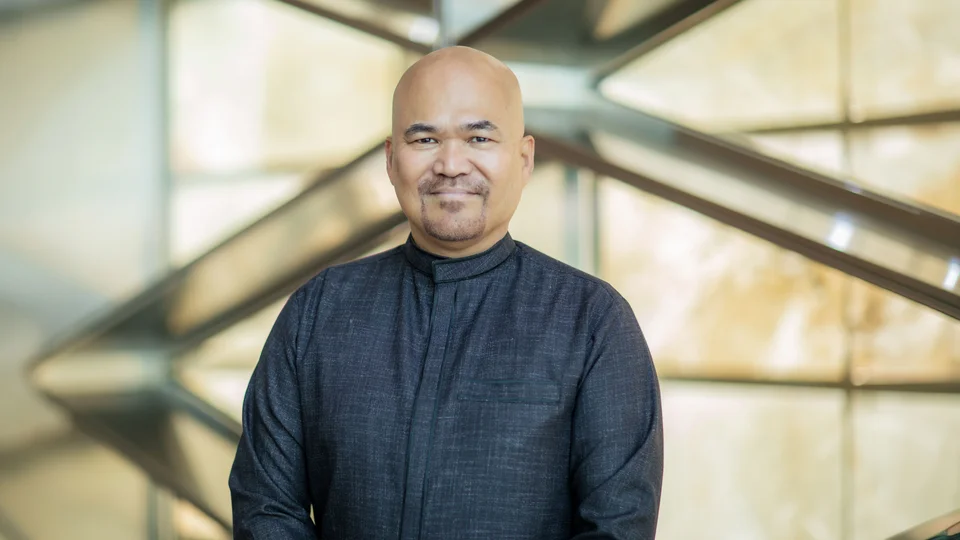
CEMSE SRSI intern Safeer Ahmad earns second place at Harvard Health Systems Innovation Lab Hackathon
Safeer Ahmad's AI-powered NeuroDrive, developed through CEMSE research mentorship, earned second place among 2,040 participants from 41 countries at the Harvard Health Systems Innovation Lab Hackathon.
About
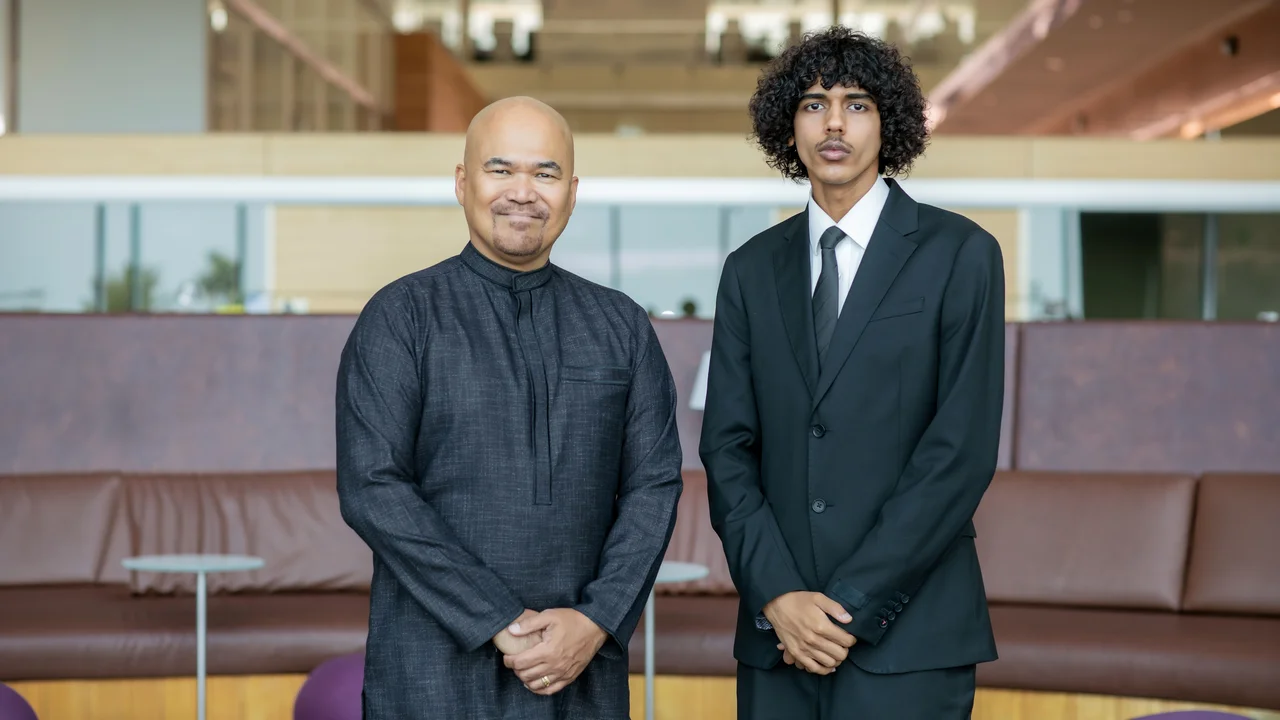
Safeer Ahmad, a senior at the KAUST School, secured second place among 2,040 entries at the 7th Harvard Health Systems Innovation Lab (HSIL) Hackathon Riyadh Hub. Held in April, the event drew participants from 41 countries, making it the largest edition of the flagship global event.
The Hackathon challenged participants to design solutions that strengthen health systems, taking ideas from concept to functional prototype within two days. The recognition reflects the strength of KAUST’s research mentorship ecosystem, which provided Ahmad with the tools and guidance to develop his deep-tech startup, NeuroDrive, into an award-winning project. He has since advanced to Bootcamp II, a two-week virtual incubation phase to refine his pitch.
NeuroDrive was developed by Ahmad at Professor Ombao’s Biostatistics Research Group (BIOSTATS) as part of KAUST Academy's Saudi Research Science Institute (SRSI). The artificial intelligence-enabled medtech device is designed to improve mobility for individuals with motor impairments by combining AI, data science, neuroscience and biomedical innovation.
When the HSIL announced its Riyadh hackathon, Ahmad recognized it as the ideal stage to present his neuro-engineering and brain-computer interface work: “It presented the perfect platform for me to stress-test the viability of my research against rigorous global standards, and to see exactly how it would hold up in a highly competitive, venture-focused environment.
“Being awarded second place and representing Saudi Arabia on a global platform was immensely validating, but the true reward was standing before world-class judges and proving that a project born in the KAUST lab could translate into a scalable, competition-worthy solution. The judges recognized it as an entrepreneurial pitch deeply anchored in high-quality, defensible science.”
Closing the gap between paralysis and autonomy
NeuroDrive aims to develop a non-invasive, software-defined bridge that translates neural signals directly into autonomous wheelchair mobility. It was born from Ahmad’s recognition of a critical gap in modern healthcare; namely, patients with severe motor impairment are often forced to choose between a complete loss of autonomy or expensive and, at times, high-risk neurosurgery.
“I wanted to engineer a middle ground, a non-invasive solution that prioritizes the patient's dignity without compromising clinical capability. We hope [it] grant[s] paralyzed patients autonomy while allowing hospitals to reclaim thousands of nursing hours currently lost to manual patient transport, delivering a massive return on investment to healthcare infrastructure.”
Interdisciplinary collaboration was at the core of the project’s success. While Ahmad developed the initial idea and prototype, the BIOSTATS group’s diverse expertise honed a theoretical algorithm into an actionable healthcare solution.
“The NeuroDrive project has inspired many BIOSTATS members to support Safeer in all aspects of the research,” Ombao said. “This support includes building hardware, designing electroencephalogram (EEG) experiments, extracting the most predictive features, and applying statistical and deep learning methods for mapping features and motor intent.”
The team’s immediate focus is to refine the initial prototype, further train the model and pursue additional innovation and investment platforms. In parallel, they are executing a 12-month go-to-market strategy to launch alpha pilot programs at leading neurological centers across Saudi Arabia. This phase of development is expected to generate localized clinical datasets critical for product validation and regulatory submissions.
A bright future in biomedicine
Participating in the HSIL hackathon has proved to be a profound turning point for Ahmad, drawing him away from his original academic focus centered on environmental engineering. After graduating from TKS, he now plans to pursue a degree in biomedical engineering: “My time in the SRSI program fundamentally shifted my entire approach. I learned that true innovation in healthcare requires much more than advanced technology; it demands rigorous risk mitigation, statistical validity and data defensibility.
“The mentorship I received from Professor Ombao and his group taught me to look beyond the prototype and consider scalability, patient safety and clinical integration, ultimately elevating the project from a summer science project to a validated, venture-ready medical device.”
The TKS senior’s ambitions extend well beyond his graduation. “My ultimate objective is to scale NeuroDrive into a global enterprise, advancing AI-driven medical devices and brain-computer interfaces to translate our research into tangible, real-world healthcare solutions.”
Ombao added: “Safeer’s achievement is remarkable. He stands out for his entrepreneurial spirit and his keen ability to see the big picture of the research process. However, I would like him never to take the mathematical and statistical details of his work for granted. Safeer has a bright future as a technological innovator in brain-computer interfaces.”