
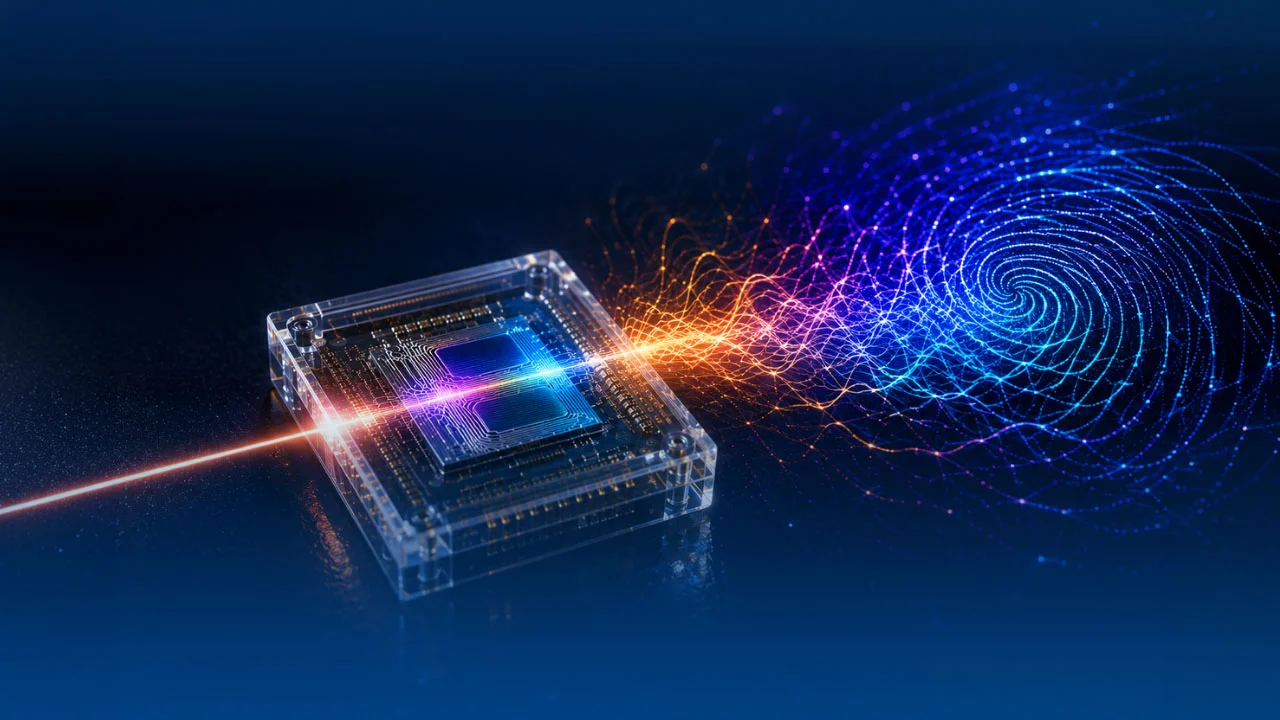
KAUST researchers have developed a photonics and AI-based authentication system that enables devices to verify their identity using unique optical fingerprints, offering a potential new approach to securing future cloud computing and AI infrastructure.
About
Researchers at King Abdullah University of Science and Technology (KAUST) have developed a new technology that allows digital devices to verify their identity using their own physical characteristics, potentially offering a faster and more secure alternative to conventional passwords and security keys.
Published in Nature Electronics, the research addresses a growing challenge facing the digital systems that power cloud computing, artificial intelligence, and connected devices. As these networks grow, so does the need to confirm that every device communicating within them is genuine and has not been copied or compromised.
The KAUST team developed a system that uses tiny laser devices to generate unique digital fingerprints. Just as no two human fingerprints are exactly alike, each laser produces its own distinctive light pattern that can be used to verify identity.
The researchers then combined the technology with artificial intelligence, enabling the system to recognize and authenticate those fingerprints almost instantly.
"Every connected device needs a way to prove that it is genuine," said Assistant Professor Yating Wan, who led the research at KAUST. "Today this often relies on stored passwords or security keys. Our approach explores whether devices can instead identify themselves using characteristics that are inherently part of the hardware."
Read the full story at KAUST News.
Related People


Zhican Zhou
- Postdoctoral Research Fellow, NUS