
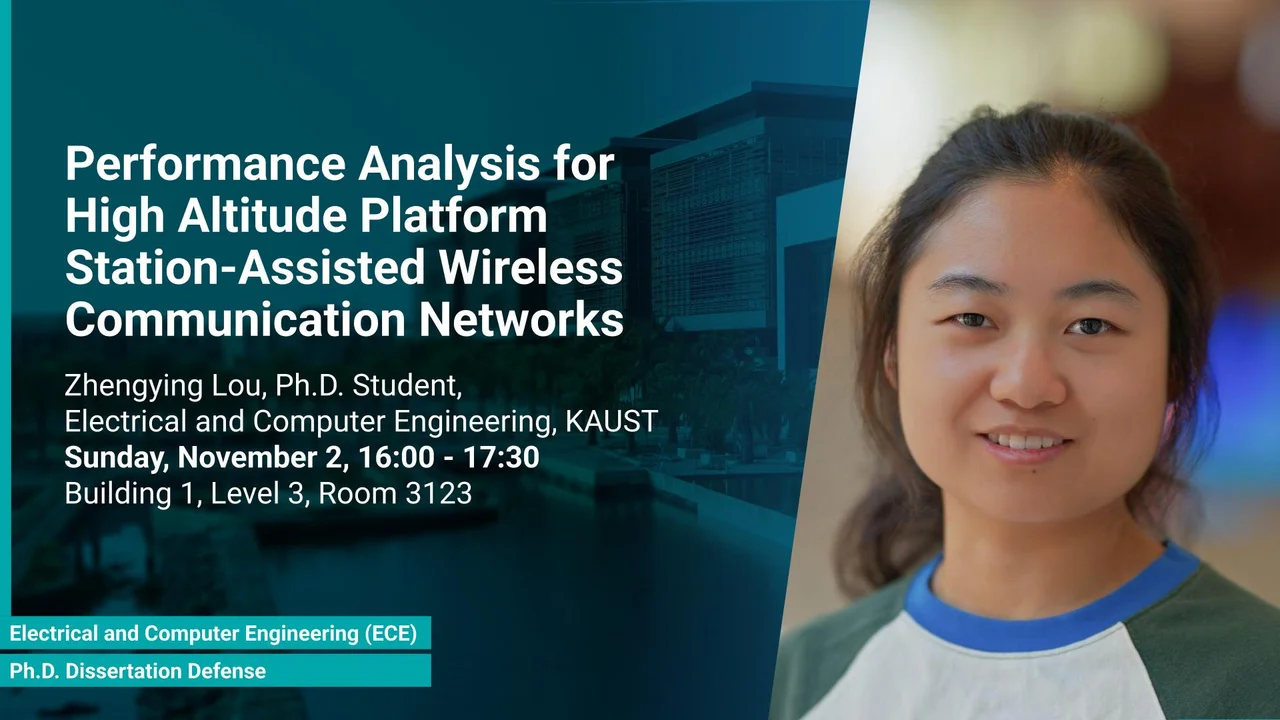
Performance Analysis for High Altitude Platform Station-Assisted Wireless Communication Networks
High altitude platform stations (HAPS) have recently emerged as a pivotal stratospheric segment within the broader non-terrestrial network (NTN) ecosystem, offering a promising solution for enhancing coverage, reliability, and efficiency in next-generation wireless networks. This thesis presents a comprehensive investigation into the architecture, performance, and integration of HAPS-assisted wireless communication networks from multiple perspectives.
Overview
First, we explore the primary communication links between HAPS and other NTN platforms, including satellites and unmanned aerial vehicles (UAVs). The advantages and challenges of HAPS are analyzed within various prospective NTN architectures, such as ad-hoc, cell-free, and integrated access and backhaul networks. Through performance evaluation in these scenarios, we highlight the indispensable role of HAPS in interconnecting heterogeneous NTN components and supporting diverse metrics, including routing latency, energy efficiency, coverage probability, and channel capacity.
Next, we develop a stochastic geometry-based analytical framework for evaluating the coverage performance of large-scale HAPS networks, taking into account the impact of directional antennas and general channel models. Analytical expressions for both uplink and downlink coverage probabilities are derived for cellular and cell-free deployments, and their accuracy is validated via Monte Carlo simulations. The influences of key network-level and physical-layer parameters on coverage probability are systematically investigated, offering design insights for future HAPS-enabled NTN deployments.
Furthermore, motivated by the surging demand for robust maritime connectivity, we propose a space-air-ground-sea integrated network (SAGSIN) that synergistically incorporates onshore base stations, UAVs, HAPS, and low Earth orbit satellites to achieve seamless and reliable communication across vast oceanic regions. Using stochastic geometry, we model the spatial distribution of network elements and derive analytical results for uplink coverage and communication probability under diverse data rate requirements. Numerical results confirm that the proposed SAGSIN framework significantly extends coverage from coastal to deep-sea regions, while dynamic resource scheduling across multiple links further enhances system efficiency.
Collectively, this thesis advances the field of HAPS-assisted wireless communication networks by establishing analytical models and performance evaluation frameworks. The research provides valuable insights and practical design guidelines to support the development and deployment of reliable, efficient, and seamlessly integrated 6G wireless networks.
Presenters
Brief Biography
Zhengying Lou is a Ph.D. student at King Abdullah University of Science and Technology (KAUST), Thuwal, Saudi Arabia. She received her B.S. degree in Communication Engineering from University of Electronic Science and Technology of China in 2021. In 2022, she received her M.Sc. degree in Electrical and Computer Engineering from KAUST. Her current research interests include stochastic geometry and wireless networks.
Related People
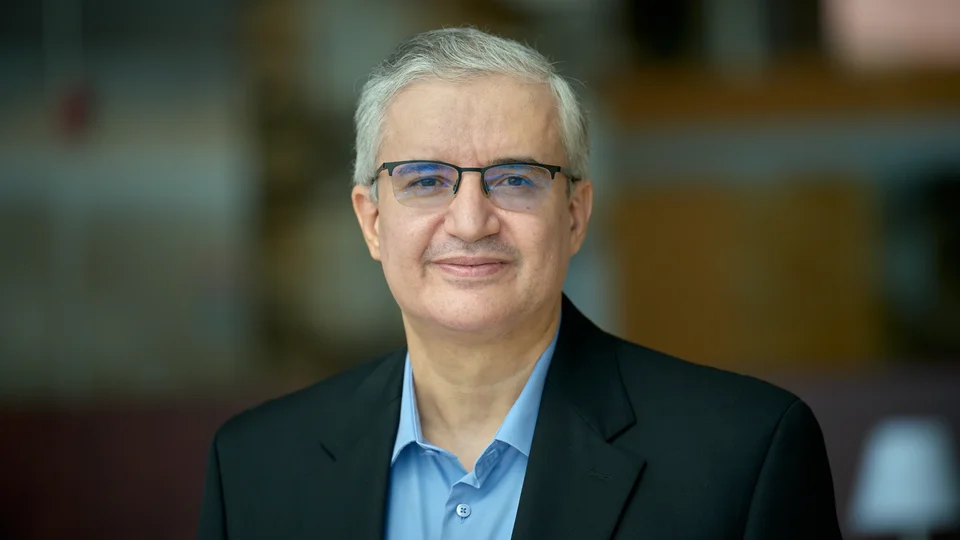
Mohamed-Slim Alouini
- Al-Khawarzmi Distinguished Professor, Electrical and Computer Engineering

Zhengying Lou
- Ph.D. Student, Electrical and Computer Engineering