Design and Optimization of Memristive Synapses for Scalable Neuromorphic Systems
This dissertation develops a memristor-based neuromorphic computing framework for energy-efficient edge intelligence, in which the sensing, memory, and computing capabilities of memristive devices are jointly exploited to enable adaptive sensing, event-driven information processing, and efficient biomedical signal classification.
Overview
The growing demand for real-time artificial intelligence at the edge is exposing the limitations of conventional von Neumann architectures, particularly the energy consumption and latency associated with frequent data transfer between physically separated memory and processing units. Emerging applications in wearable healthcare, artificial vision, and intelligent sensing require compact, low-power, and adaptive hardware capable of efficiently processing complex and time-varying signals. Memristive devices offer a promising alternative by integrating sensing, memory, and computation within compact and programmable hardware. However, translating their unique physical properties into practical neuromorphic systems requires coordinated optimization across device, circuit, and algorithm levels.
The dissertation is built around a unified device–circuit–algorithm co-design framework that exploits the nonlinear dynamics, programmable conductance, and memory-dependent behavior of memristive devices to enable adaptive and energy-efficient neuromorphic edge computing. First, a flexible optoelectronic memristive synapse is developed to integrate optical sensing, memory, and synaptic learning within a single device, enabling patient-specific transfer learning for multiple physiological signal classification tasks. Second, a memristor-based reservoir computing architecture is introduced to efficiently process asynchronous event data by directly leveraging intrinsic device nonlinearity and short-term memory for spatiotemporal feature extraction, reducing the need for conventional data representation and preprocessing. Third, the framework is extended to an integrated event-driven biomedical signal processing system, where memristive event encoding, reservoir computing, and in-memory classification are combined to minimize redundant sampling, data movement, and computational overhead. Through device characterization, circuit-level design, and system-level evaluation, the proposed approaches demonstrate improved adaptability, data efficiency, classification performance, and hardware efficiency. Collectively, this dissertation establishes a pathway toward scalable, low-power, and adaptive neuromorphic edge systems for wearable healthcare, artificial vision, and intelligent sensing applications.
Presenters
Brief Biography
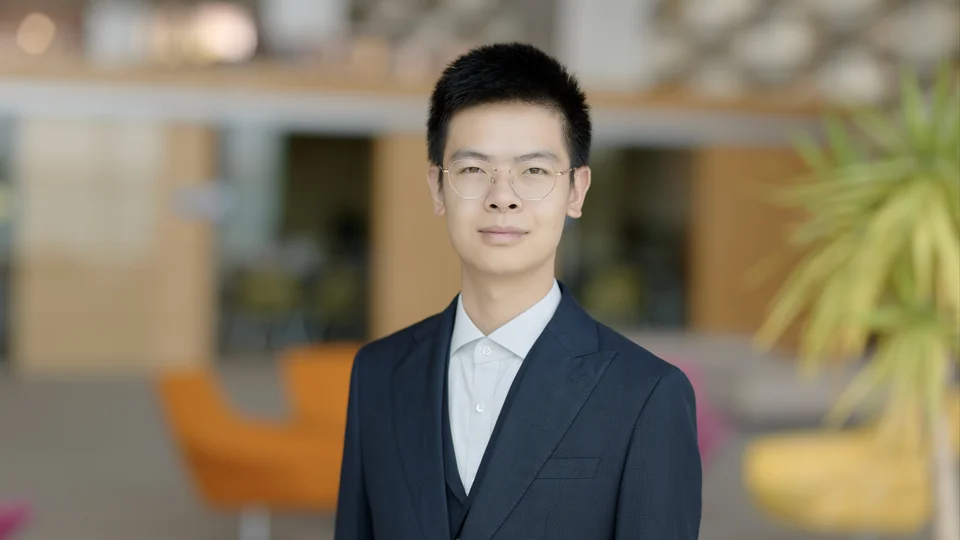
Hanrui Li is a Ph.D. student in Electrical and Computer Engineering at King Abdullah University of Science and Technology (KAUST), under the supervision of Prof. Nazek El-Atab. He received his B.S. in Microelectronics Science and Engineering from Changchun University of Science and Technology in 2022.
He has authored or co-authored 30 publications, including 12 first/co-first-author papers, in prominent journals such as Advanced Materials, Nature Communications, Nano-Micro Letters, Advanced Science, and Light: Science & Applications. His professional research experience includes two internships at top hedge funds in China and work as a quantitative researcher and co-founder of a proprietary trading company specializing in high-frequency trading (HFT) strategies across the Chinese futures market.