About Abdulkadir Celik Abdulkadir Celik Associate Professor, University of Southampton 5G and beyond UAV-Assisted Cellular and Sensor Networks Underwater Optical Wireless Communications and Networking Abdulkadir Celik's research focuses on next-generation wireless communication systems, including network design, optimization, and emerging wireless technologies. Projects Related Projects 2026 BioContact Assurance System Mon, Aug 17 2026 Research body area networks Reliable electrode-skin contact is fundamental for accurate biomedical signal acquisition in applications such as ECG, EEG, and EMG monitoring. Traditional lead-off detection methods face challenges from motion artifacts, environmental noise, and fluctuating skin-electrode impedance. The BioContact Assurance System (BCAS) leverages common-ground human body communication (CG-HBC), utilizing the human body itself as a signal transmission medium. BCAS enables real-time electrode contact monitoring and verification, paving the way for improved performance in wearable healthcare devices and broader From Lab to Digital Twin: Calibration of mmWave Ray-Tracing with RIS Reflections Thu, Aug 27 2026 Research wireless communication Beyond 5G networks are expected to deliver ultra-reliable, low-latency, and high-capacity connectivity. One of the key enabling technologies for achieving these goals is a reconfigurable intelligent surface (RIS), which is a programmable metasurface composed of many passive elements, each capable of adjusting the phase of incident signals. By intelligently controlling these elements, RIS can manipulate wireless propagation environment to enhance coverage, increase capacity, and improve energy efficiency. To accurately model the behavior of RIS within complex and dynamic environments, digital Generative AI-Based Channel Estimation Framework: CG-CGAN Thu, Aug 6 2026 Research wireless communication Generative artificial intelligence (GenAI) is reshaping wireless communications by moving beyond data-driven modeling to directly generating multiple components of the channel. This is especially important for millimeter wave (mmWave) massive MIMO (mMIMO) systems, where high-dimensional channels, low signal-to-noise ratio (SNR), and hybrid architectures make channel estimation difficult. Traditional compressed sensing (CS) and deep learning (DL) approaches are either too computationally heavy or not accurate enough. Our research introduces a generative learning framework that leverages user 2025 BioLink: Internet of Body via HBC for Healthcare Thu, Sep 25 2025 Research body area networks BioLink is an umbrella research initiative advancing Human Body Communication (HBC) technologies for connected and personalized healthcare. It brings together multiple research projects spanning ultra-low-power HBC transceiver integrated circuits, wearable and implantable sensing systems, physiological-signal monitoring, body-area networking, embedded intelligence, and secure healthcare connectivity. HBC uses the human body itself as a medium for data exchange between devices placed on, around, or within the body. In contrast to conventional wireless links that radiate radio-frequency signals Digital Twin For Indoor Scenario Fri, Sep 12 2025 wireless communication In indoor wireless scenarios, Digital Twin enables the accurate modeling of complex environments, such as offices, factories, and smart homes, allowing for the real-time optimization of coverage, interference management, and seamless connectivity for IoT devices. IT supports applications like intelligent building management, immersive AR/VR, and industrial automation. At CCSL, we investigate two specific indoor DT scenarios: digital twin–aided beamforming design and digital twin–aided blockage prediction/detection for MIMO systems. Experiment Description Digital Twin (DT) technology enables Digital Twin For Outdoor Scenario Fri, Sep 12 2025 Research wireless communication In outdoor scenarios, DTs provide large-scale virtual replicas of urban or rural networks to optimize base station placement, manage mobility, and enhance vehicular or drone communications. These advantages make DTs a powerful tool for improving reliability, efficiency, and adaptability across diverse wireless environments. At CCSL, we investigate two specific DT scenarios for outdoor wireless cellular networks: digital twin–aided beamforming design and digital twin–aided blockage prediction/detection for MIMO systems. Experiment Description Digital Twin (DT) technology enables the accurate Digital Twin For RIS-Aided Systems Fri, Sep 12 2025 Research wireless communication Beyond 5G networks are expected to deliver ultra-reliable, low-latency, and high-capacity connectivity. One of the key enabling technologies for achieving these goals is a reconfigurable intelligent surface (RIS), which is a programmable metasurface composed of many passive elements, each capable of adjusting the phase of incident signals. By intelligently controlling these elements, RIS can manipulate wireless propagation environment to enhance coverage, increase capacity, and improve energy efficiency. To accurately model the behavior of RIS within complex and dynamic environments, digital Multi-Target Detection and JVAR Estimation Wed, Sep 24 2025 Research wireless communication Integrated sensing and communication has been a key element towards the advancements of next generation wireless communication systems. Moreover, the convergence of radar and communication systems is rapidly gaining momentum as we advance towards beyond fifth-generation (5G) networks. A promising approach involves the utilization of existing 5G new radio 5G-NR control signals for sensing purposes. This approach exploits the periodic nature of such signals to collect environmental data without degrading the communication performance. Synchronization signal block (SSB) is the most popular Multimodal Sensing for Indoor RIS-Aided Beam Selection Wed, Sep 24 2025 Research wireless communication In the 5G standard, beam sweeping is typically periodically executed through exhaustive search methods to maintain continuous alignment of user equipment (UE) and base station (BS) beamformers. In a reconfigurable intelligent surface (RIS)-aided massive MIMO (mMIMO) system, beam training is a daunting challenge as RIS codebook sizes are significantly larger compared to regular transceivers. To address the beam-training overhead, deep learning-based solutions have attracted great interest, enabling learning from data and adapting to dynamic conditions. The integration of multimodal sensing On-Body HBC Networking Thu, Sep 25 2025 Research body area networks To advance innovations in next-generation Internet of Bodies (IoB) networks, there is a growing need for miniature, ultra-low-power devices capable of continuous and reliable operation. This need has led to a surge of interest in Human Body Communication (HBC), where nodes exchange messages directly through the human body as a secure and energy-efficient medium. With evidence showing that HBC can achieve up to 100× lower power consumption compared to conventional RF technologies, our research focuses on developing novel communication and networking techniques that facilitate connectivity over Wire-Free Wearables: Adaptive Low-Power Transceivers for Human Body Communication Thu, Sep 25 2025 Research body area networks Wearable and implantable sensing is limited by its radio, not by its sensor. On the body, conventional RF links suffer shadowing and multipath, radiate energy into the surrounding room, and end up dominating the power budget of a node whose battery has to be small enough to wear. Human Body Communication (HBC) removes that radio: the signal is coupled into conductive tissue through skin electrodes and travels along the wearer, cutting transmit energy by orders of magnitude while keeping the data confined to the person carrying it. This project is the analog / mixed-signal integrated-circuit 2018 Wireless Data Center Networks Mon, Jan 1 2018 - Fri, Jan 1 2021 wireless data center networks Data center networks (DCNs) are essential infrastructures to embrace the era of the highly diversified massive amount of data generated by emerging technological applications. In order to store and process such a data deluge, today’s DCNs have to deploy enormous length of wires to interconnect a plethora of servers and switches. Unfortunately, wired DCNs exposes several drawbacks such as cabling cost and complexity, low space utilization due to the cable bundles, and insufficiency to overcome chronic oversubscription and hotspot problems.
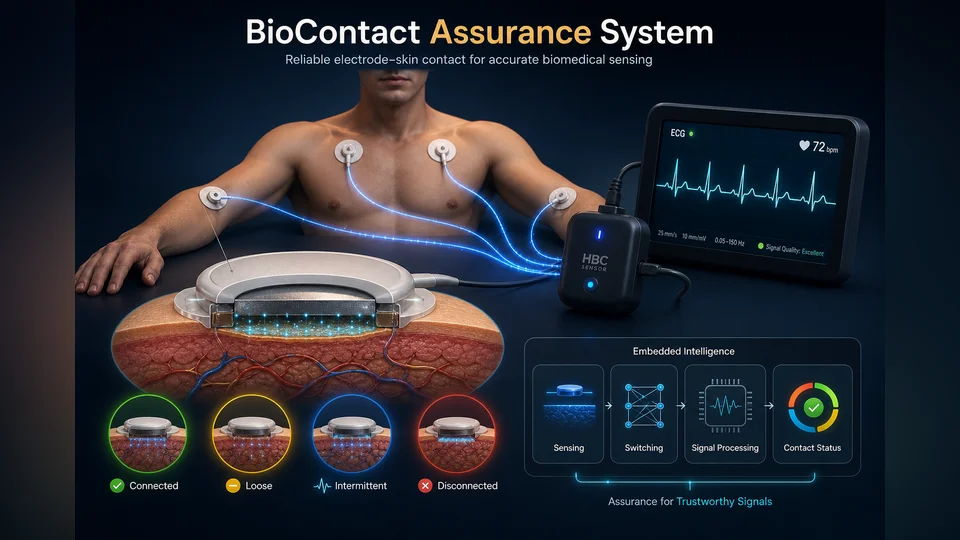
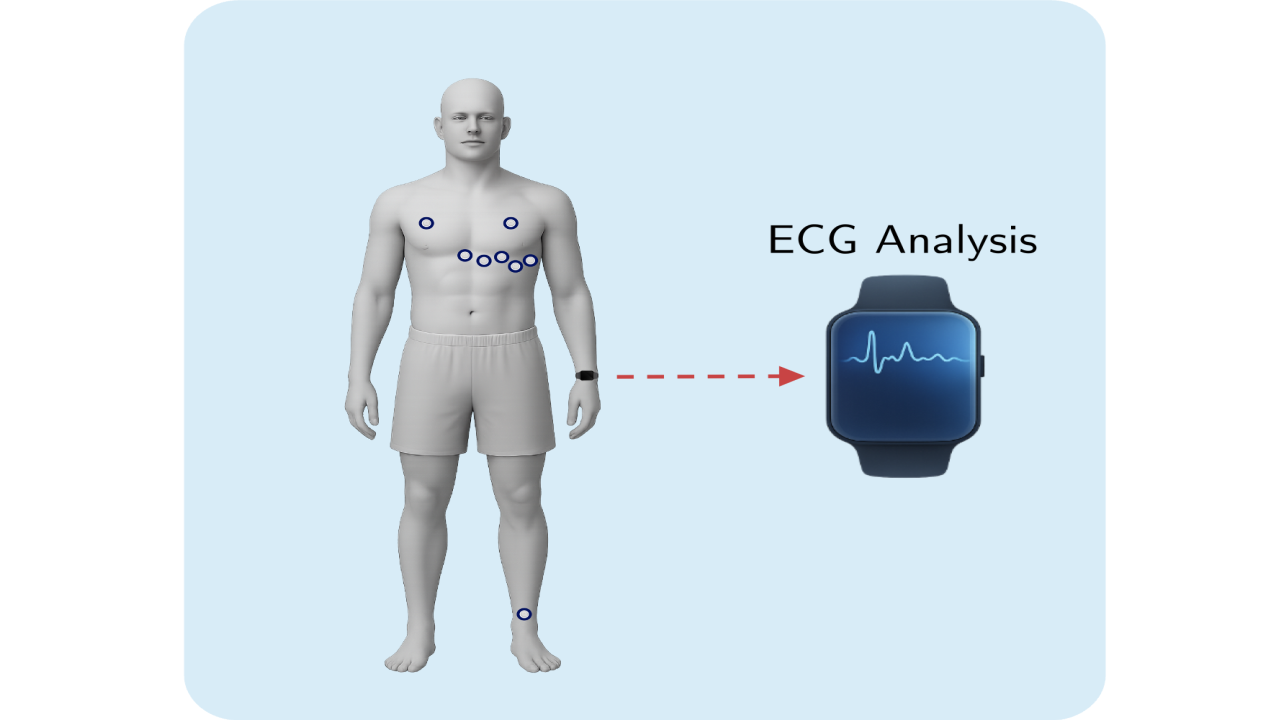
BioContact Assurance System Mon, Aug 17 2026 Research body area networks Reliable electrode-skin contact is fundamental for accurate biomedical signal acquisition in applications such as ECG, EEG, and EMG monitoring. Traditional lead-off detection methods face challenges from motion artifacts, environmental noise, and fluctuating skin-electrode impedance. The BioContact Assurance System (BCAS) leverages common-ground human body communication (CG-HBC), utilizing the human body itself as a signal transmission medium. BCAS enables real-time electrode contact monitoring and verification, paving the way for improved performance in wearable healthcare devices and broader
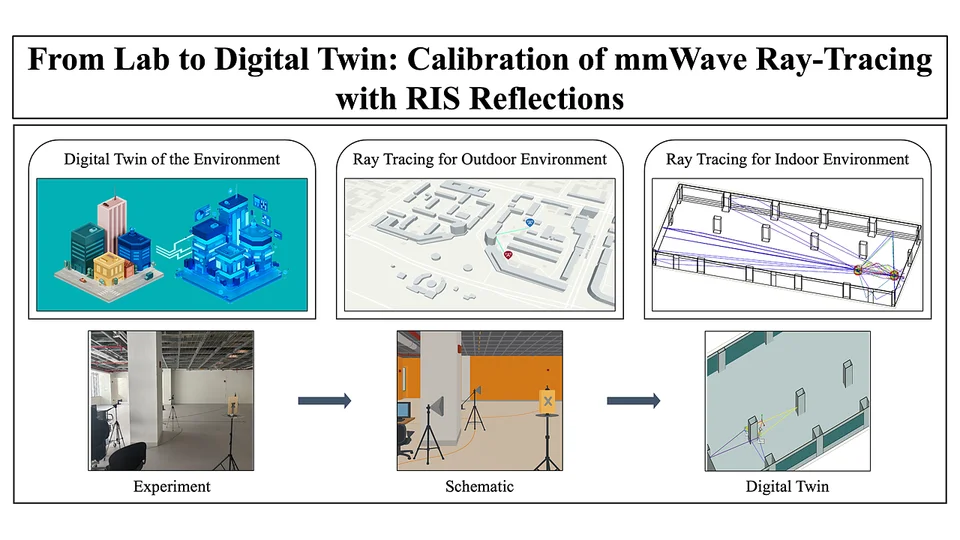
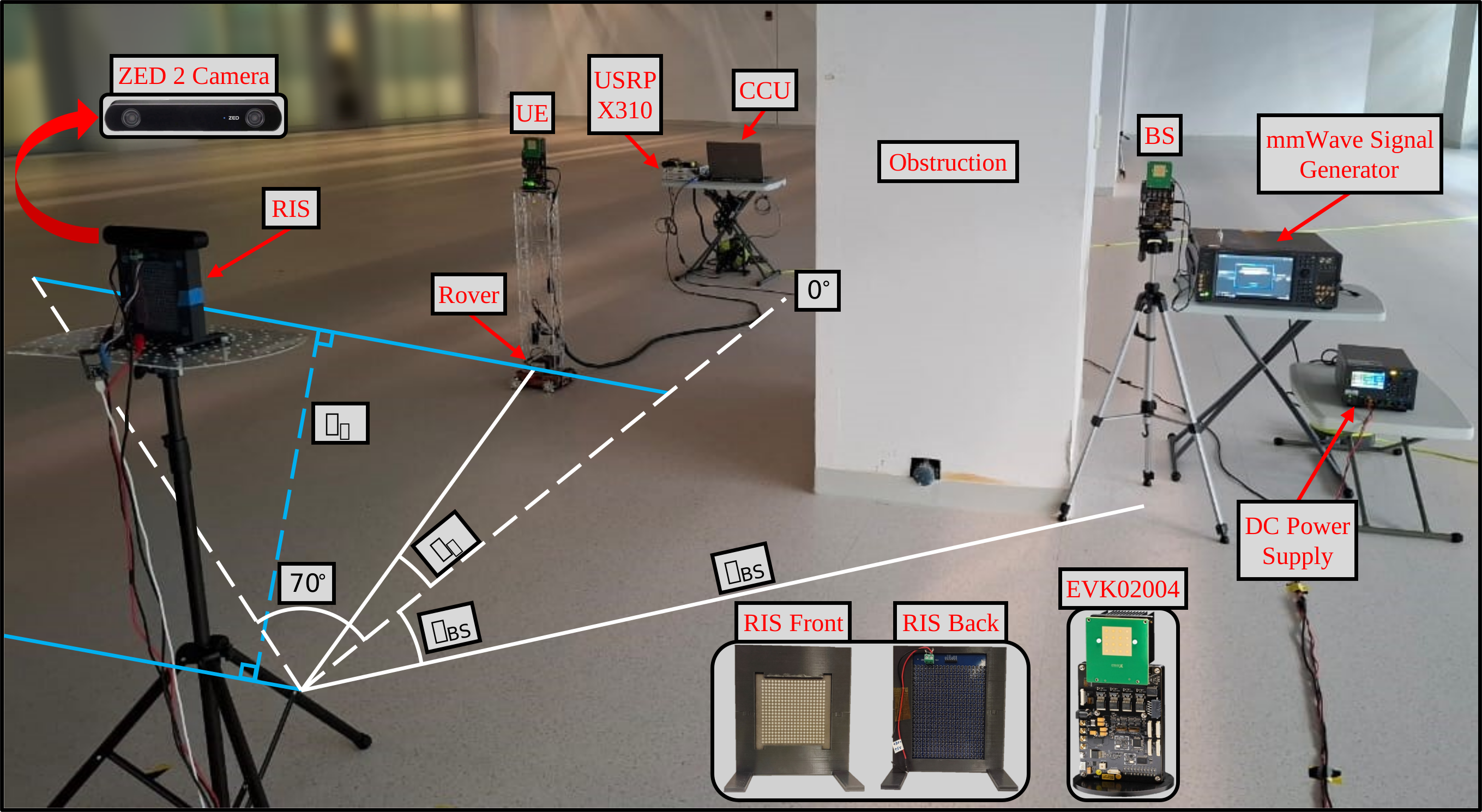
From Lab to Digital Twin: Calibration of mmWave Ray-Tracing with RIS Reflections Thu, Aug 27 2026 Research wireless communication Beyond 5G networks are expected to deliver ultra-reliable, low-latency, and high-capacity connectivity. One of the key enabling technologies for achieving these goals is a reconfigurable intelligent surface (RIS), which is a programmable metasurface composed of many passive elements, each capable of adjusting the phase of incident signals. By intelligently controlling these elements, RIS can manipulate wireless propagation environment to enhance coverage, increase capacity, and improve energy efficiency. To accurately model the behavior of RIS within complex and dynamic environments, digital
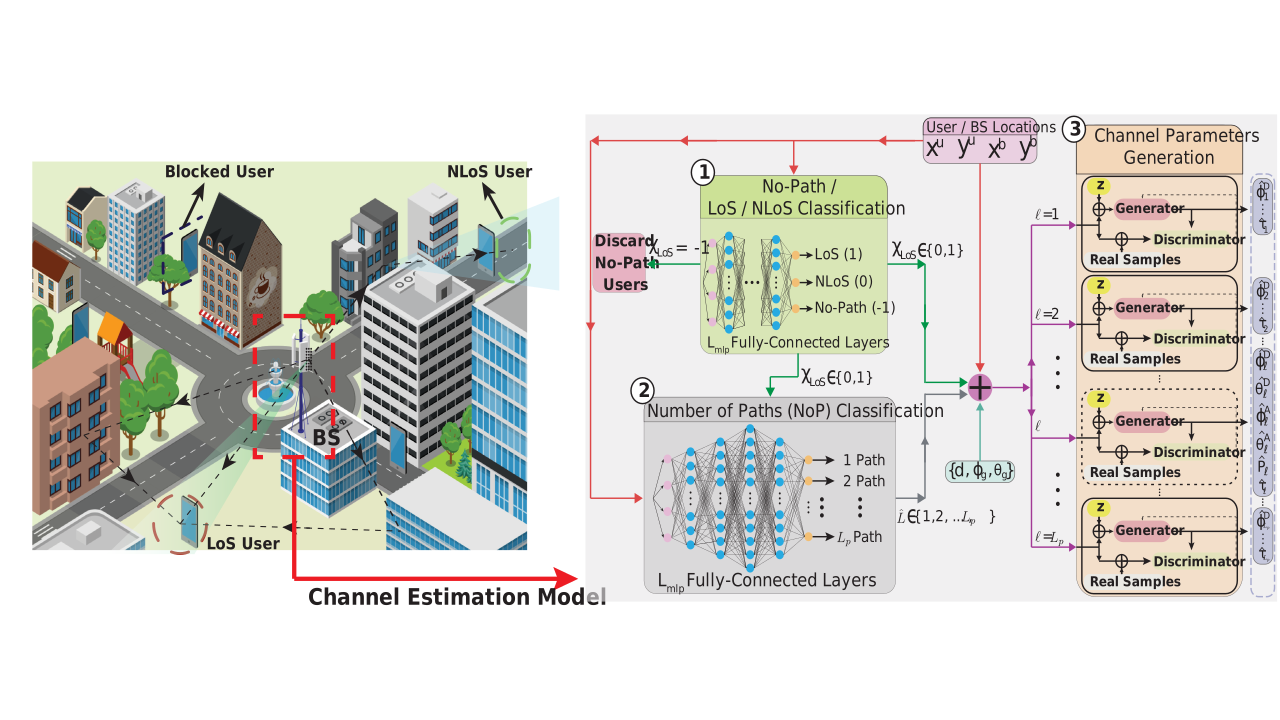
Generative AI-Based Channel Estimation Framework: CG-CGAN Thu, Aug 6 2026 Research wireless communication Generative artificial intelligence (GenAI) is reshaping wireless communications by moving beyond data-driven modeling to directly generating multiple components of the channel. This is especially important for millimeter wave (mmWave) massive MIMO (mMIMO) systems, where high-dimensional channels, low signal-to-noise ratio (SNR), and hybrid architectures make channel estimation difficult. Traditional compressed sensing (CS) and deep learning (DL) approaches are either too computationally heavy or not accurate enough. Our research introduces a generative learning framework that leverages user
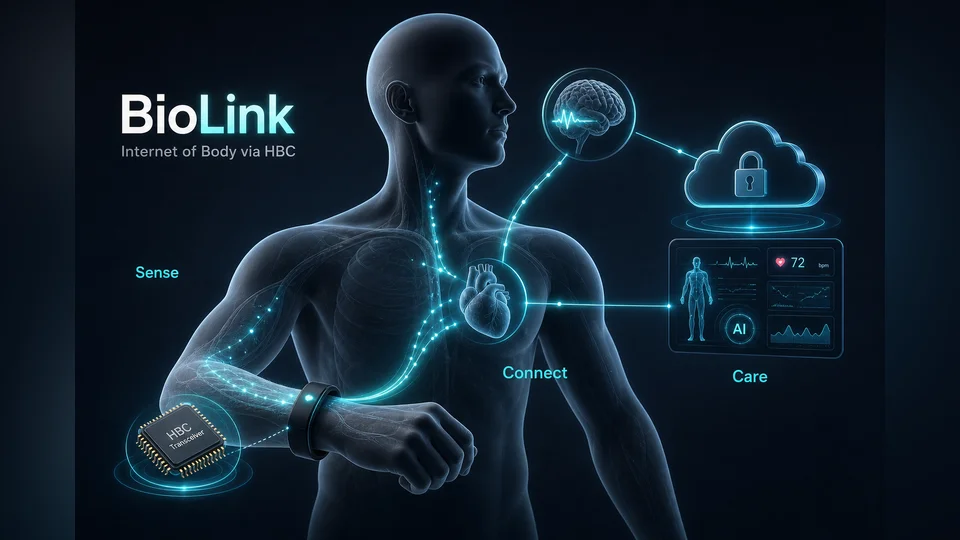
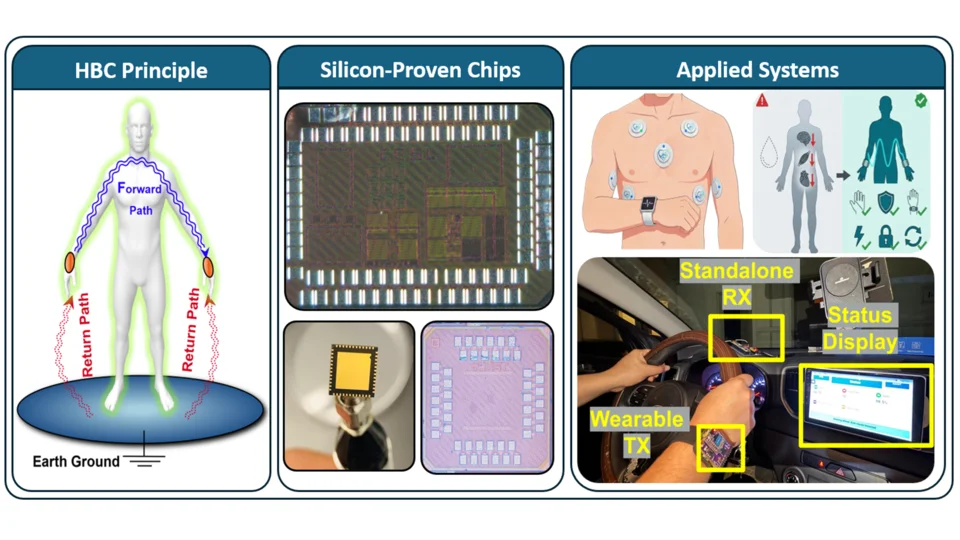
BioLink: Internet of Body via HBC for Healthcare Thu, Sep 25 2025 Research body area networks BioLink is an umbrella research initiative advancing Human Body Communication (HBC) technologies for connected and personalized healthcare. It brings together multiple research projects spanning ultra-low-power HBC transceiver integrated circuits, wearable and implantable sensing systems, physiological-signal monitoring, body-area networking, embedded intelligence, and secure healthcare connectivity. HBC uses the human body itself as a medium for data exchange between devices placed on, around, or within the body. In contrast to conventional wireless links that radiate radio-frequency signals
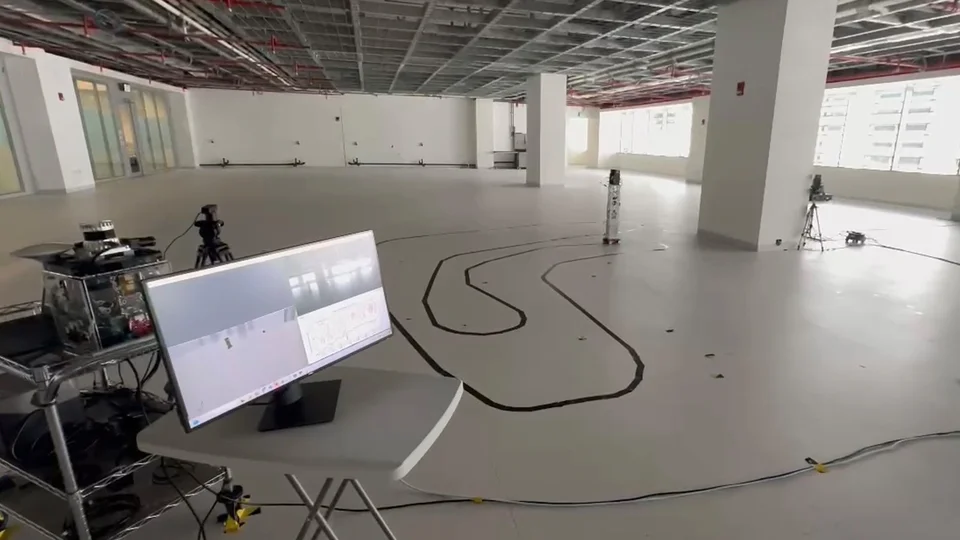
Digital Twin For Indoor Scenario Fri, Sep 12 2025 wireless communication In indoor wireless scenarios, Digital Twin enables the accurate modeling of complex environments, such as offices, factories, and smart homes, allowing for the real-time optimization of coverage, interference management, and seamless connectivity for IoT devices. IT supports applications like intelligent building management, immersive AR/VR, and industrial automation. At CCSL, we investigate two specific indoor DT scenarios: digital twin–aided beamforming design and digital twin–aided blockage prediction/detection for MIMO systems. Experiment Description Digital Twin (DT) technology enables
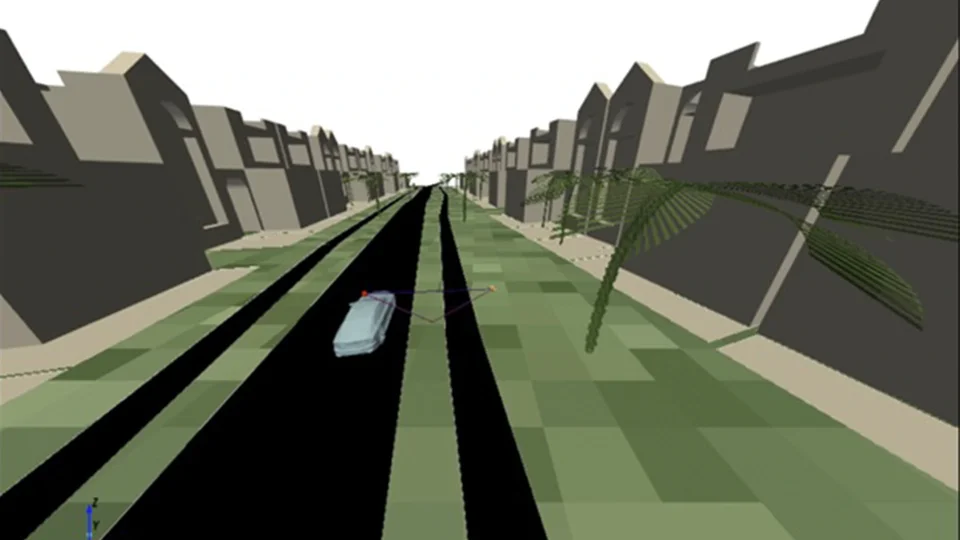
Digital Twin For Outdoor Scenario Fri, Sep 12 2025 Research wireless communication In outdoor scenarios, DTs provide large-scale virtual replicas of urban or rural networks to optimize base station placement, manage mobility, and enhance vehicular or drone communications. These advantages make DTs a powerful tool for improving reliability, efficiency, and adaptability across diverse wireless environments. At CCSL, we investigate two specific DT scenarios for outdoor wireless cellular networks: digital twin–aided beamforming design and digital twin–aided blockage prediction/detection for MIMO systems. Experiment Description Digital Twin (DT) technology enables the accurate
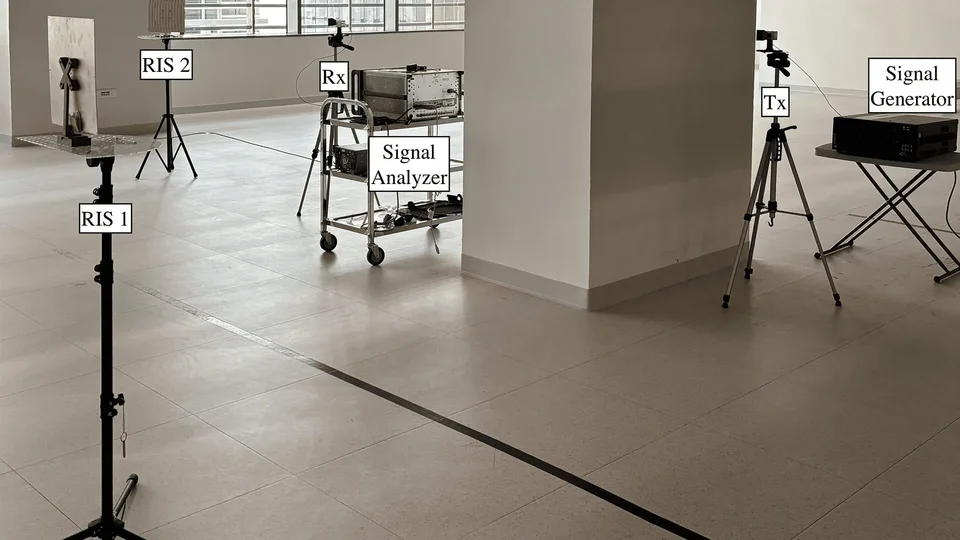
Digital Twin For RIS-Aided Systems Fri, Sep 12 2025 Research wireless communication Beyond 5G networks are expected to deliver ultra-reliable, low-latency, and high-capacity connectivity. One of the key enabling technologies for achieving these goals is a reconfigurable intelligent surface (RIS), which is a programmable metasurface composed of many passive elements, each capable of adjusting the phase of incident signals. By intelligently controlling these elements, RIS can manipulate wireless propagation environment to enhance coverage, increase capacity, and improve energy efficiency. To accurately model the behavior of RIS within complex and dynamic environments, digital
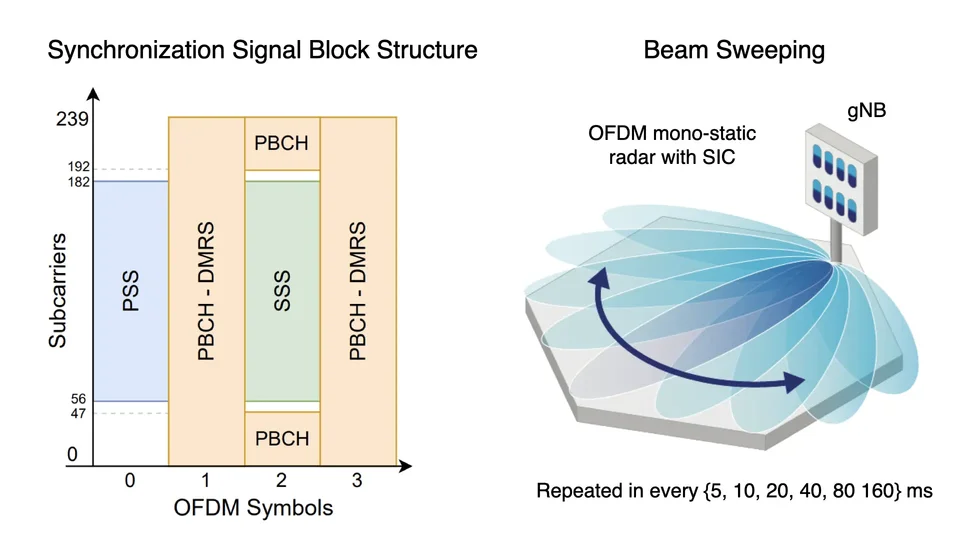
Multi-Target Detection and JVAR Estimation Wed, Sep 24 2025 Research wireless communication Integrated sensing and communication has been a key element towards the advancements of next generation wireless communication systems. Moreover, the convergence of radar and communication systems is rapidly gaining momentum as we advance towards beyond fifth-generation (5G) networks. A promising approach involves the utilization of existing 5G new radio 5G-NR control signals for sensing purposes. This approach exploits the periodic nature of such signals to collect environmental data without degrading the communication performance. Synchronization signal block (SSB) is the most popular
Multimodal Sensing for Indoor RIS-Aided Beam Selection Wed, Sep 24 2025 Research wireless communication In the 5G standard, beam sweeping is typically periodically executed through exhaustive search methods to maintain continuous alignment of user equipment (UE) and base station (BS) beamformers. In a reconfigurable intelligent surface (RIS)-aided massive MIMO (mMIMO) system, beam training is a daunting challenge as RIS codebook sizes are significantly larger compared to regular transceivers. To address the beam-training overhead, deep learning-based solutions have attracted great interest, enabling learning from data and adapting to dynamic conditions. The integration of multimodal sensing
On-Body HBC Networking Thu, Sep 25 2025 Research body area networks To advance innovations in next-generation Internet of Bodies (IoB) networks, there is a growing need for miniature, ultra-low-power devices capable of continuous and reliable operation. This need has led to a surge of interest in Human Body Communication (HBC), where nodes exchange messages directly through the human body as a secure and energy-efficient medium. With evidence showing that HBC can achieve up to 100× lower power consumption compared to conventional RF technologies, our research focuses on developing novel communication and networking techniques that facilitate connectivity over
Wire-Free Wearables: Adaptive Low-Power Transceivers for Human Body Communication Thu, Sep 25 2025 Research body area networks Wearable and implantable sensing is limited by its radio, not by its sensor. On the body, conventional RF links suffer shadowing and multipath, radiate energy into the surrounding room, and end up dominating the power budget of a node whose battery has to be small enough to wear. Human Body Communication (HBC) removes that radio: the signal is coupled into conductive tissue through skin electrodes and travels along the wearer, cutting transmit energy by orders of magnitude while keeping the data confined to the person carrying it. This project is the analog / mixed-signal integrated-circuit
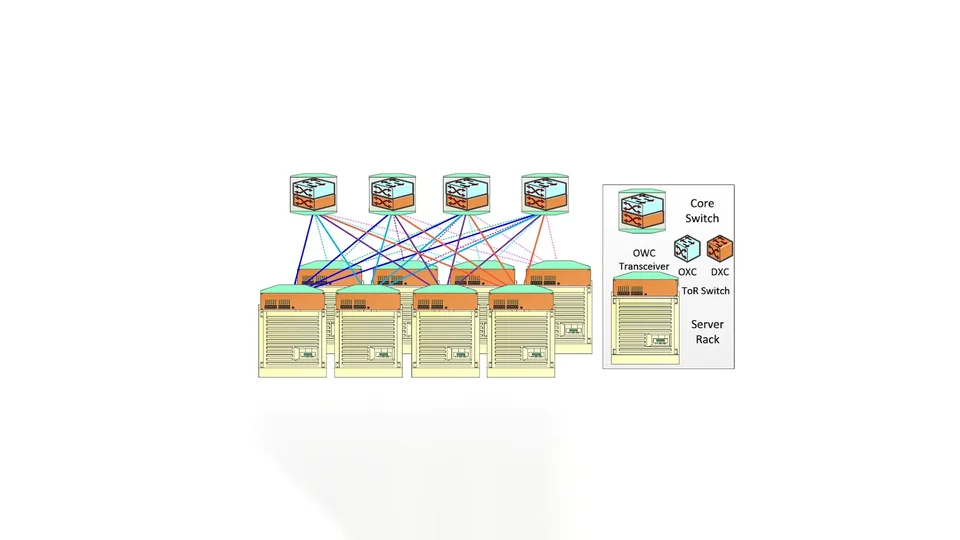
Wireless Data Center Networks Mon, Jan 1 2018 - Fri, Jan 1 2021 wireless data center networks Data center networks (DCNs) are essential infrastructures to embrace the era of the highly diversified massive amount of data generated by emerging technological applications. In order to store and process such a data deluge, today’s DCNs have to deploy enormous length of wires to interconnect a plethora of servers and switches. Unfortunately, wired DCNs exposes several drawbacks such as cabling cost and complexity, low space utilization due to the cable bundles, and insufficiency to overcome chronic oversubscription and hotspot problems.
Engage ORCID ShareClipboard Related Sites Communication and Computing Systems Lab (CCSL) Electrical and Computer Engineering (ECE) Networking Research Lab (NETLAB) Communication Theory Lab (CTL) Related Content Articles 7 Projects 12 Related Links LinkedIn Google Scholar ResearchGate Personal Website