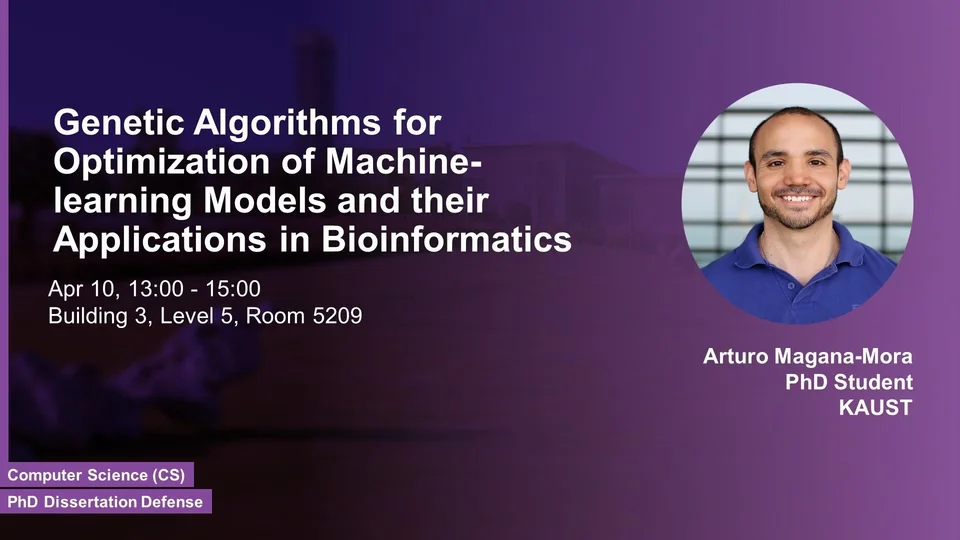
About Arturo Magana Mora Arturo Magana Mora Ph.D., Computer Science machine learning data mining Arturo Magana-Mora obtained his Ph.D. in Computer Science at the King Abdullah University of Science and Technology (KAUST) under the supervision of Prof. Vladimir Bajic in 2017 and later joined the National Institute of Advanced Industrial Science and Technology (AIST) in Japan as a postdoctoral research fellow in the Com. Bio Big-Data Open Innovation Lab (CBBD-OIL). Research Interest His research interests include the development of novel machine-learning and data mining techniques to address the complex problems in biology. His research work has resulted in several peer-reviewed Events Presented Events Apr 9 - Apr 15, 2017 Genetic Algorithms for Optimization of Machine-learning Models and their Applications in Bioinformatics Arturo Magana Mora, Ph.D., Computer Science Apr 10, 13:00 - 15:00 B3 L5 R5209 machine learning data mining biology genetics bioinformatics Abstract Machine-learning (ML) techniques have been widely applied to solve different problems in biology. However, biological data are large and complex, which often results in extremely intricate ML models. Frequently, these models may have poor performance or may be computationally unfeasible. This study presents a set of novel computational methods and focuses on the application of genetic algorithms (GAs) for the simplification and optimization of ML models and their applications to biological problems. The dissertation addresses the following three challenges. The first challenge is
Genetic Algorithms for Optimization of Machine-learning Models and their Applications in Bioinformatics Arturo Magana Mora, Ph.D., Computer Science Apr 10, 13:00 - 15:00 B3 L5 R5209 machine learning data mining biology genetics bioinformatics Abstract Machine-learning (ML) techniques have been widely applied to solve different problems in biology. However, biological data are large and complex, which often results in extremely intricate ML models. Frequently, these models may have poor performance or may be computationally unfeasible. This study presents a set of novel computational methods and focuses on the application of genetic algorithms (GAs) for the simplification and optimization of ML models and their applications to biological problems. The dissertation addresses the following three challenges. The first challenge is
Engage ORCID ShareClipboard Related Sites Computer Science (CS) Related Content Articles 3 Events 1 Related Links Publications list on ORCID View list of Publications on KAUST Repository Also view list of Publications on Google Scholar