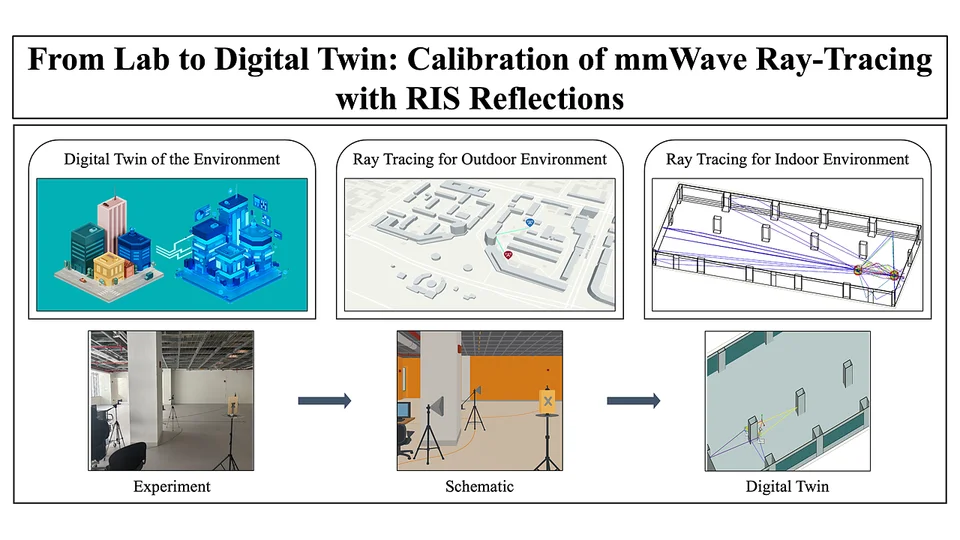
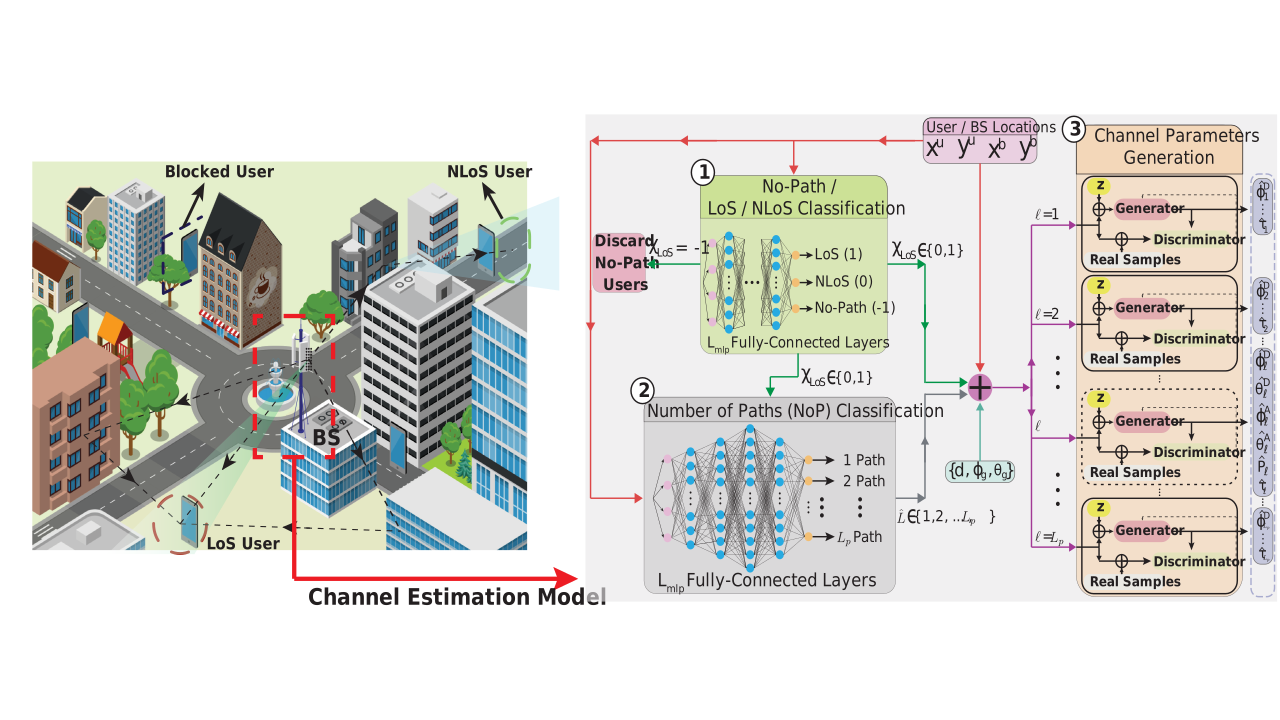
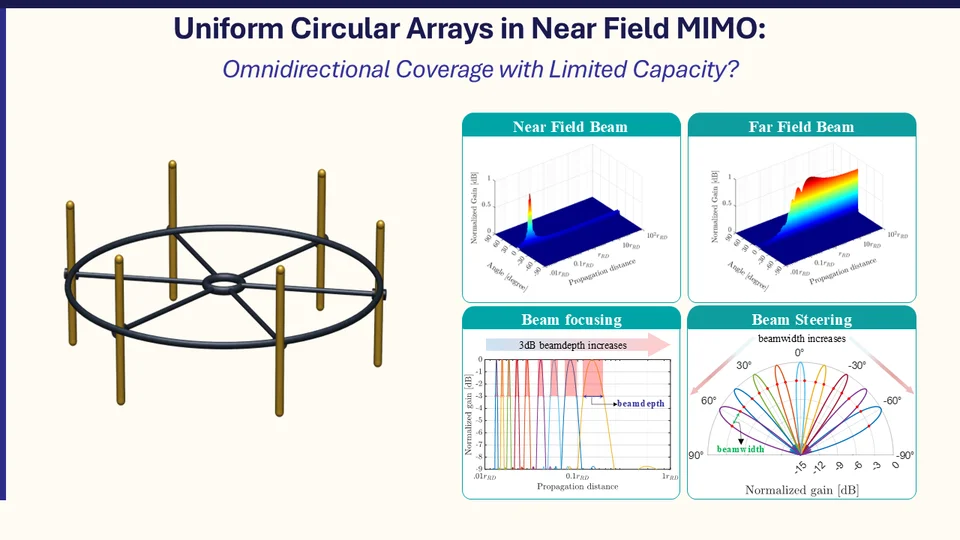
About Asmaa Abdallah Asmaa Abdallah Research Scientist, Electrical and Computer Engineering Deep learning Digital signal processing Resource allocation Machine learning applications for wireless communication systems 5G and beyond UAV-Assisted cellular and sensor networks artificial intelligence Projects Related Projects 2026 From Lab to Digital Twin: Calibration of mmWave Ray-Tracing with RIS Reflections Thu, Aug 27 2026 Research wireless communication Beyond 5G networks are expected to deliver ultra-reliable, low-latency, and high-capacity connectivity. One of the key enabling technologies for achieving these goals is a reconfigurable intelligent surface (RIS), which is a programmable metasurface composed of many passive elements, each capable of adjusting the phase of incident signals. By intelligently controlling these elements, RIS can manipulate wireless propagation environment to enhance coverage, increase capacity, and improve energy efficiency. To accurately model the behavior of RIS within complex and dynamic environments, digital Generative AI-Based Channel Estimation Framework: CG-CGAN Thu, Aug 6 2026 Research wireless communication Generative artificial intelligence (GenAI) is reshaping wireless communications by moving beyond data-driven modeling to directly generating multiple components of the channel. This is especially important for millimeter wave (mmWave) massive MIMO (mMIMO) systems, where high-dimensional channels, low signal-to-noise ratio (SNR), and hybrid architectures make channel estimation difficult. Traditional compressed sensing (CS) and deep learning (DL) approaches are either too computationally heavy or not accurate enough. Our research introduces a generative learning framework that leverages user Uniform Circular Arrays in Near-Field: Omnidirectional Coverage With Limited Capacity Wed, Aug 5 2026 Research wireless communication • Background: Ultra-massive MIMO in the radiative near-field uses spherical wavefronts to create finite-depth beams, separating users by distance and angle. Uniform Linear Arrays (ULAs) restrict finite-depth beams primarily to the boresight. Uniform Circular Arrays (UCAs) offer rotational symmetry, expanding angular coverage. Does the omnidirectional coverage of a UCA inherently translate into improved spatial multiplexing and sum-rate capacity compared to a ULA? • Methodology : Traditional Rayleigh distance overestimates the near-field region. We utilize the Effective Beamfocusing Rayleigh 2025 Digital Twin For RIS-Aided Systems Fri, Sep 12 2025 Research wireless communication Beyond 5G networks are expected to deliver ultra-reliable, low-latency, and high-capacity connectivity. One of the key enabling technologies for achieving these goals is a reconfigurable intelligent surface (RIS), which is a programmable metasurface composed of many passive elements, each capable of adjusting the phase of incident signals. By intelligently controlling these elements, RIS can manipulate wireless propagation environment to enhance coverage, increase capacity, and improve energy efficiency. To accurately model the behavior of RIS within complex and dynamic environments, digital On-Body HBC Networking Thu, Sep 25 2025 Research body area networks To advance innovations in next-generation Internet of Bodies (IoB) networks, there is a growing need for miniature, ultra-low-power devices capable of continuous and reliable operation. This need has led to a surge of interest in Human Body Communication (HBC), where nodes exchange messages directly through the human body as a secure and energy-efficient medium. With evidence showing that HBC can achieve up to 100× lower power consumption compared to conventional RF technologies, our research focuses on developing novel communication and networking techniques that facilitate connectivity over Polar Codebook Design for Near-Field Communication Thu, Sep 25 2025 Research wireless communication As sixth-generation (6G) wireless networks approach, leveraging the mmWave and THz bands' abundant spectrum becomes crucial, promising ultra-high data rates and enabling immersive communication experiences. This transformation, characterized by the integration of ultra-massive MIMO (UM-MIMO) systems, facilitates significant increases in throughput and capacity by utilizing densely packed antenna arrays. The resulting shift from traditional far-field communication, with its planar wavefronts, to near-field communication, where spherical wavefronts predominate, necessitates a reevaluation of
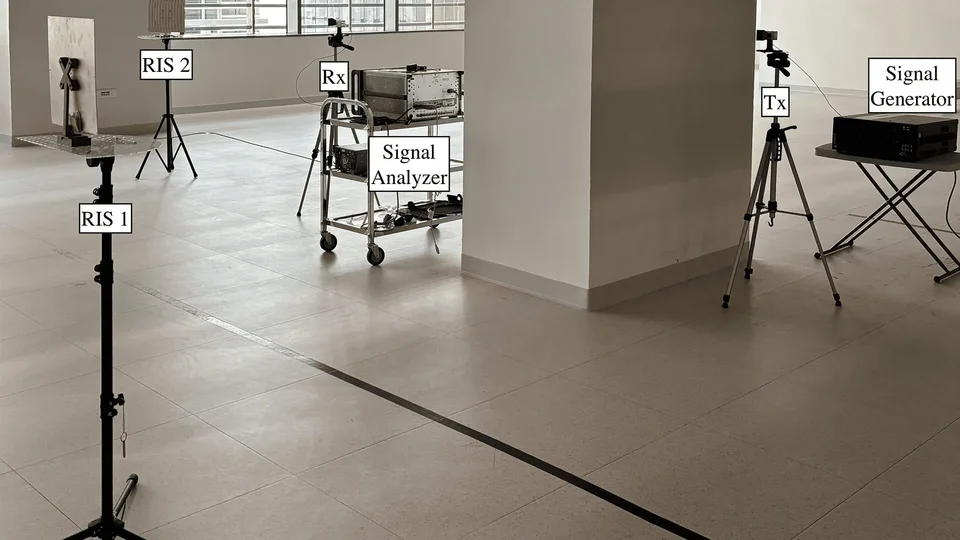
From Lab to Digital Twin: Calibration of mmWave Ray-Tracing with RIS Reflections Thu, Aug 27 2026 Research wireless communication Beyond 5G networks are expected to deliver ultra-reliable, low-latency, and high-capacity connectivity. One of the key enabling technologies for achieving these goals is a reconfigurable intelligent surface (RIS), which is a programmable metasurface composed of many passive elements, each capable of adjusting the phase of incident signals. By intelligently controlling these elements, RIS can manipulate wireless propagation environment to enhance coverage, increase capacity, and improve energy efficiency. To accurately model the behavior of RIS within complex and dynamic environments, digital
Generative AI-Based Channel Estimation Framework: CG-CGAN Thu, Aug 6 2026 Research wireless communication Generative artificial intelligence (GenAI) is reshaping wireless communications by moving beyond data-driven modeling to directly generating multiple components of the channel. This is especially important for millimeter wave (mmWave) massive MIMO (mMIMO) systems, where high-dimensional channels, low signal-to-noise ratio (SNR), and hybrid architectures make channel estimation difficult. Traditional compressed sensing (CS) and deep learning (DL) approaches are either too computationally heavy or not accurate enough. Our research introduces a generative learning framework that leverages user
Uniform Circular Arrays in Near-Field: Omnidirectional Coverage With Limited Capacity Wed, Aug 5 2026 Research wireless communication • Background: Ultra-massive MIMO in the radiative near-field uses spherical wavefronts to create finite-depth beams, separating users by distance and angle. Uniform Linear Arrays (ULAs) restrict finite-depth beams primarily to the boresight. Uniform Circular Arrays (UCAs) offer rotational symmetry, expanding angular coverage. Does the omnidirectional coverage of a UCA inherently translate into improved spatial multiplexing and sum-rate capacity compared to a ULA? • Methodology : Traditional Rayleigh distance overestimates the near-field region. We utilize the Effective Beamfocusing Rayleigh
Digital Twin For RIS-Aided Systems Fri, Sep 12 2025 Research wireless communication Beyond 5G networks are expected to deliver ultra-reliable, low-latency, and high-capacity connectivity. One of the key enabling technologies for achieving these goals is a reconfigurable intelligent surface (RIS), which is a programmable metasurface composed of many passive elements, each capable of adjusting the phase of incident signals. By intelligently controlling these elements, RIS can manipulate wireless propagation environment to enhance coverage, increase capacity, and improve energy efficiency. To accurately model the behavior of RIS within complex and dynamic environments, digital
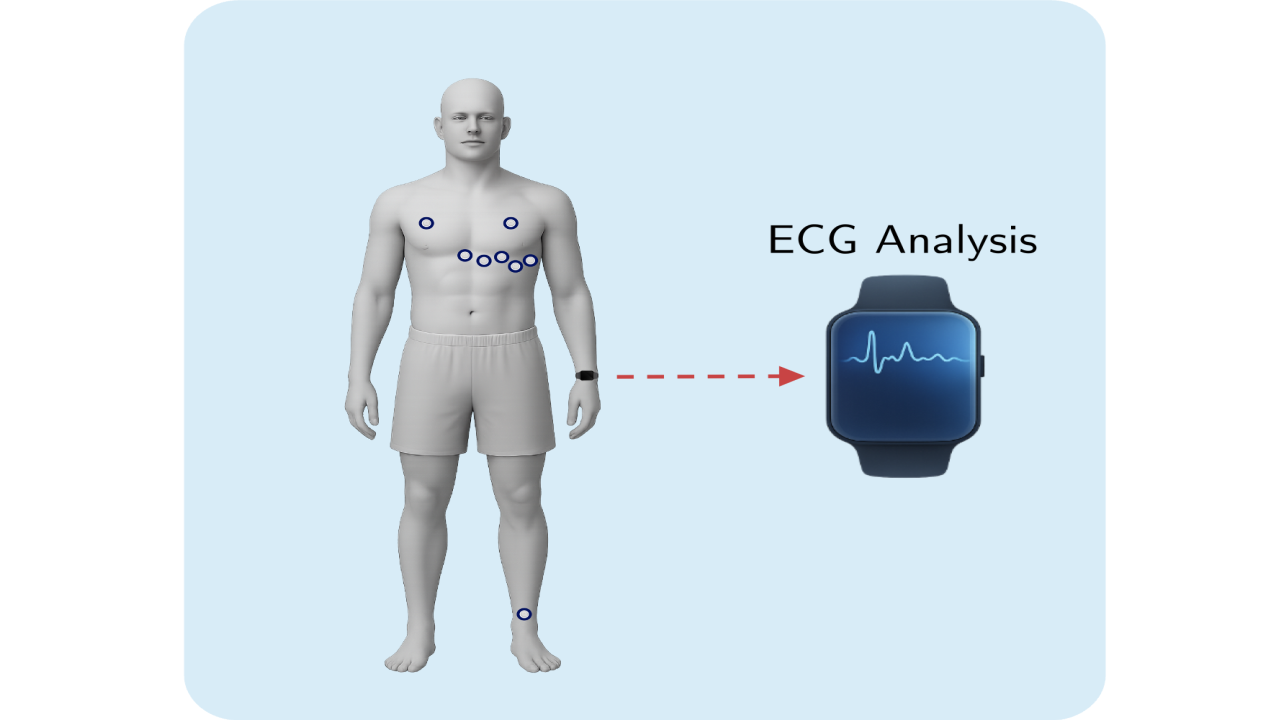
On-Body HBC Networking Thu, Sep 25 2025 Research body area networks To advance innovations in next-generation Internet of Bodies (IoB) networks, there is a growing need for miniature, ultra-low-power devices capable of continuous and reliable operation. This need has led to a surge of interest in Human Body Communication (HBC), where nodes exchange messages directly through the human body as a secure and energy-efficient medium. With evidence showing that HBC can achieve up to 100× lower power consumption compared to conventional RF technologies, our research focuses on developing novel communication and networking techniques that facilitate connectivity over
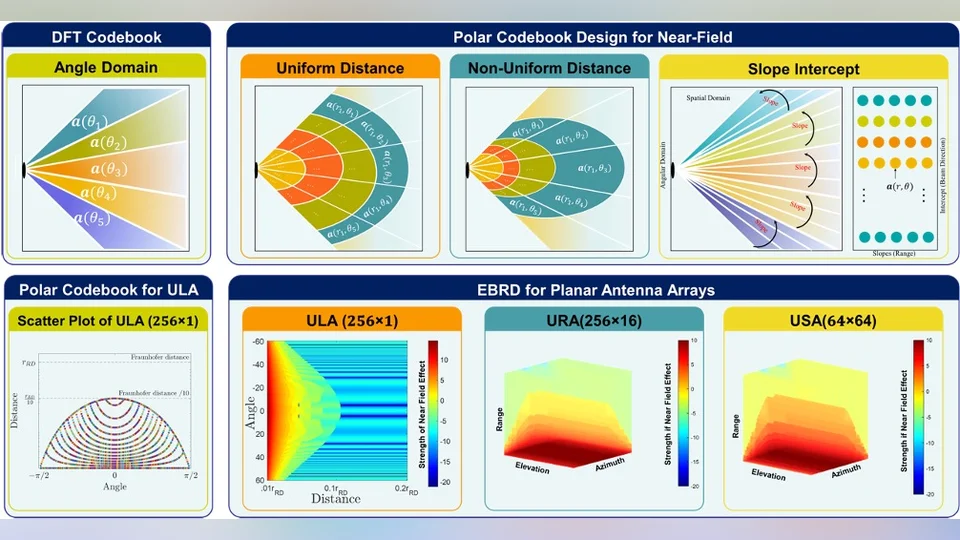
Polar Codebook Design for Near-Field Communication Thu, Sep 25 2025 Research wireless communication As sixth-generation (6G) wireless networks approach, leveraging the mmWave and THz bands' abundant spectrum becomes crucial, promising ultra-high data rates and enabling immersive communication experiences. This transformation, characterized by the integration of ultra-massive MIMO (UM-MIMO) systems, facilitates significant increases in throughput and capacity by utilizing densely packed antenna arrays. The resulting shift from traditional far-field communication, with its planar wavefronts, to near-field communication, where spherical wavefronts predominate, necessitates a reevaluation of
Engage KAUST Academic Portal KAUST Repository ORCID Scopus ShareClipboard Related Sites Electrical and Computer Engineering (ECE) Communication and Computing Systems Lab (CCSL) Related Content Articles 4 Projects 6 Events 1 Related Links Google Scholar Publications