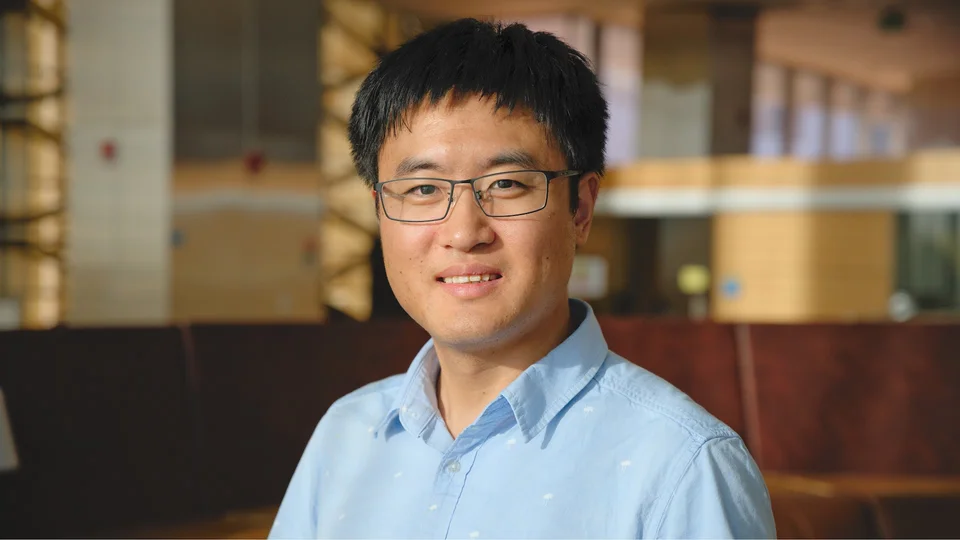
About Guangming Zang Guangming Zang Research Engineer, Computer Science inverse problems computational imaging Deep learning optimization Guangming Zang is a research engineer in the Computational Imaging Group (VCCIMAGING) under the supervision of Professor Wolfgang Heidrich at King Abdullah University of Science and Technology (KAUST). Education and Early Career Guangming obtained his bachelor degree in Software Engineering from China University of Geosciences in Wuhan, China in 2013. He received his master degree in Computer Science from University of Chinese Academy of Sciences in China. Before joining KAUST, Guangming was a research assistant (2013 – 2014) at The National Space Science Center at Chinese Academy of Sciences Articles Related News February 2019 Scanning in the Fourth Dimension 1 min read · Sun, Feb 17 2019 News visualization visual computing Three-dimensional (3D) computed tomography is a widely used technology that visualizes an object's external and internal structure by assembling a series of two-dimensional images taken sequentially across or around it. However, as anyone who has had a medical magnetic resonance imaging scan will recall, this type of 3D reconstruction requires the subject to be motionless throughout the capture process, which can take minutes. Capturing a 3D structure that changes or deforms over time is much more difficult, and existing approaches often yield reconstructions marred by image artifacts and
Scanning in the Fourth Dimension 1 min read · Sun, Feb 17 2019 News visualization visual computing Three-dimensional (3D) computed tomography is a widely used technology that visualizes an object's external and internal structure by assembling a series of two-dimensional images taken sequentially across or around it. However, as anyone who has had a medical magnetic resonance imaging scan will recall, this type of 3D reconstruction requires the subject to be motionless throughout the capture process, which can take minutes. Capturing a 3D structure that changes or deforms over time is much more difficult, and existing approaches often yield reconstructions marred by image artifacts and
Engage ORCID ShareClipboard Related Sites Computational Imaging Group (VCCIMAGING) Computer Science (CS) Related Content Articles 1 Events 1 Related Links Also view list of Publications on KAUST Repository Also view list of Publications on ORCID Repository Computational Imaging Group (VCCIMAGING)