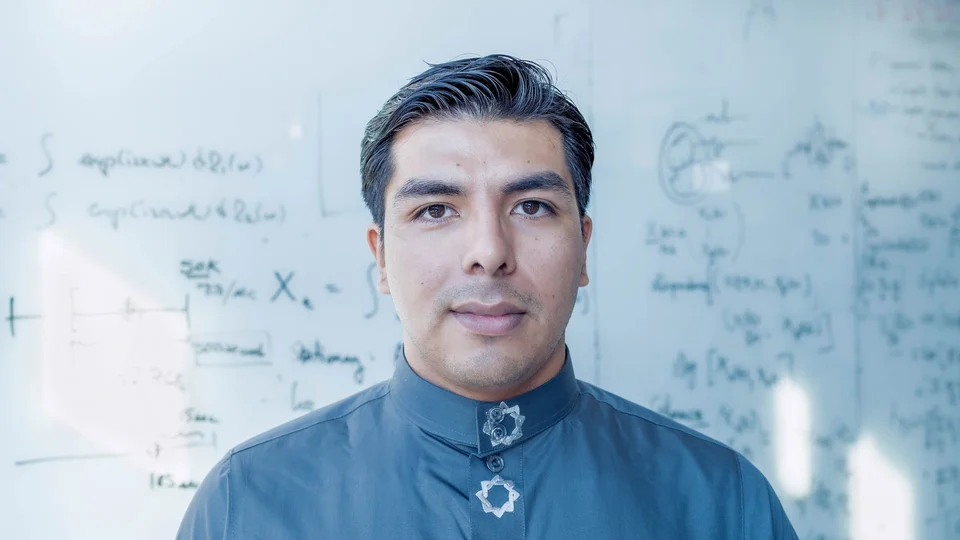
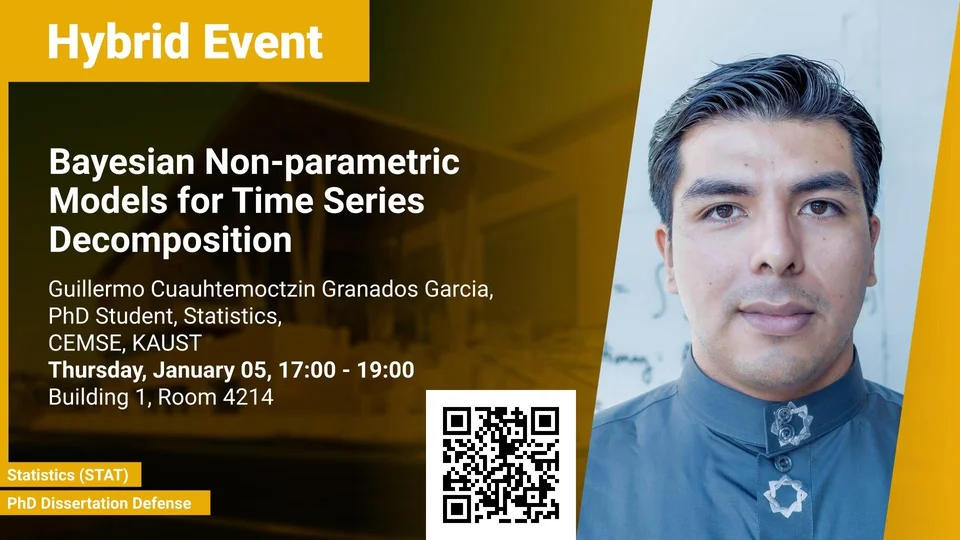
About Guillermo C. Granados Garcia Guillermo C. Granados Garcia Ph.D. Student, Statistics Time Series Guillermo is a Ph.D. candidate In Statistics at the King Abdullah University of Science and Technology (KAUST), studying under the supervision of Professor Hernando Ombao in his research group. Education and Early Career Guillermo obtained his Bachelor of Science in Actuary by the Universidad Nacional Autónoma de México. Then, he joined the MS/Ph.D. program in Statistics at KAUST in 2017. In 2018, he graduated his Master of Science in Statistics at KAUST. Research Interest His research interests lie in fields such as stochastic financial models, actuarial sciences, biostatistics, time series Events Presented Events Jan 1 - Jan 7, 2023 Bayesian Non-parametric Models for Time Series Decomposition Guillermo C. Granados Garcia, Ph.D. Student, Statistics Jan 5, 17:00 - 19:00 B1 R4214 spectral density function The standard approach to analyzing brain electrical activity is to examine the spectral density function (SDF) and identify frequency bands, defined apriori, that have the most substantial relative contributions to the overall variance of the signal. However, a limitation of this approach is that the precise frequency and bandwidth of oscillations are not uniform across cognitive demands. Thus, these bands should not be arbitrarily set in any analysis. To overcome this limitation, we propose three Bayesian Non-parametric models for time series decomposition, which are data-driven approaches that identify (i) the number of prominent spectral peaks, (ii) the frequency peak locations, and (iii) their corresponding bandwidths (or spread of power around the peaks).
Bayesian Non-parametric Models for Time Series Decomposition Guillermo C. Granados Garcia, Ph.D. Student, Statistics Jan 5, 17:00 - 19:00 B1 R4214 spectral density function The standard approach to analyzing brain electrical activity is to examine the spectral density function (SDF) and identify frequency bands, defined apriori, that have the most substantial relative contributions to the overall variance of the signal. However, a limitation of this approach is that the precise frequency and bandwidth of oscillations are not uniform across cognitive demands. Thus, these bands should not be arbitrarily set in any analysis. To overcome this limitation, we propose three Bayesian Non-parametric models for time series decomposition, which are data-driven approaches that identify (i) the number of prominent spectral peaks, (ii) the frequency peak locations, and (iii) their corresponding bandwidths (or spread of power around the peaks).
Related Sites Biostatistics Group (BIOSTATS) Statistics (STAT) Related Content Events 1 Related Links LinkedIn