About Hernando Ombao Hernando Ombao Professor, Statistics Time Series Spectral Analysis Wavelets Longitudinal Models Mixed Effects Models Functional Magnetic Resonance Imaging Electroencephalograms KAUST Professor of Statistics Hernando Ombao is an expert in time series models and their applications to designed medical experiments on complex biological processes. Events Presented Events Feb 4 - Feb 10, 2024 Dependence and Causality in Functional Brain Networks Hernando Ombao, Professor, Statistics Feb 8, 12:00 - 13:10 B9 L2 H2 H2 Brain activity over the entire network is complex. A full understanding of brain activity requires careful study of its multi-scale spatial-temporal organization. Motivated by these challenges, we will explore some characterizations of dependence between components of a multivariate time series and then apply these to the study of brain functional connectivity. Nov 12 - Nov 18, 2023 Experimental Design Statistical Workshop Hernando Ombao, Professor, Statistics Nov 14, 09:00 - Nov 15, 17:00 B1 L4 R4102 This workshop will cover the statistical essentials to designing experiments including power analysis, sample size calculation, regression, and variance analysis. A statistically sound experimental design is essential in applying for research grants. Detailed syllabi will be sent to those who register. Limited seats. Sign up now! Feb 6 - Feb 12, 2022 Exploring Spectral Dependence in Multivariate Time Series Hernando Ombao, Professor, Statistics Feb 10, 12:00 - 13:00 KAUST Advances in imaging technology have given neuroscientists unprecedented access to examine various facets of how the brain “works”. Brain activity is complex. A full understanding of brain activity requires careful study of its multi-scale spatial-temporal organization (from neurons to regions of interest; and from transient events to long-term temporal dynamics). Motivated by these challenges, we will explore some characterizations of dependence between components of a multivariate time series and then apply these to the study of brain functional connectivity. This is potentially interesting for brain scientists because functional brain networks are associated with cognitive function and mental and neurological diseases. Nov 1 - Nov 7, 2020 Exploring Non-Linear Interactions in Multivariate Time Series Hernando Ombao, Professor, Statistics Nov 5, 12:00 - 13:00 KAUST Linear Multivariate extremes Bayesian computational statistics Advances in imaging technology have given neuroscientists unprecedented access to examine various facets of how the brain “works”. Brain activity is complex. A full understanding of brain activity requires careful study of its multi-scale spatial-temporal organization (from neurons to regions of interest; and from transient events to long-term temporal dynamics). Motivated by these challenges, we will explore some characterizations of dependence between components of a multivariate time series and then apply these to the study of brain functional connectivity.
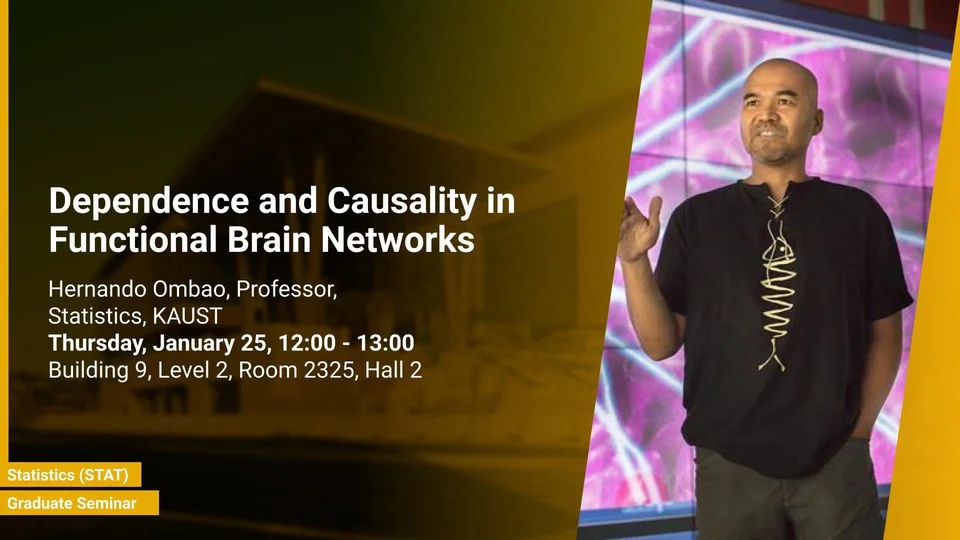
Dependence and Causality in Functional Brain Networks Hernando Ombao, Professor, Statistics Feb 8, 12:00 - 13:10 B9 L2 H2 H2 Brain activity over the entire network is complex. A full understanding of brain activity requires careful study of its multi-scale spatial-temporal organization. Motivated by these challenges, we will explore some characterizations of dependence between components of a multivariate time series and then apply these to the study of brain functional connectivity.
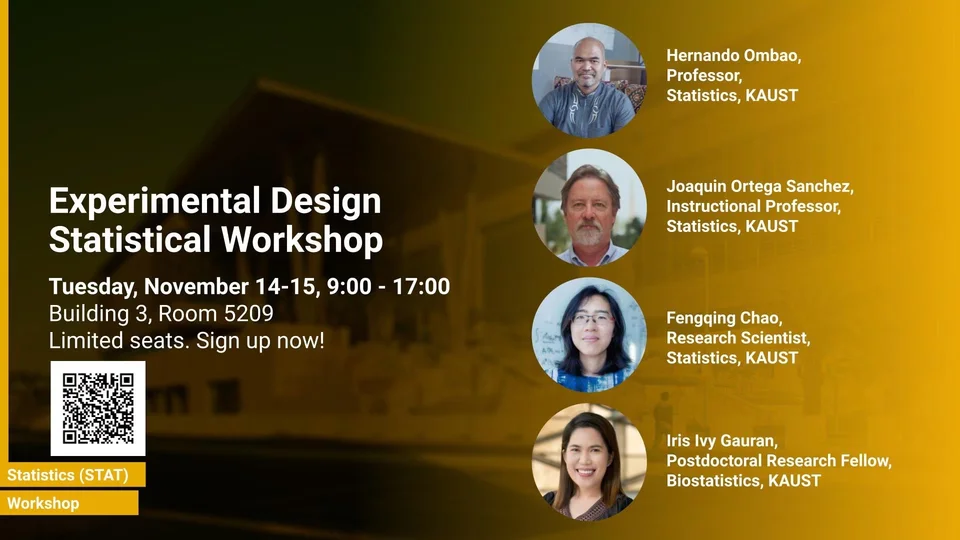
Experimental Design Statistical Workshop Hernando Ombao, Professor, Statistics Nov 14, 09:00 - Nov 15, 17:00 B1 L4 R4102 This workshop will cover the statistical essentials to designing experiments including power analysis, sample size calculation, regression, and variance analysis. A statistically sound experimental design is essential in applying for research grants. Detailed syllabi will be sent to those who register. Limited seats. Sign up now!
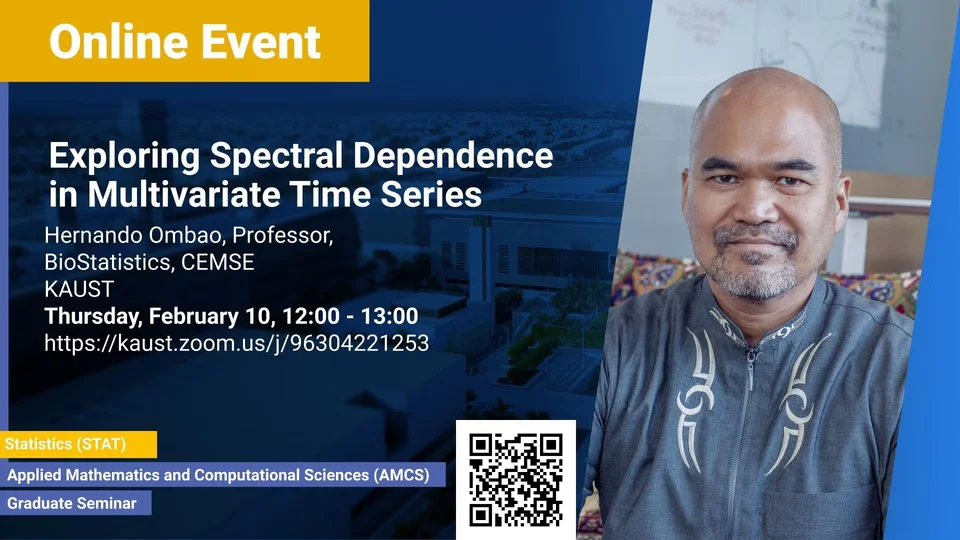
Exploring Spectral Dependence in Multivariate Time Series Hernando Ombao, Professor, Statistics Feb 10, 12:00 - 13:00 KAUST Advances in imaging technology have given neuroscientists unprecedented access to examine various facets of how the brain “works”. Brain activity is complex. A full understanding of brain activity requires careful study of its multi-scale spatial-temporal organization (from neurons to regions of interest; and from transient events to long-term temporal dynamics). Motivated by these challenges, we will explore some characterizations of dependence between components of a multivariate time series and then apply these to the study of brain functional connectivity. This is potentially interesting for brain scientists because functional brain networks are associated with cognitive function and mental and neurological diseases.
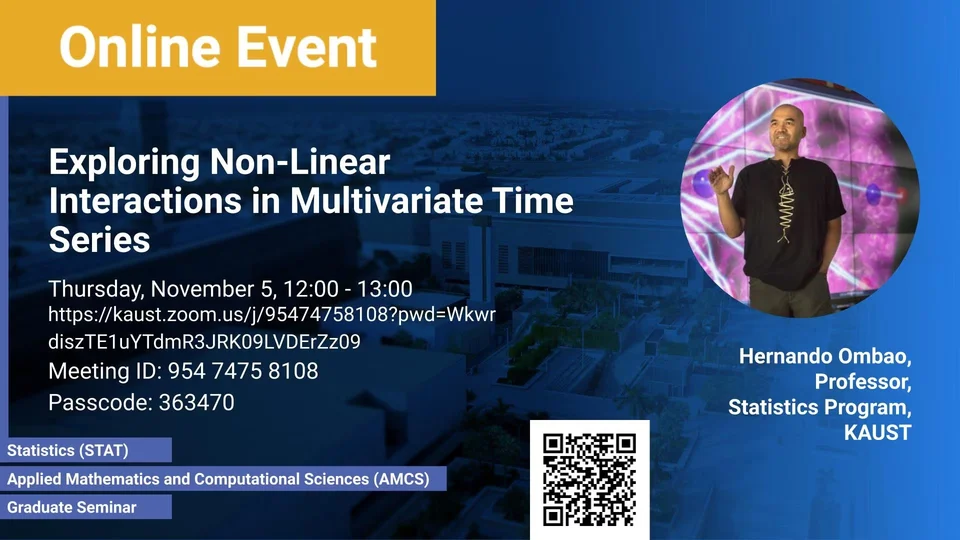
Exploring Non-Linear Interactions in Multivariate Time Series Hernando Ombao, Professor, Statistics Nov 5, 12:00 - 13:00 KAUST Linear Multivariate extremes Bayesian computational statistics Advances in imaging technology have given neuroscientists unprecedented access to examine various facets of how the brain “works”. Brain activity is complex. A full understanding of brain activity requires careful study of its multi-scale spatial-temporal organization (from neurons to regions of interest; and from transient events to long-term temporal dynamics). Motivated by these challenges, we will explore some characterizations of dependence between components of a multivariate time series and then apply these to the study of brain functional connectivity.
Engage ORCID KAUST Repository KAUST Academic Portal ShareClipboard Related Sites Statistics (STAT) Applied Mathematics and Computational Science (AMCS) Bioengineering (BioE) Biostatistics Group (BIOSTATS) Related Content Articles 27 Events 4 Related Links Also view list of Publications on Scopus View list of Publications on Mendeley