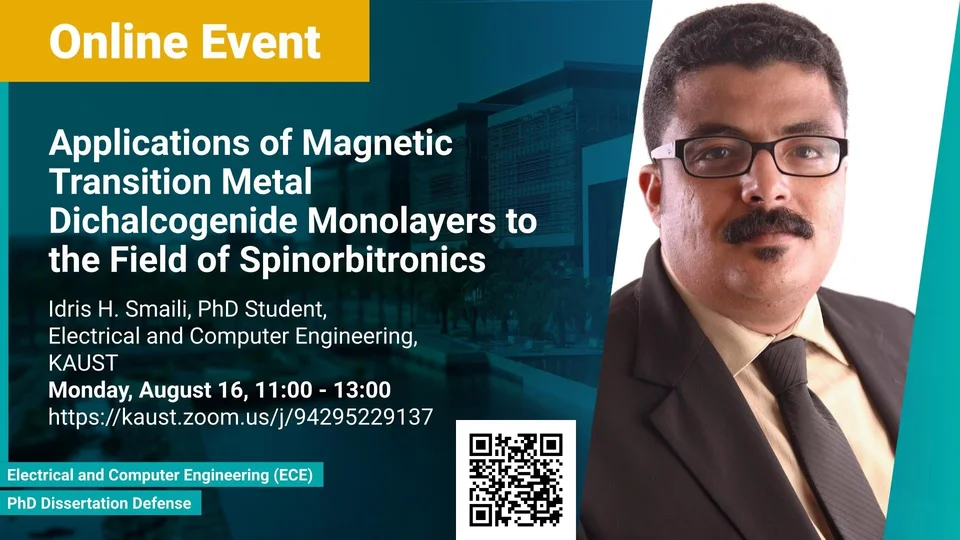
About Idris H. Smaili Idris H. Smaili Ph.D. Student, Electrical and Computer Engineering flexible nanodevices flexible solar cells density functional theory thin films nanomaterials Idris H. Smaili is a Ph.D. student in the electrical and computer engineering program at Computational Physics & Materials Science Lab under the supervision of Prof. Udo Schwingenschlogl at King Abdullah University of Science and Technology (KAUST). Idris obtained his bachelor's degree in Electrical Engineering, Electronics, and Communications from King Abdul-Aziz University (KAU) in Jeddah, Saudi Arabia, in 2007. After that, he joined Rochester Institute of Technology (RIT), Rochester, NY, USA, to receive his master's degree in Microelectronic Engineering in 2014. Idris is a lecturer at the Events Presented Events Aug 15 - Aug 21, 2021 Applications of Magnetic Transition Metal Dichalcogenide Monolayers to the Field of Spinorbitronics Idris H. Smaili, Ph.D. Student, Electrical and Computer Engineering Aug 16, 11:00 - 13:00 KAUST flexible nanodevices flexible solar cells nanomaterials thin films density functional theory Magnetic random access memory (MRAM) devices have been widely studied since the 1960s. During this time, the size of spintronic devices has continued to decrease. Consequently, there is now an urgent need for new low-dimensional magnetic materials to mimic the traditional structures of spintronics at the nanoscale. We also require new effective mechanisms to conduct the main functions of memory devices, which are: reading, writing, and storing data.
Applications of Magnetic Transition Metal Dichalcogenide Monolayers to the Field of Spinorbitronics Idris H. Smaili, Ph.D. Student, Electrical and Computer Engineering Aug 16, 11:00 - 13:00 KAUST flexible nanodevices flexible solar cells nanomaterials thin films density functional theory Magnetic random access memory (MRAM) devices have been widely studied since the 1960s. During this time, the size of spintronic devices has continued to decrease. Consequently, there is now an urgent need for new low-dimensional magnetic materials to mimic the traditional structures of spintronics at the nanoscale. We also require new effective mechanisms to conduct the main functions of memory devices, which are: reading, writing, and storing data.
Related Sites Electrical and Computer Engineering (ECE) Physical Science and Engineering (PSE) Related Content Events 1