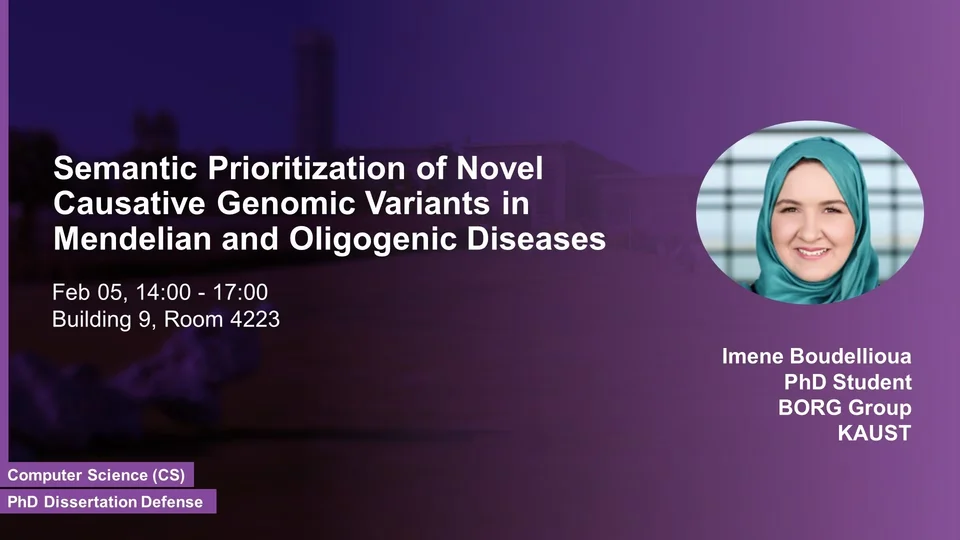
About Imane Boudellioua Imane Boudellioua Ph.D. (former), Computer Science functional prediction machine learning genetic variation variant prioritization Imane Boudellioua obtained her Ph.D. degree in Computer Science under the supervision of Professor Robert Hoehndorf at the Bio-Ontology Research Group (BORG) at King Abdullah University of Science and Technology (KAUST). Imene has a Master's degree in Computer Science from KAUST. During Master's her thesis supervisor was Professor Basem Shihada. Thesis title: " A Vehicular Guidance Wireless Sensor Actuator Network." Research Interests Imane Boudellioua's research interests include the application of machine learning and data mining algorithms for functional annotation of various biological Events Presented Events Feb 3 - Feb 9, 2019 Semantic Prioritization of Novel Causative Genomic Variants in Mendelian and Oligogenic Diseases Imane Boudellioua, Ph.D. (former), Computer Science Feb 5, 14:00 - 17:00 B9 R4223 functional prediction machine learning genetic variation variant prioritization Abstract Recent advances in Next Generation Sequencing (NGS) technologies have facilitated the generation of massive amounts of genomic data which in turn is bringing the promise that personalized medicine will soon become widely available. As a result, there is an increasing pressure to develop computational tools to analyze and interpret genomic data. In this dissertation, we present a systematic approach for interrogating patients' genomes to identify candidate causal genomic variants of Mendelian and oligogenic diseases. To achieve that, we leverage the use of biomedical data available
Semantic Prioritization of Novel Causative Genomic Variants in Mendelian and Oligogenic Diseases Imane Boudellioua, Ph.D. (former), Computer Science Feb 5, 14:00 - 17:00 B9 R4223 functional prediction machine learning genetic variation variant prioritization Abstract Recent advances in Next Generation Sequencing (NGS) technologies have facilitated the generation of massive amounts of genomic data which in turn is bringing the promise that personalized medicine will soon become widely available. As a result, there is an increasing pressure to develop computational tools to analyze and interpret genomic data. In this dissertation, we present a systematic approach for interrogating patients' genomes to identify candidate causal genomic variants of Mendelian and oligogenic diseases. To achieve that, we leverage the use of biomedical data available
Related Sites Bio-Ontology Research Group (BORG) Computer Science (CS) Related Content Articles 7 Projects 2 Events 1 Related Links Also view Publications in the KAUST Repository.