About Luis Espath Luis Espath Postdoctoral Research Fellow, Stochastic Numerics Research Group Fluid Mechanics Continuum Mechanics Luis Espath worked as a Postdoctoral Fellow at Professor Raul F. Tempone's Stochastic Numerics Research Group (STOCHNUM) at King Abdullah University of Science and Technology (KAUST). Research Interests Luis's research interests included Aerodynamic and Structural Shape Optimization, Gravity Currents via Direct Numerical Simulation, Navier-Stokes-Cahn-Hilliard systems, Fluid mechanics, Continuum Mechanics, Solid Mechanics, and Shape Optimization. Selected Publications Clavijo, S. P., A. F. Sarmiento, L. F. R. Espath, Lisandro Dalcin, A. M. A. Cortes, and V. M. Calo. "Reactive n-species Cahn Articles Related News June 2026 Article "Multi-Iteration Stochastic Optimizers" published in Applied Mathematics & Optimization 2 min read · Sun, Jun 14 2026 News The article “ Multi-Iteration Stochastic Optimizers” by André Carlon, Luis Espath, Rafael Holdorf, and Raúl Tempone has been published in Applied Mathematics & Optimization. The paper introduces a new class of first-order stochastic optimization methods based on the Multi-Iteration stochastiC Estimator (MICE). The central idea is to reuse gradient information collected along the optimization path through successive control variates. By exploiting correlations between nearby iterates, MICE reduces the variance of stochastic gradient estimates while keeping the additional sampling cost under August 2022 New preprint available from research on quasi-Newton methods for stochastic optimization 1 min read · Sun, Aug 28 2022 News stochastic optimization Bayesian Estimation machine learning A preprint of a new research project of our group named " Approximating Hessian matrices using Bayesian inference: a new approach for quasi-Newton methods in stochastic optimization" is available at arXiv. The manuscript is authored by André Carlon, Prof. Luis Espath, and Prof. Raúl Tempone. Abstract: Using quasi-Newton methods in stochastic optimization is not a trivial task. In deterministic optimization, these methods are often a common choice due to their excellent performance regardless of the problem's condition number. However, standard quasi-Newton methods fail to extract curvature September 2017 Direct numerical simulation of bi-disperse particle-laden gravity currents in the channel configuration 1 min read · Fri, Sep 15 2017 News numerical simulations We present a numerical investigation of bi-disperse particle-laden gravity currents in the lock-exchange configuration. Previous results, based on numerical simulation and laboratory experiments, are used to establish comparisons.
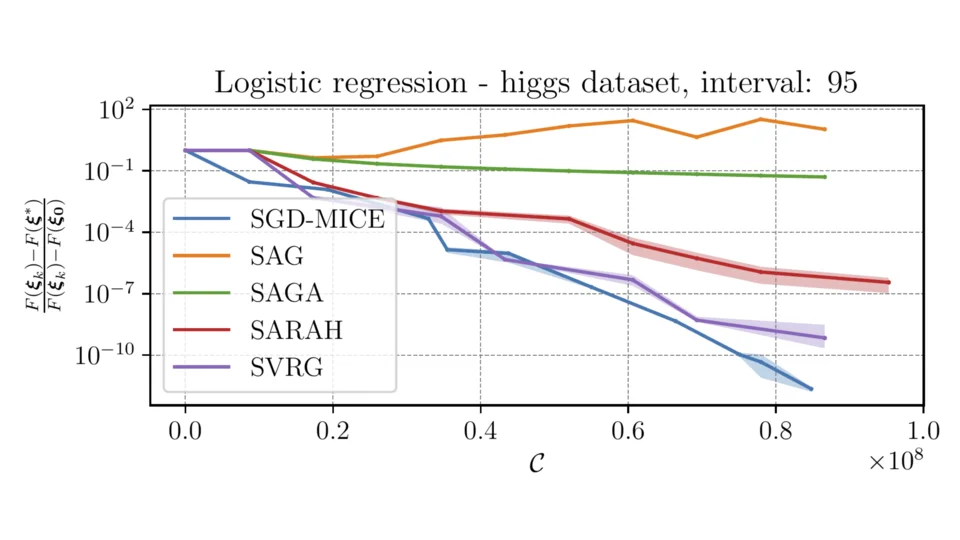
Article "Multi-Iteration Stochastic Optimizers" published in Applied Mathematics & Optimization 2 min read · Sun, Jun 14 2026 News The article “ Multi-Iteration Stochastic Optimizers” by André Carlon, Luis Espath, Rafael Holdorf, and Raúl Tempone has been published in Applied Mathematics & Optimization. The paper introduces a new class of first-order stochastic optimization methods based on the Multi-Iteration stochastiC Estimator (MICE). The central idea is to reuse gradient information collected along the optimization path through successive control variates. By exploiting correlations between nearby iterates, MICE reduces the variance of stochastic gradient estimates while keeping the additional sampling cost under
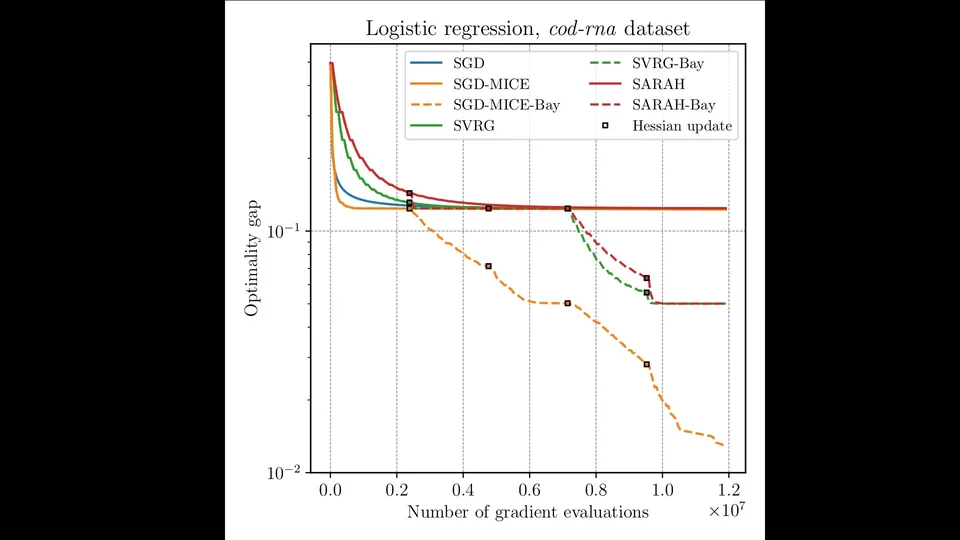
New preprint available from research on quasi-Newton methods for stochastic optimization 1 min read · Sun, Aug 28 2022 News stochastic optimization Bayesian Estimation machine learning A preprint of a new research project of our group named " Approximating Hessian matrices using Bayesian inference: a new approach for quasi-Newton methods in stochastic optimization" is available at arXiv. The manuscript is authored by André Carlon, Prof. Luis Espath, and Prof. Raúl Tempone. Abstract: Using quasi-Newton methods in stochastic optimization is not a trivial task. In deterministic optimization, these methods are often a common choice due to their excellent performance regardless of the problem's condition number. However, standard quasi-Newton methods fail to extract curvature
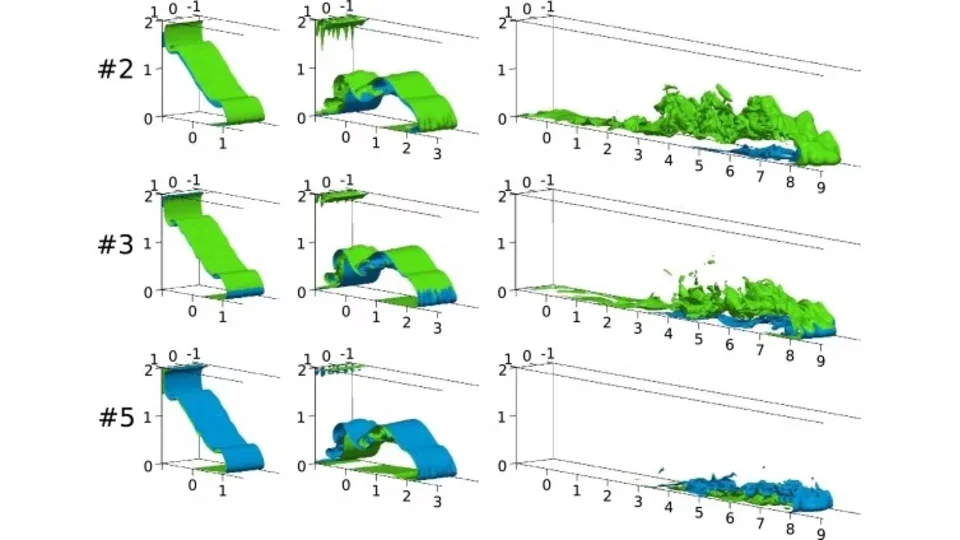
Direct numerical simulation of bi-disperse particle-laden gravity currents in the channel configuration 1 min read · Fri, Sep 15 2017 News numerical simulations We present a numerical investigation of bi-disperse particle-laden gravity currents in the lock-exchange configuration. Previous results, based on numerical simulation and laboratory experiments, are used to establish comparisons.
Related Sites Stochastic Numerics Research Group (STOCHNUM) Applied Mathematics and Computational Science (AMCS) Related Content Articles 3 Related Links Google Scholar Citations Publications list on ResearchGate