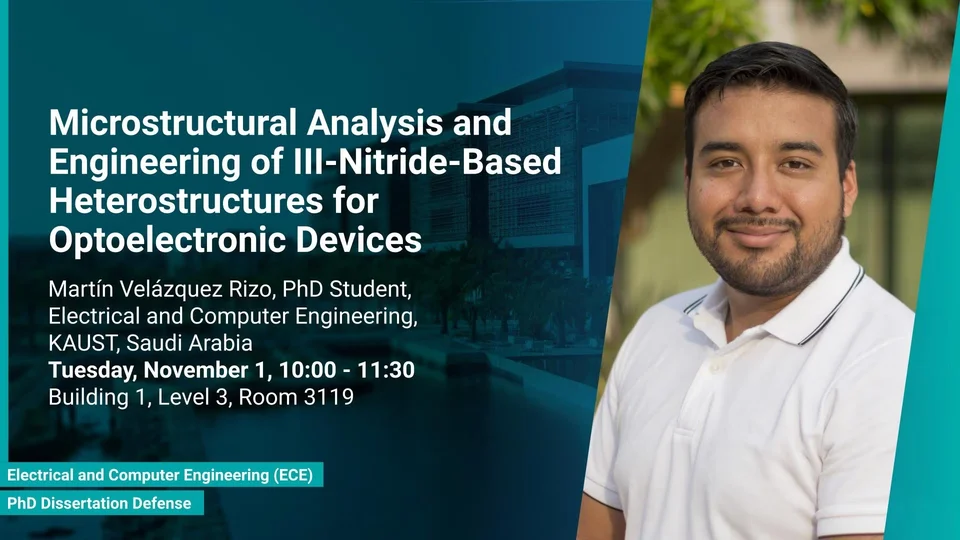
About Martín Velázquez Rizo Martín Velázquez Rizo Ph.D. Student, Electrical and Computer Engineering photocatalytic energy conversion Martín Velázquez Rizo obtained his Master's degree in Electrical Engineering under the supervision of Prof. Hossein Fariborzi at King Abdullah University of Science and Technology (KAUST). Martin has a B. Sc. degree in Physics from the Universidad Nacional Autónoma de México. During his undergraduate studies, he did research in Mexico as well as abroad. At the age of 23, he graduated from College (with honorable mention). One year later he came to KAUST to enroll in the M.S./Ph.D. program in Electrical Engineering. He is deeply interested in the physics behind the electronic devices that Events Presented Events Oct 30 - Nov 5, 2022 Microstructural Analysis and Engineering of III-Nitride-Based Heterostructures for Optoelectronic Devices Martín Velázquez Rizo, Ph.D. Student, Electrical and Computer Engineering Nov 1, 10:00 - 11:30 B1 L3 R3119 photocatalytic energy conversion This dissertation presents a variety of methodological approaches to characterize, from a microstructural point of view, different properties of novel III-nitride-based heterostructures and devices. The results of the various characterizations contributed to developing novel LEDs and photocatalysts. The analyses and results presented in this dissertation strongly relied on the analytical capabilities offered by transmission electron microscopy, which proved to be a convenient and versatile tool for the characterization of many aspects related to the fabrication of III-nitride-based optoelectronic devices.
Microstructural Analysis and Engineering of III-Nitride-Based Heterostructures for Optoelectronic Devices Martín Velázquez Rizo, Ph.D. Student, Electrical and Computer Engineering Nov 1, 10:00 - 11:30 B1 L3 R3119 photocatalytic energy conversion This dissertation presents a variety of methodological approaches to characterize, from a microstructural point of view, different properties of novel III-nitride-based heterostructures and devices. The results of the various characterizations contributed to developing novel LEDs and photocatalysts. The analyses and results presented in this dissertation strongly relied on the analytical capabilities offered by transmission electron microscopy, which proved to be a convenient and versatile tool for the characterization of many aspects related to the fabrication of III-nitride-based optoelectronic devices.
Engage ORCID ShareClipboard Related Sites Electrical and Computer Engineering (ECE) Energy Conversion Devices and Materials Laboratory (ECODEVICES) Related Content Articles 15 Events 1 Related Links Also view Publications in the KAUST Repository.