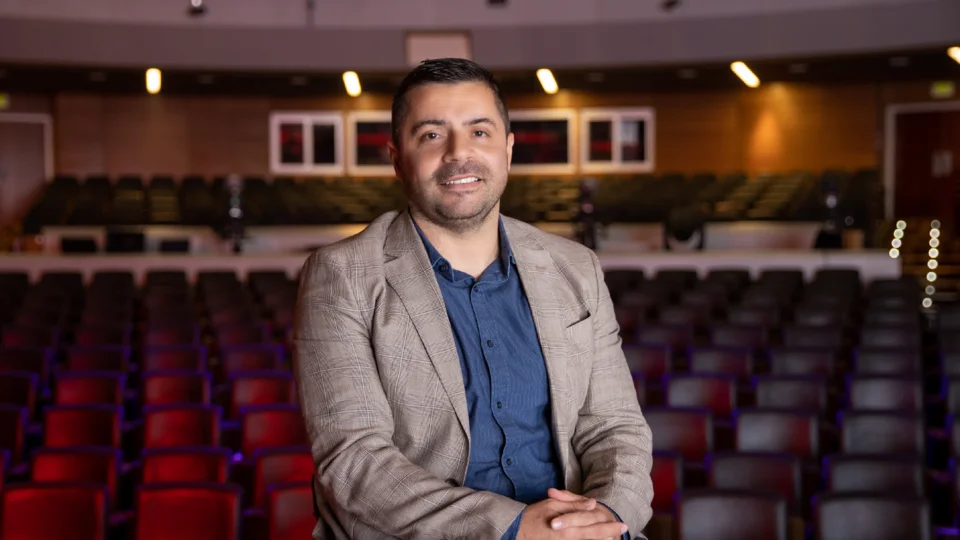
About Matteo Parsani Matteo Parsani Associate Professor, Applied Mathematics and Computational Science Structure-Preserving Algorithms fluid dynamics High Performance Computing Numerical Optimization aeroacoustics Professor Parsani develops robust, variable order and self-adaptive algorithms for solving fluid flow problems in complex geometries. The application domains currently driving Parsani's research are compressible computational aerodynamics, computational aeroacoustics for noise reduction in vehicles and molecular communication. Events Presented Events Apr 2 - Apr 8, 2023 Using the smithy of computational science to enhance the robustness and efficiency of complex fluid flow simulations. Matteo Parsani, Associate Professor, Applied Mathematics and Computational Science Apr 3, 12:00 - 13:00 B9 L3 R3128 This talk will review the recent shift in the construction and modern analysis of a large class of spatially and temporally adaptive methods whose properties are very close to our current analytical knowledge about hyperbolic or mixed hyperbolic-parabolic partial differential equations (PDEs) in computational physics. Thus these algorithms can be regarded as the elite methods in the field. Next, we will show examples of how the robustness and efficiency of the fully-discrete representation of PDEs can be enhanced using computational science's smithy, i.e., "modern" numerical analysis. The talk will showcase complex flow problems in aeronautics, aerospace, and automotive sectors, provide preliminary results in other fields, and present an outlook for future research directions where data science can currently be the linesman. Feb 6 - Feb 12, 2022 Numerical analysis, physics, and high-performance computing: A firm three-hand shake for next-generation predictive computational fluid dynamics frameworks. Matteo Parsani, Associate Professor, Applied Mathematics and Computational Science Feb 6, 14:00 - 16:00 B4 L5 R5220 Together with the algorithm suitability to exploit current petascale and next-generation exascale supercomputers, robust, accurate, and structure-preserving discretizations are necessary for developing predictive computational tools. The research carried out in the Advanced Numerical Algorithms and Numerical Simulations Laboratory (AANSLab) leverages a multidisciplinary platform that integrates numerical analysis, physics, and high-performance computing. In particular, we focus on the analysis and development of novel numerical methods for ordinary and partial differential equations with provable properties such as nonlinear stability and conservation, and structure-preserving techniques. These properties are critical for designing reliable, efficient, and self-adaptive solvers for complex geometries – an essential cornerstone for next-generation computational frameworks. Current classes of partial differential equations that we are working on are the compressible Navier–Stokes equations, the Eulerian model for compressible heat-conducting flows, and the diffusion-reaction and convection-diffusion-reaction equations for molecular communication. We also use deep learning to complement and speed up the process of solving efficiently large-scale PDE-based problems. In this talk, I will summarize the progress we made in the last five years in the following areas: - Numerical analysis and algorithm development for robust, smart compressible flow solvers. - Development from the ground up of a new scalable hp-adaptive computational fluid dynamics (CFD) framework that places KAUST a few years ahead of the NASA CFD 2030 vision: o Applications and impact in the automotive and aerospace industry. o Improving knowledge of flow physics: Examples in detonation and aeroacoustics. - Advection-reaction-diffusion algorithms for molecular communication. Finally, I'll discuss our translational work to solve industrially relevant flow problems in partnership with Boeing, NASA Langley Research Center, and McLaren F1 Racing Team, and my future research plans. Nov 21 - Nov 27, 2021 An efficient high-order reconstructions multidimensional scheme with application to instabilities in direct initiation of gaseous detonations in free space Matteo Parsani, Associate Professor, Applied Mathematics and Computational Science Nov 25, 12:00 - 13:00 KAUST When constructing high-order schemes for solving hyperbolic conservation laws with multi-dimensional finite volume schemes, the corresponding high-order reconstructions are commonly performed in characteristic spaces to eliminate spurious oscillations as much as possible. Sep 6 - Sep 12, 2020 A cheap rotated characteristic decomposition technique for high-order reconstructions in multi-dimensions with application to instabilities in direct initiation of gaseous detonations in free space Matteo Parsani, Associate Professor, Applied Mathematics and Computational Science Sep 10, 12:00 - 13:00 KAUST When constructing high-order schemes for solving hyperbolic conservation laws with multi-dimensional finite volume schemes, the corresponding high-order reconstructions are commonly performed in characteristic spaces to eliminate spurious oscillations as much as possible. For multi-dimensional finite volume schemes, we need to perform the characteristic decomposition several times in different normal directions of the target cell, which is very time-consuming. We propose a rotated characteristic decomposition technique that requires only one-time decomposition for multi-dimensional reconstructions. This technique not only reduces the computational cost remarkably, but also controls spurious oscillations effectively. We take a third-order weighted essentially non-oscillatory finite volume scheme for solving the Euler equations as an example to demonstrate the efficiency of the proposed technique. We apply the new methodology to the simulation of instabilities in direct initiation of gaseous detonations in free space. Feb 9 - Feb 15, 2020 Unveiling the potential of energy/entropy stable numerical methods for hyperbolic/mixed hyperbolic-parabolic PDEs Matteo Parsani, Associate Professor, Applied Mathematics and Computational Science Feb 13, 12:00 - 13:00 B9 L2 H1 algorithm Hyperbolic PDEs PDE parabolic-hyperbolic PDE SBP numerical methods for PDE's Abstract The demand for increasingly multidisciplinary reliable simulations, for both analysis and design optimization purposes, requires transformational advances in individual components of future PDEs solvers. At the algorithmic level, hardware compatibility and efficiency are of paramount importance in determining viability on future hardware. However, equally important (if not more so) is provable algorithmic robustness which becomes progressively more challenging to achieve as problem size and physics complexity increase. We show that rigorously designed adaptive semi- and fully-discrete
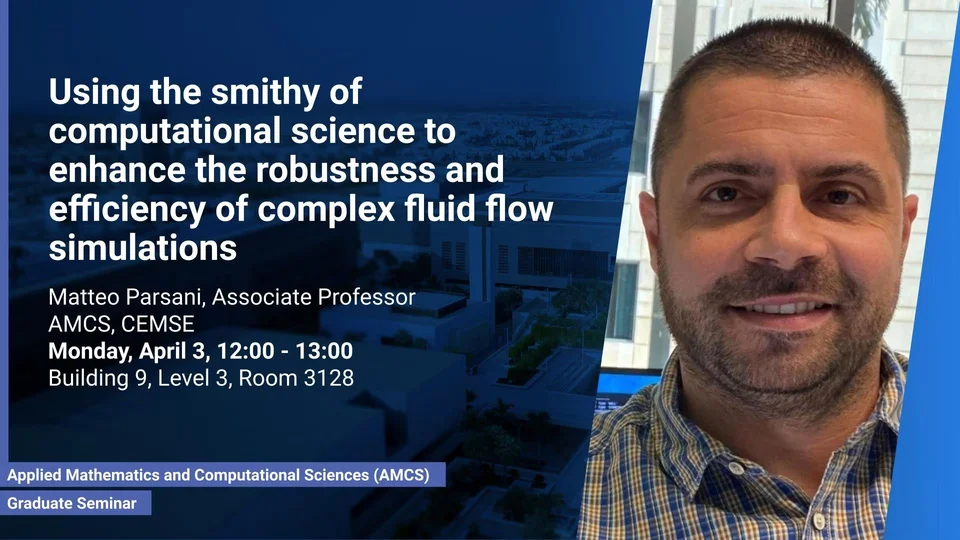
Using the smithy of computational science to enhance the robustness and efficiency of complex fluid flow simulations. Matteo Parsani, Associate Professor, Applied Mathematics and Computational Science Apr 3, 12:00 - 13:00 B9 L3 R3128 This talk will review the recent shift in the construction and modern analysis of a large class of spatially and temporally adaptive methods whose properties are very close to our current analytical knowledge about hyperbolic or mixed hyperbolic-parabolic partial differential equations (PDEs) in computational physics. Thus these algorithms can be regarded as the elite methods in the field. Next, we will show examples of how the robustness and efficiency of the fully-discrete representation of PDEs can be enhanced using computational science's smithy, i.e., "modern" numerical analysis. The talk will showcase complex flow problems in aeronautics, aerospace, and automotive sectors, provide preliminary results in other fields, and present an outlook for future research directions where data science can currently be the linesman.
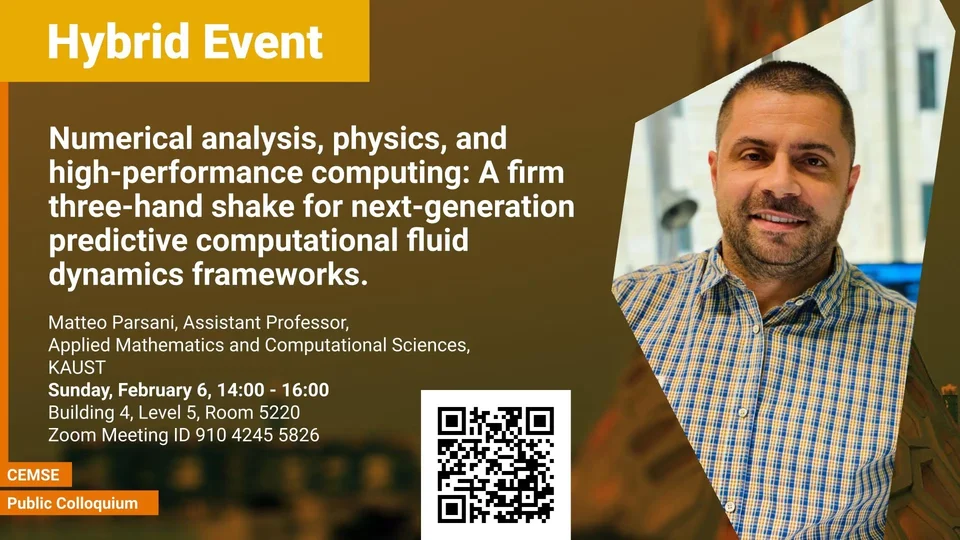
Numerical analysis, physics, and high-performance computing: A firm three-hand shake for next-generation predictive computational fluid dynamics frameworks. Matteo Parsani, Associate Professor, Applied Mathematics and Computational Science Feb 6, 14:00 - 16:00 B4 L5 R5220 Together with the algorithm suitability to exploit current petascale and next-generation exascale supercomputers, robust, accurate, and structure-preserving discretizations are necessary for developing predictive computational tools. The research carried out in the Advanced Numerical Algorithms and Numerical Simulations Laboratory (AANSLab) leverages a multidisciplinary platform that integrates numerical analysis, physics, and high-performance computing. In particular, we focus on the analysis and development of novel numerical methods for ordinary and partial differential equations with provable properties such as nonlinear stability and conservation, and structure-preserving techniques. These properties are critical for designing reliable, efficient, and self-adaptive solvers for complex geometries – an essential cornerstone for next-generation computational frameworks. Current classes of partial differential equations that we are working on are the compressible Navier–Stokes equations, the Eulerian model for compressible heat-conducting flows, and the diffusion-reaction and convection-diffusion-reaction equations for molecular communication. We also use deep learning to complement and speed up the process of solving efficiently large-scale PDE-based problems. In this talk, I will summarize the progress we made in the last five years in the following areas: - Numerical analysis and algorithm development for robust, smart compressible flow solvers. - Development from the ground up of a new scalable hp-adaptive computational fluid dynamics (CFD) framework that places KAUST a few years ahead of the NASA CFD 2030 vision: o Applications and impact in the automotive and aerospace industry. o Improving knowledge of flow physics: Examples in detonation and aeroacoustics. - Advection-reaction-diffusion algorithms for molecular communication. Finally, I'll discuss our translational work to solve industrially relevant flow problems in partnership with Boeing, NASA Langley Research Center, and McLaren F1 Racing Team, and my future research plans.
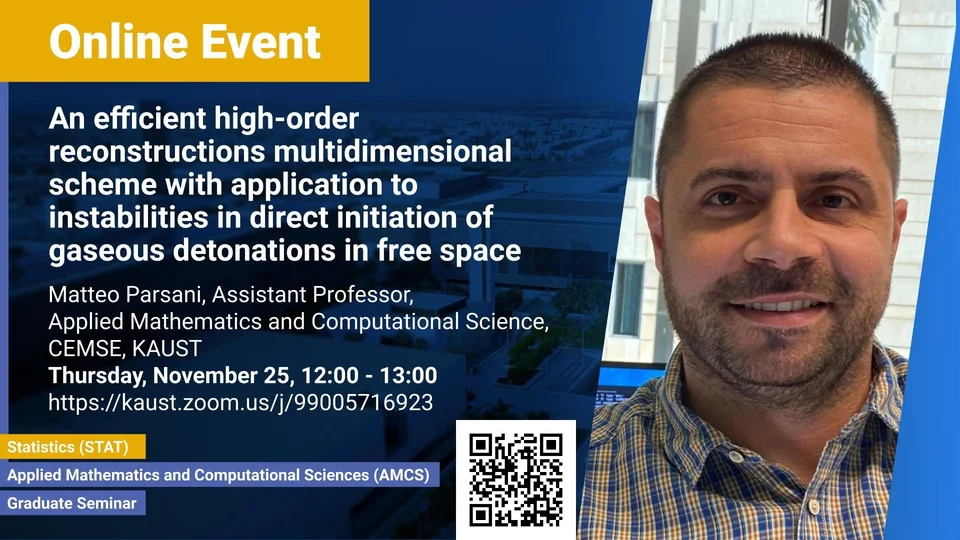
An efficient high-order reconstructions multidimensional scheme with application to instabilities in direct initiation of gaseous detonations in free space Matteo Parsani, Associate Professor, Applied Mathematics and Computational Science Nov 25, 12:00 - 13:00 KAUST When constructing high-order schemes for solving hyperbolic conservation laws with multi-dimensional finite volume schemes, the corresponding high-order reconstructions are commonly performed in characteristic spaces to eliminate spurious oscillations as much as possible.
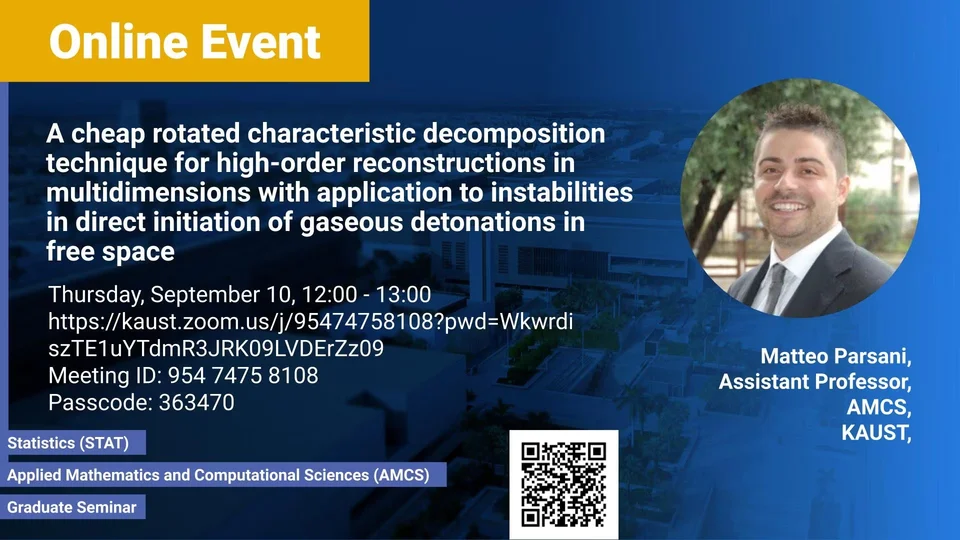
A cheap rotated characteristic decomposition technique for high-order reconstructions in multi-dimensions with application to instabilities in direct initiation of gaseous detonations in free space Matteo Parsani, Associate Professor, Applied Mathematics and Computational Science Sep 10, 12:00 - 13:00 KAUST When constructing high-order schemes for solving hyperbolic conservation laws with multi-dimensional finite volume schemes, the corresponding high-order reconstructions are commonly performed in characteristic spaces to eliminate spurious oscillations as much as possible. For multi-dimensional finite volume schemes, we need to perform the characteristic decomposition several times in different normal directions of the target cell, which is very time-consuming. We propose a rotated characteristic decomposition technique that requires only one-time decomposition for multi-dimensional reconstructions. This technique not only reduces the computational cost remarkably, but also controls spurious oscillations effectively. We take a third-order weighted essentially non-oscillatory finite volume scheme for solving the Euler equations as an example to demonstrate the efficiency of the proposed technique. We apply the new methodology to the simulation of instabilities in direct initiation of gaseous detonations in free space.
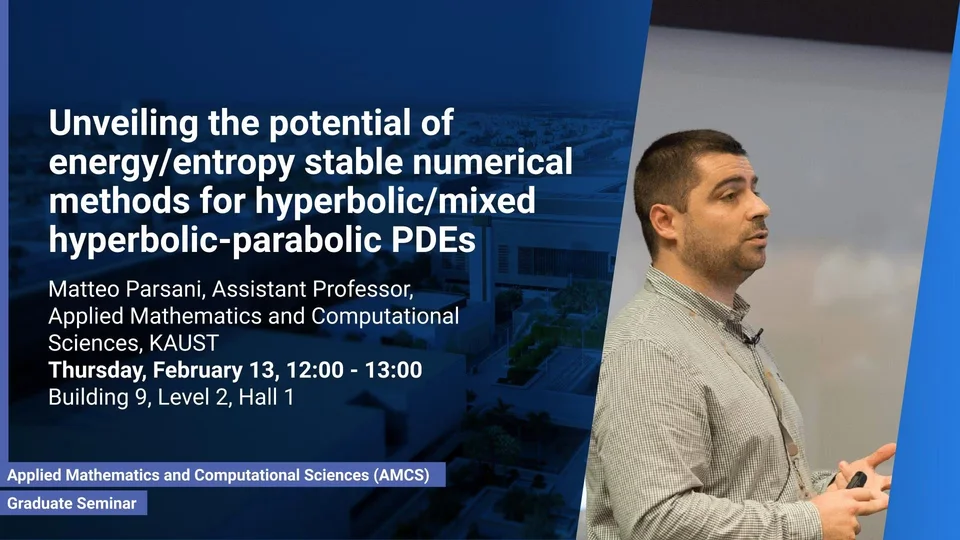
Unveiling the potential of energy/entropy stable numerical methods for hyperbolic/mixed hyperbolic-parabolic PDEs Matteo Parsani, Associate Professor, Applied Mathematics and Computational Science Feb 13, 12:00 - 13:00 B9 L2 H1 algorithm Hyperbolic PDEs PDE parabolic-hyperbolic PDE SBP numerical methods for PDE's Abstract The demand for increasingly multidisciplinary reliable simulations, for both analysis and design optimization purposes, requires transformational advances in individual components of future PDEs solvers. At the algorithmic level, hardware compatibility and efficiency are of paramount importance in determining viability on future hardware. However, equally important (if not more so) is provable algorithmic robustness which becomes progressively more challenging to achieve as problem size and physics complexity increase. We show that rigorously designed adaptive semi- and fully-discrete
Engage KAUST Repository KAUST Academic Portal ORCID Scopus LinkedIn ShareClipboard Related Sites Applied Mathematics and Computational Science (AMCS) Computer Science (CS) Mechanical Engineering (ME) Center of Excellence for Generative AI (GenAI) Flow Simulation at the Exascale (Exaflow) Advanced Algorithm and Numerical Simulations Laboratory (AANSLab) Related Content Articles 15 Events 5