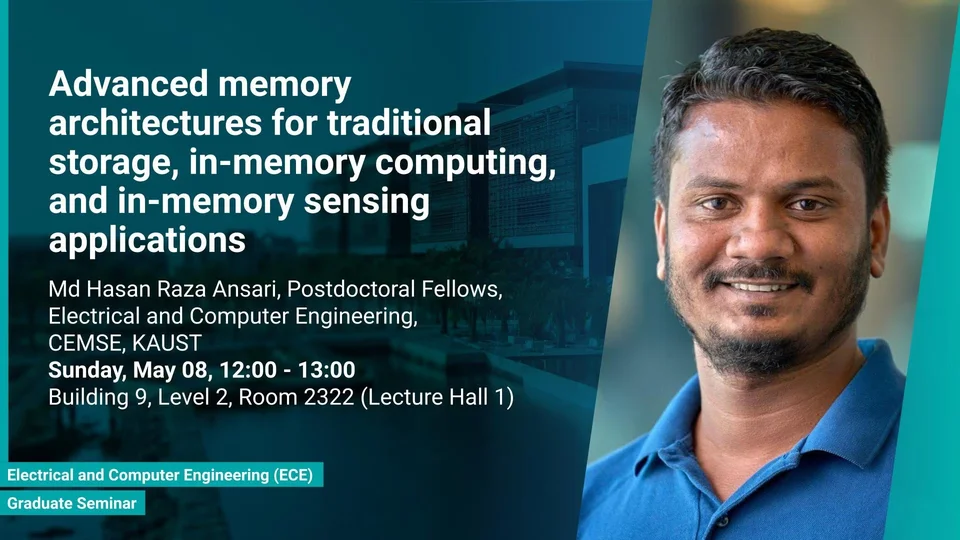
About MD Hasan Raza Ansari MD Hasan Raza Ansari Postdoctoral Research Fellow, Electrical and Computer Engineering logic devices emerging memory devices neuromorphic devices Dr. Hasan Ansari is a Postdoctoral Research Fellow working with Professor Nazek El-Atab in the Computer, Electrical and Mathematical Sciences and Engineering (CEMSE) division at King Abdullah University of Science and Technology (KAUST). Education and Early Career Dr. Hasan Ansari (Member, IEEE) received the M.Tech. degree in nanotechnology from the Vellore Institute of Technology (VIT), Vellore, India, in 2016, and a PhD in electrical engineering from the Indian Institute of Technology (IIT), Indore, India, in 2019. After his Ph.D., he worked as a postdoctoral fellow at Gachon University Events Presented Events May 8 - May 14, 2022 Advanced memory architectures for traditional storage, in-memory computing, and in-memory sensing applications MD Hasan Raza Ansari, Postdoctoral Research Fellow, Electrical and Computer Engineering May 8, 12:00 - 13:00 B9 L2 R2322 H1 In-memory computing Since Moore's law is facing several bottlenecks, electron devices are currently developing toward the trend of “More than Moore” which is based on functional diversification in terms of sensing, storage, and processing of information.
Advanced memory architectures for traditional storage, in-memory computing, and in-memory sensing applications MD Hasan Raza Ansari, Postdoctoral Research Fellow, Electrical and Computer Engineering May 8, 12:00 - 13:00 B9 L2 R2322 H1 In-memory computing Since Moore's law is facing several bottlenecks, electron devices are currently developing toward the trend of “More than Moore” which is based on functional diversification in terms of sensing, storage, and processing of information.
Related Sites Electrical and Computer Engineering (ECE) Smart, Advanced Memory devices and Applications lab (SAMA) Related Content Events 1 Related Links J1. Vertically Stacked Nanosheet FET: ChargeTrapping Memory and Synapse With Linear Weight Adjustability for Neuromorphic Computing Applications C1. Comparative Analysis of Vertically Stacked Nanosheet FET based SONOS Memory C2. Optimization of Performance Metrics of Charge Trapping Synaptic Device for Neuromorphic Applications C3. Mimicking Synaptic Behaviors with Junctionless Transistor for Low Power Neuromorphic Computing J2. Silicon Nanowire Charge Trapping Memory for Energy-Efficient Neuromorphic Computing C4. Long-Term Potentiation and Depression with Vertically Stacked Nanosheet FET C5. A Novel Wavy Channel Gate-All-Around FETs for Next-Generation CMOS Applications C6. How to Control the State Transformation from Short-Term Potentiation to Long-Term Potentiation of Charge Trapping Synapse? J3. Nano-scale charge trapping memory based on two-dimensional conjugated microporous polymer C7. Single-Body-Integrated Complementary Tunneling Field-Effect Transistor (SBI CTFET) and Design Consideration of Processing Margin in Dual-Gate Formation J4. Engineered Vertically Stacked NSFET Charge-Trapping Synapse for Neuromorphic Applications J5. Efficient Implementation of Boolean Logic Functions Using Double Gate Charge-Trapping Memory for In-Memory Computing LinkedIn ReaseachGate Google Scholar