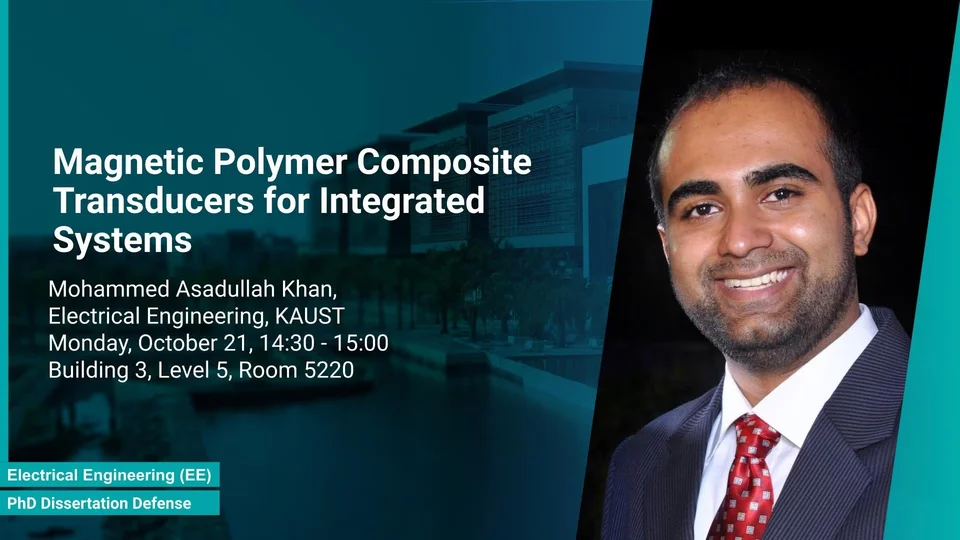
About Mohammed Asadullah Khan Mohammed Asadullah Khan Ph.D., Electrical and Computer Engineering MEMS transducers composite magnets Mohammed Asadullah Khan received the B.E. degree from Osmania University, Hyderabad, India, in 2008, and the M.E. degree from the Indian Institute of Science, Bangalore, India, in 2010. He was a Design Engineer with Intel Integrated Platform Research Labs from 2010 to 2013. He is currently pursuing a Ph.D. degree in electrical engineering from the Sensing, Magnetism, and Microsystems Group, under the supervision of Prof. Jürgen Kosel. He has co-authored 11 journal articles after joining KAUST. Also, while working at KAUST, he presented his research at various international conferences. He is Events Presented Events Oct 20 - Oct 26, 2019 Magnetic Polymer Composite Transducers for Integrated Systems Mohammed Asadullah Khan, Ph.D., Electrical and Computer Engineering Oct 21, 14:30 - 15:30 B3 L5 R5220 Compact, autonomous computing systems with integrated transducers are imperative to deliver advances in healthcare, navigation, livestock monitoring, point of care diagnostics, remote sensing, internet-of-things applications, smart cities etc. Reflecting this need, there has been sustained growth in the market for transducers. Polymer based transducers, which meld highly desirable properties such as low cost, light weight, high manufacturability, biocompatibility and flexibility, are quite attractive. Doping polymers with magnetic materials results in the formation of magnetic composite polymers, enhancing the attractive traits of polymer transducers with magnetic properties. This dissertation is dedicated to the development of magnetic polymer transducers, which are suitable for energy harvesting and saline fluid transduction.
Magnetic Polymer Composite Transducers for Integrated Systems Mohammed Asadullah Khan, Ph.D., Electrical and Computer Engineering Oct 21, 14:30 - 15:30 B3 L5 R5220 Compact, autonomous computing systems with integrated transducers are imperative to deliver advances in healthcare, navigation, livestock monitoring, point of care diagnostics, remote sensing, internet-of-things applications, smart cities etc. Reflecting this need, there has been sustained growth in the market for transducers. Polymer based transducers, which meld highly desirable properties such as low cost, light weight, high manufacturability, biocompatibility and flexibility, are quite attractive. Doping polymers with magnetic materials results in the formation of magnetic composite polymers, enhancing the attractive traits of polymer transducers with magnetic properties. This dissertation is dedicated to the development of magnetic polymer transducers, which are suitable for energy harvesting and saline fluid transduction.
Related Sites Electrical and Computer Engineering (ECE) Related Content Events 1 Related Links Research gate Google Scholar