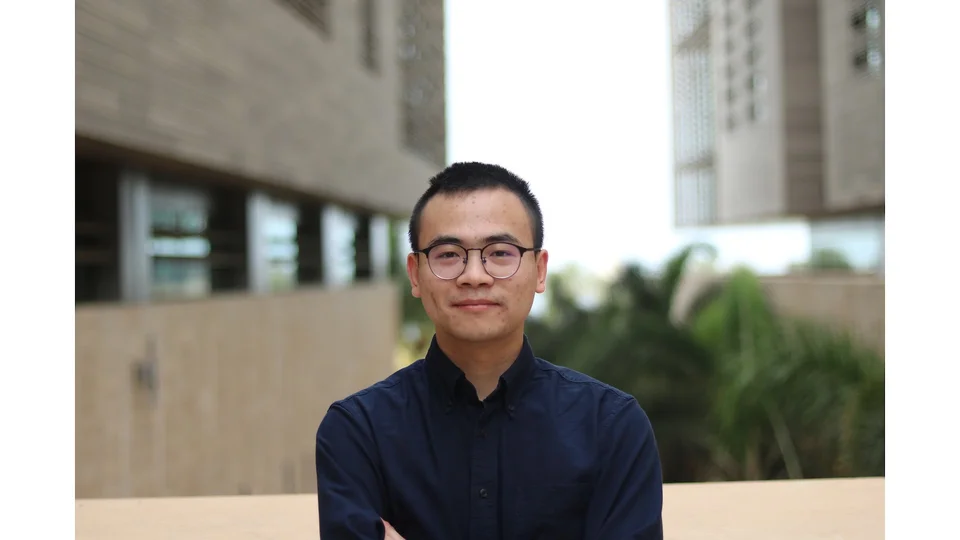
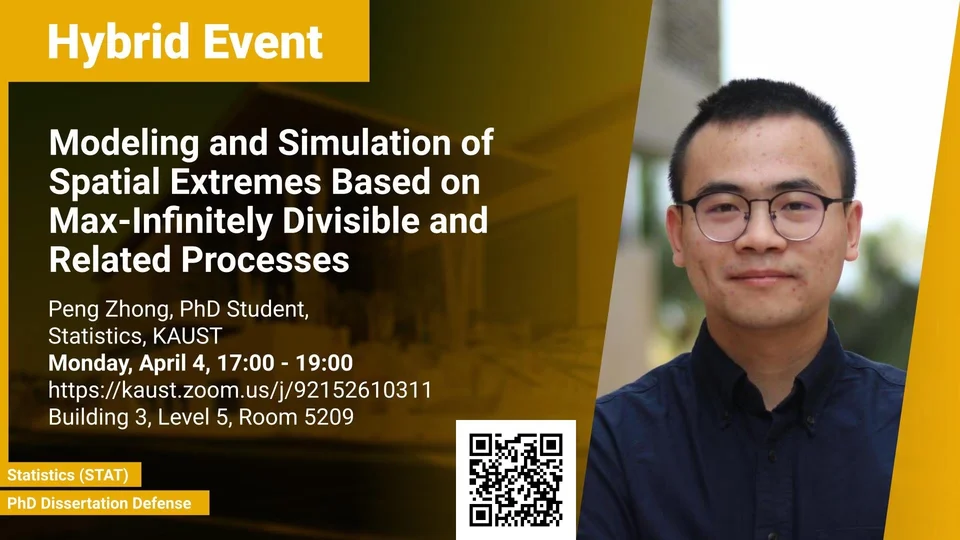
About Peng Zhong Peng Zhong Ph.D. Student, Statistics spatial statistics extreme-value theory spatio-temporal statistics computational statistics Peng Zhong was a Ph.D. student in Statistics at the King Abdullah University of Science and Technology (KAUST), under the supervision of Prof. Raphaël Huser. Peng successfully defended his PhD thesis entitled " Modeling and Simulation of Spatial Extremes Based on Max-Infinitely Divisible and Related Processes" on April 4th, 2022; see his PhD thesis here. His PhD committee was composed of Professors Raphaël Huser (chair), Daniel Cooley (external examiner from Colorado State University, US), Marc Genton, and Ajay Jasra. For his next career steps, Peng has accepted a postdoctoral fellowship Events Presented Events Apr 3 - Apr 9, 2022 Modeling and Simulation of Spatial Extremes Based on Max-Infinitely Divisible and Related Processes Peng Zhong, Ph.D. Student, Statistics Apr 4, 17:00 - 19:00 B3 L5 R5209 The statistical modeling of extreme natural hazards is becoming increasingly important due to climate change, whose effects have been increasingly visible throughout the last decades. It is thus crucial to understand the dependence structure of rare, high-impact events over space and time for realistic risk assessment. For spatial extremes, max-stable processes have played a central role in modeling block maxima. However, the spatial tail dependence strength is persistent across quantile levels in those models, which is often not realistic in practice. This lack of flexibility implies that max-stable processes cannot capture weakening dependence at increasingly extreme levels, resulting in a drastic overestimation of joint tail risk.
Modeling and Simulation of Spatial Extremes Based on Max-Infinitely Divisible and Related Processes Peng Zhong, Ph.D. Student, Statistics Apr 4, 17:00 - 19:00 B3 L5 R5209 The statistical modeling of extreme natural hazards is becoming increasingly important due to climate change, whose effects have been increasingly visible throughout the last decades. It is thus crucial to understand the dependence structure of rare, high-impact events over space and time for realistic risk assessment. For spatial extremes, max-stable processes have played a central role in modeling block maxima. However, the spatial tail dependence strength is persistent across quantile levels in those models, which is often not realistic in practice. This lack of flexibility implies that max-stable processes cannot capture weakening dependence at increasingly extreme levels, resulting in a drastic overestimation of joint tail risk.
Engage ORCID ShareClipboard Related Sites Extreme Statistics (XSTAT) Statistics (STAT) Related Content Articles 8 Events 1 Related Links https://pangchung.github.io/