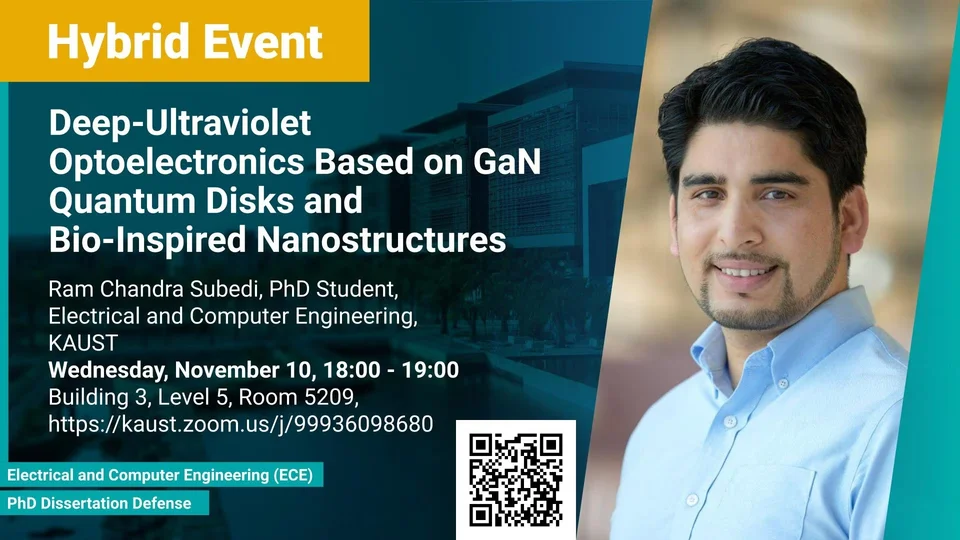
About Ram Chandra Subedi Ram Chandra Subedi Ph.D. Student, Electrical and Computer Engineering semiconductors Deep UV optoelectronic devices Bio-inspired luminescent material Ram Chandra Subedi (RC) is a Ph.D. student at Photonics Lab under the supervision of Professor Boon Ooi at King Abdullah University of Science and Technology (KAUST). He received his B.Sc. and M.Sc. in Physics from Tribhuvan University, Nepal in 2009 and 2011 respectively. In addition, he received his M.S. in the Experimental Condensed Matter Physics University of Georgia, Athens (UGA in 2016). During his stay at UGA, he worked as a Teaching/Research Assistant. His research at UGA was primarily focused on polymer/ small molecule-based Organic Light-Emitting Diodes (OLEDs) and Organic Spin Events Presented Events Nov 7 - Nov 13, 2021 Deep-Ultraviolet Optoelectronics Based on GaN Quantum Disks and Bio-Inspired Nanostructures Ram Chandra Subedi, Ph.D. Student, Electrical and Computer Engineering Nov 10, 18:00 - 19:00 B3 L5 R5209 Optoelectronics in the deep-ultraviolet (DUV) regime is still a growing research field that requires significant effort to understand the material properties and optimize the device structures to realize highly efficient DUV devices. Of all the wide bandgap materials, AlGaN is perhaps the most studied semiconductor to replace the environmentally hazardous mercury lamps; however, the external quantum efficiency (EQE) of AlGaN based DUV devices is insufficient to replace the existing old-fashioned mercury UV lamps.
Deep-Ultraviolet Optoelectronics Based on GaN Quantum Disks and Bio-Inspired Nanostructures Ram Chandra Subedi, Ph.D. Student, Electrical and Computer Engineering Nov 10, 18:00 - 19:00 B3 L5 R5209 Optoelectronics in the deep-ultraviolet (DUV) regime is still a growing research field that requires significant effort to understand the material properties and optimize the device structures to realize highly efficient DUV devices. Of all the wide bandgap materials, AlGaN is perhaps the most studied semiconductor to replace the environmentally hazardous mercury lamps; however, the external quantum efficiency (EQE) of AlGaN based DUV devices is insufficient to replace the existing old-fashioned mercury UV lamps.
Engage ORCID ShareClipboard Related Sites Electrical and Computer Engineering (ECE) Photonics Laboratory (Photonics) Related Content Articles 2 Events 1 Related Links View Publications in the KAUST Repository. View Publications on ORCID View Publications on ResearchGate Downloadable CV Link to Publons Link to Google Scholar LinkedIn