About Raphaël Huser Raphaël Huser Associate Professor, Statistics Statistics of extremes extreme-value theory spatio-temporal statistics data science machine learning copulas Environmental Statistics geostatistics applications to finance applications to neuroscience Professor Huser develops novel statistical methodology and machine learning solutions to model and predict extreme events in various applications ranging from climate and earth sciences to finance and neuroscience. Events Presented Events Sep 14 - Sep 20, 2025 Neural Methods for Amortized Inference with Models for Spatial Extremes Raphaël Huser, Associate Professor, Statistics Sep 18, 12:00 - 13:00 B9, L2, R2325 Neural Bayes estimators are neural networks that approximate Bayes estimators. Once trained, these estimators are not only statistically efficient, but also extremely fast to evaluate and amenable to rapid uncertainty quantification. Neural Bayes estimators thus have compelling advantages when used with spatial models that have a computationally intractable likelihood function, as often the case when modeling spatial extremes. In this talk, I will showcase the power of neural Bayes estimators for spatial extremes in a range of climate-related and geo-environmental data applications. Apr 28 - May 4, 2024 Statistical Deep-Learning for Spatiotemporal Extremes Raphaël Huser, Associate Professor, Statistics May 2, 12:00 - 13:00 B9 L2 H2 H2 Rare, low-probability events often lead to the biggest impacts. Therefore, the development of statistical approaches for modeling, predicting and quantifying environmental risks associated with natural hazards is of utmost importance. In this seminar, I will show how statistical deep-learning methods can help solve challenges that arise when modeling complex and massive spatiotemporal extremes data. Nov 27 - Dec 3, 2022 A unifying partially-interpretable framework for neural network-based extreme quantile regression Raphaël Huser, Associate Professor, Statistics Nov 29, 12:00 - 13:00 B9 L2 R2322 Artificial Neural Network quantile regression In this paper, we propose a new methodological framework for performing extreme quantile regression using artificial neural networks, which are able to capture complex non-linear relationships and scale well to high-dimensional data. Feb 20 - Feb 26, 2022 Extreme Statistics: Theory and Methods for Modeling Rare High-Impact Events in Complex Settings Raphaël Huser, Associate Professor, Statistics Feb 20, 16:00 - 17:30 B4 B5 A0215 Rare, low-probability events often lead to the biggest impacts. The goal of the Extreme Statistics (extSTAT) research group at KAUST is to develop cutting-edge statistical approaches for modeling, predicting and quantifying risks associated with these extreme events in complex systems arising in various scientific fields, such as climate science and finance. In particular, the work that we develop and continue to refine has a direct potential impact to climate scientists and related stakeholders, such as engineers and insurers, who have realized that under climate change, the greatest environmental, ecological, and infrastructural risks and damages, are often caused by changes in the intensity, frequency, spatial extent, and persistence of extreme events, rather than changes in their average behavior. However, while datasets are often massive in modern day applications, extreme events are always scarce by nature. This makes it very challenging to provide reliable risk assessment and prediction, especially when extrapolation to yet-unseen levels is required. To overcome these existing limitations, the extSTAT research group develops novel methods that transcend classical extreme-value theory to build new resilient statistical models, as well as computationally efficient inference methods, which improve the prediction of rare events in complex, high-dimensional, spatio-temporal, non-stationary settings. In this talk, I will provide an overview of my group's recent research activities and future directions with a focus on core statistical methodology contributions. The technical part of the talk will describe selected research highlights, which include (but are not limited to) the development of new flexible sub-asymptotic models applied to assessing contagion risk among leading cryptocurrencies, the development of a novel low-rank spatial modeling framework applied to estimating extreme hotspots in high-resolution Red Sea surface temperature data, and the development specialized spatio-temporal point process models applied to predicting devastating rainfall-induced landslides in a region of Italy. I will conclude my talk with an outlook on my future research plans. Motivated by methodological obstacles that arise with “big models” for complex extremes data, as well as new substantive challenges in collaborative work at KAUST, we will embark on the development of fundamentally superior models that have an intrinsically sparse probabilistic structure, as well as new "hybrid" methods that combine the strength of (parametric) models from extreme-value theory with the pragmatism and predictive power of (nonparametric) machine learning algorithms, thus opening the door to interpretable and “extreme-ly” accurate predictive models for rare events in unprecedented dimensions. Aug 29 - Sep 4, 2021 High-resolution Modeling and Estimation of Extreme Red Sea Surface Temperature Hotspots Raphaël Huser, Associate Professor, Statistics Sep 2, 12:00 - 13:00 KAUST Modeling, estimation and prediction of spatial extremes is key for risk assessment in a wide range of geo-environmental, geo-physical, and climate science applications. In this work, we propose a flexible approach for modeling and estimating extreme sea surface temperature (SST) hotspots, i.e., high threshold exceedance regions, for the whole Red Sea, a vital region of high biodiversity. Sep 22 - Sep 28, 2019 Statistics of Extremes Raphaël Huser, Associate Professor, Statistics Sep 26, 12:00 - 13:00 B9 L2 H1 R2322 extreme environmental events probabilities risks univariate extremes Spatial extremes Extreme environmental events such as droughts, floods and heat-waves take place in space and time, and it is necessary to take this into account when evaluating their risks and estimating their probabilities. During this seminar, I will review some classical and more recent work on this topic, focusing on the modeling of univariate and spatial extremes. The ideas will be illustrated by applications to peak river flow data from the UK, and heavy rainfall close to Jeddah.
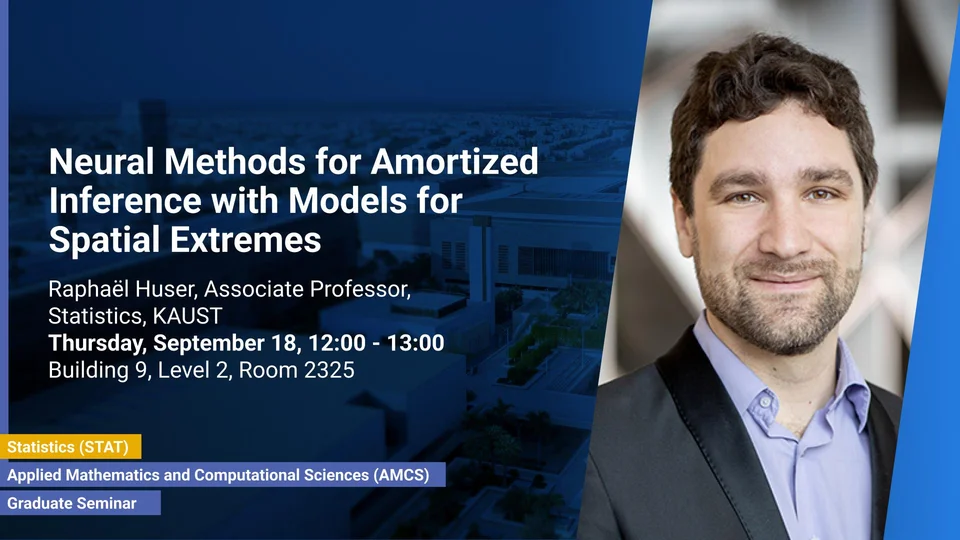
Neural Methods for Amortized Inference with Models for Spatial Extremes Raphaël Huser, Associate Professor, Statistics Sep 18, 12:00 - 13:00 B9, L2, R2325 Neural Bayes estimators are neural networks that approximate Bayes estimators. Once trained, these estimators are not only statistically efficient, but also extremely fast to evaluate and amenable to rapid uncertainty quantification. Neural Bayes estimators thus have compelling advantages when used with spatial models that have a computationally intractable likelihood function, as often the case when modeling spatial extremes. In this talk, I will showcase the power of neural Bayes estimators for spatial extremes in a range of climate-related and geo-environmental data applications.
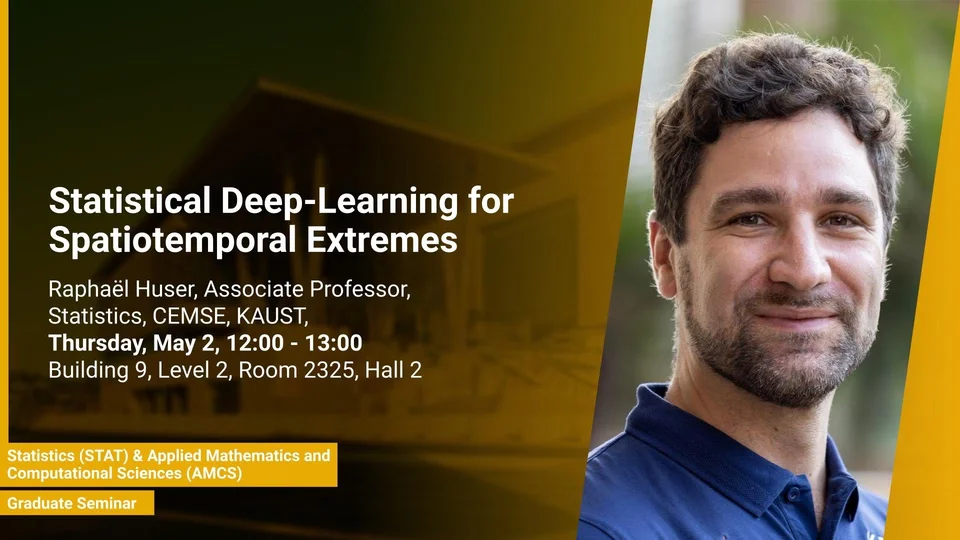
Statistical Deep-Learning for Spatiotemporal Extremes Raphaël Huser, Associate Professor, Statistics May 2, 12:00 - 13:00 B9 L2 H2 H2 Rare, low-probability events often lead to the biggest impacts. Therefore, the development of statistical approaches for modeling, predicting and quantifying environmental risks associated with natural hazards is of utmost importance. In this seminar, I will show how statistical deep-learning methods can help solve challenges that arise when modeling complex and massive spatiotemporal extremes data.
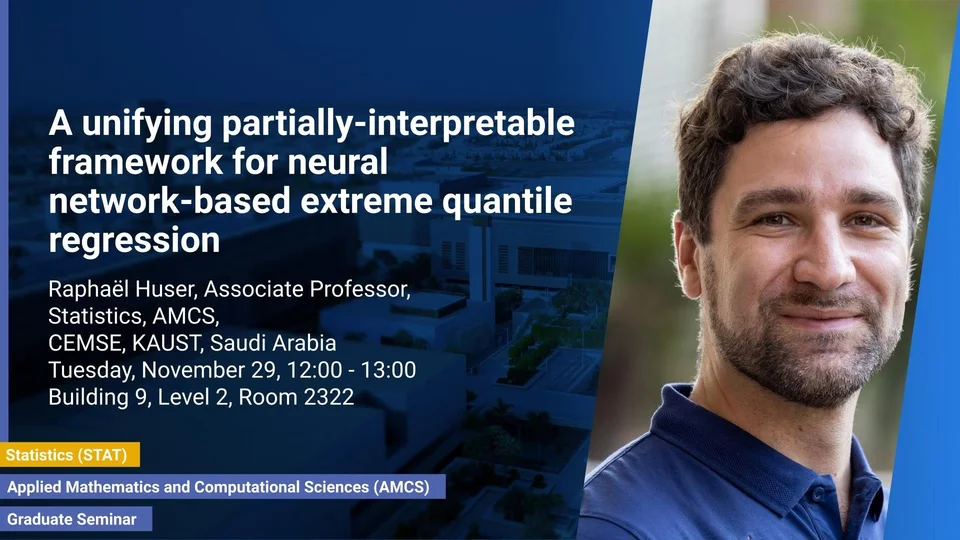
A unifying partially-interpretable framework for neural network-based extreme quantile regression Raphaël Huser, Associate Professor, Statistics Nov 29, 12:00 - 13:00 B9 L2 R2322 Artificial Neural Network quantile regression In this paper, we propose a new methodological framework for performing extreme quantile regression using artificial neural networks, which are able to capture complex non-linear relationships and scale well to high-dimensional data.
Extreme Statistics: Theory and Methods for Modeling Rare High-Impact Events in Complex Settings Raphaël Huser, Associate Professor, Statistics Feb 20, 16:00 - 17:30 B4 B5 A0215 Rare, low-probability events often lead to the biggest impacts. The goal of the Extreme Statistics (extSTAT) research group at KAUST is to develop cutting-edge statistical approaches for modeling, predicting and quantifying risks associated with these extreme events in complex systems arising in various scientific fields, such as climate science and finance. In particular, the work that we develop and continue to refine has a direct potential impact to climate scientists and related stakeholders, such as engineers and insurers, who have realized that under climate change, the greatest environmental, ecological, and infrastructural risks and damages, are often caused by changes in the intensity, frequency, spatial extent, and persistence of extreme events, rather than changes in their average behavior. However, while datasets are often massive in modern day applications, extreme events are always scarce by nature. This makes it very challenging to provide reliable risk assessment and prediction, especially when extrapolation to yet-unseen levels is required. To overcome these existing limitations, the extSTAT research group develops novel methods that transcend classical extreme-value theory to build new resilient statistical models, as well as computationally efficient inference methods, which improve the prediction of rare events in complex, high-dimensional, spatio-temporal, non-stationary settings. In this talk, I will provide an overview of my group's recent research activities and future directions with a focus on core statistical methodology contributions. The technical part of the talk will describe selected research highlights, which include (but are not limited to) the development of new flexible sub-asymptotic models applied to assessing contagion risk among leading cryptocurrencies, the development of a novel low-rank spatial modeling framework applied to estimating extreme hotspots in high-resolution Red Sea surface temperature data, and the development specialized spatio-temporal point process models applied to predicting devastating rainfall-induced landslides in a region of Italy. I will conclude my talk with an outlook on my future research plans. Motivated by methodological obstacles that arise with “big models” for complex extremes data, as well as new substantive challenges in collaborative work at KAUST, we will embark on the development of fundamentally superior models that have an intrinsically sparse probabilistic structure, as well as new "hybrid" methods that combine the strength of (parametric) models from extreme-value theory with the pragmatism and predictive power of (nonparametric) machine learning algorithms, thus opening the door to interpretable and “extreme-ly” accurate predictive models for rare events in unprecedented dimensions.
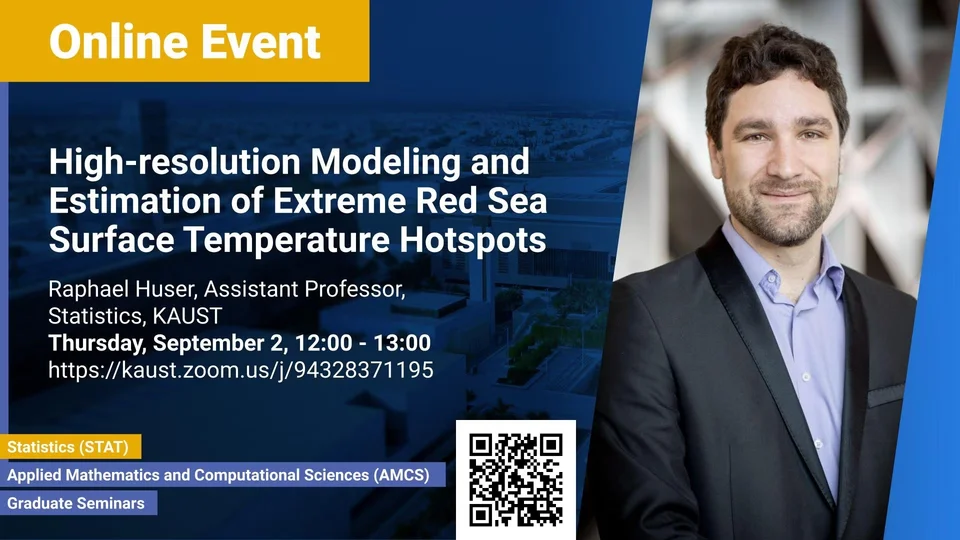
High-resolution Modeling and Estimation of Extreme Red Sea Surface Temperature Hotspots Raphaël Huser, Associate Professor, Statistics Sep 2, 12:00 - 13:00 KAUST Modeling, estimation and prediction of spatial extremes is key for risk assessment in a wide range of geo-environmental, geo-physical, and climate science applications. In this work, we propose a flexible approach for modeling and estimating extreme sea surface temperature (SST) hotspots, i.e., high threshold exceedance regions, for the whole Red Sea, a vital region of high biodiversity.
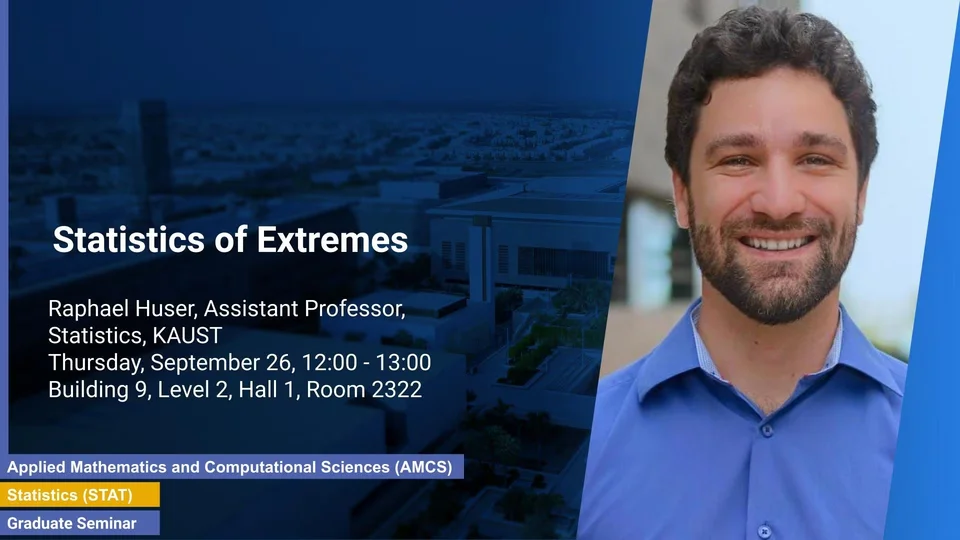
Statistics of Extremes Raphaël Huser, Associate Professor, Statistics Sep 26, 12:00 - 13:00 B9 L2 H1 R2322 extreme environmental events probabilities risks univariate extremes Spatial extremes Extreme environmental events such as droughts, floods and heat-waves take place in space and time, and it is necessary to take this into account when evaluating their risks and estimating their probabilities. During this seminar, I will review some classical and more recent work on this topic, focusing on the modeling of univariate and spatial extremes. The ideas will be illustrated by applications to peak river flow data from the UK, and heavy rainfall close to Jeddah.
Engage ORCID KAUST Academic Portal KAUST Repository Scopus LinkedIn ShareClipboard Related Sites Statistics (STAT) Applied Mathematics and Computational Science (AMCS) Extreme Statistics (XSTAT) Related Content Articles 98 Events 6 Related Links Publication list on Google Scholar List of publications in my CV Publons profile