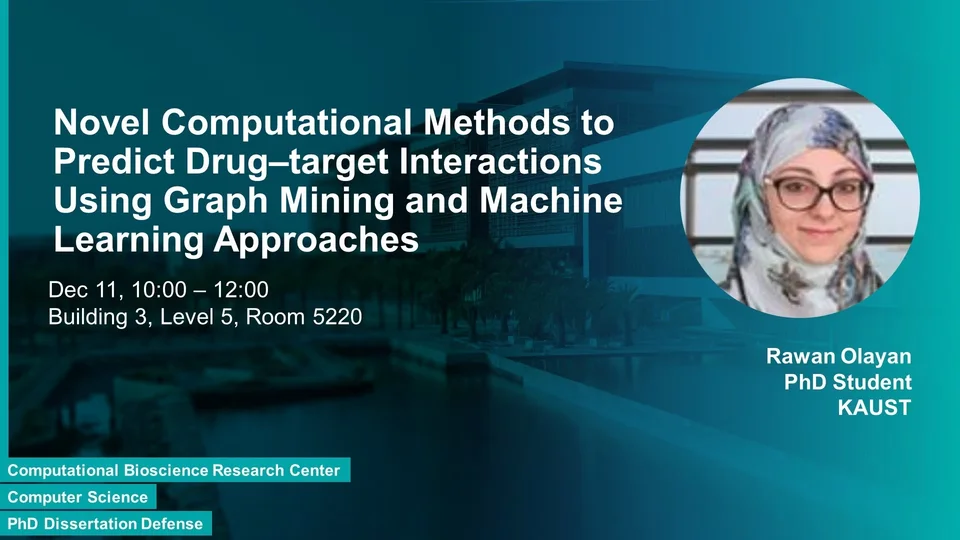
About Rawan Olayan Rawan Olayan Ph.D., Computer Science computational methods data integration graph mining machine learning Rawan Olayan obtained both, her MS Degree and PhD Degree from Computer Science at KAUST in 2013 and 2018 respectively. Her master thesis and PhD thesis supervisor was Vladimir Bajic. Under the supervision of her advisor Professor Vladimir Bajic, she completed her thesis on developing novel computational methods to predict drug-target interactions and their functional effects using data integration, graph mining and machine learning approaches. Currently, Rawan is working as a postdoctoral associate in the Carter Lab at the Jackson Laboratory for Genomic Medicine in Farmington, Connecticut. In Events Presented Events Dec 10 - Dec 16, 2017 Novel Computational Methods to Predict Drug–target Interactions Using Graph Mining and Machine Learning Approaches Rawan Olayan, Ph.D., Computer Science Dec 11, 10:00 - 12:00 B3 L5 R5220 bioinformatics data integration data mining graph mining machine learning Abstract Computational drug repurposing aims at finding new medical uses for existing drugs. The identification of novel drug-target interactions (DTIs) can be a useful part of such a task. Finding computationally DTIs is a convenient strategy to identify potentially new DTIs at low cost with reasonable accuracy. However, the current DTI prediction methods suffer a high false positive prediction rate. Here, we present a comprehensive review of the recent progress in the field of DTI prediction from data-centric and algorithmic-centric perspectives that can help in constructing novel reliable
Novel Computational Methods to Predict Drug–target Interactions Using Graph Mining and Machine Learning Approaches Rawan Olayan, Ph.D., Computer Science Dec 11, 10:00 - 12:00 B3 L5 R5220 bioinformatics data integration data mining graph mining machine learning Abstract Computational drug repurposing aims at finding new medical uses for existing drugs. The identification of novel drug-target interactions (DTIs) can be a useful part of such a task. Finding computationally DTIs is a convenient strategy to identify potentially new DTIs at low cost with reasonable accuracy. However, the current DTI prediction methods suffer a high false positive prediction rate. Here, we present a comprehensive review of the recent progress in the field of DTI prediction from data-centric and algorithmic-centric perspectives that can help in constructing novel reliable
Engage ORCID ShareClipboard Related Sites Computer Science (CS) Related Content Events 1 Related Links View list of Publications on KAUST Repository