About Ricardo Henao Ricardo Henao Associate Professor (former), Bioengineering bioscience machine learning statistical analysis Ricardo Henao, a quantitative scientist, is an Associate Professor of Bioengineering in the Biological and Environmental Science and Engineering ( BESE) Division, and Computer Science in the Computer, Electrical, Mathematical Sciences and Engineering Division ( CEMSE), member of the Smart Health Initiative ( SHI) and the Computational Biosciences Research center ( CBRC), at KAUST (King Abdullah University of Science and Technology). He is also currently an Associate Professor in the department of Biostatistics and Bioinformatics, Department of Electrical and Computer Engineering ( ECE) Events Presented Events Feb 25 - Mar 2, 2024 Learning with Longitudinal Electronic Health Record Data Ricardo Henao, Associate Professor (former), Bioengineering Feb 26, 11:30 - 12:30 B9 L2 H2 Abstract Longitudinal data extracted from electronic health record (EHR) data presents numerous opportunities for the development methodology of clinical decision support tools aimed at improving the delivery of healthcare. However, EHR data also pose many modeling challenges due to the intrinsic nature of such data, for instance, incompleteness, (not at random) missingness, temporal scale resolution, etc. Though all of these make it difficult to directly apply existing machine learning methodology to address problems of representation, identification, and prediction, we can leverage recent Jan 29 - Feb 4, 2023 Capturing Actionable Dynamics with Structured Latent Ordinary Differential Equations Ricardo Henao, Associate Professor (former), Bioengineering Feb 1, 12:00 - 13:00 B3 L5 R5220 bioinformatics We propose a structured latent ODE model that explicitly captures system input variations within its latent representation. Building on a static latent variable specification, our model learns (independent) stochastic factors of variation for each input to the system, thus separating the effects of the system inputs in the latent space. This approach provides actionable modeling through the controlled generation of time-series data for novel input combinations (or perturbations). Additionally, we propose a flexible approach for quantifying uncertainties, leveraging a quantile regression formulation.
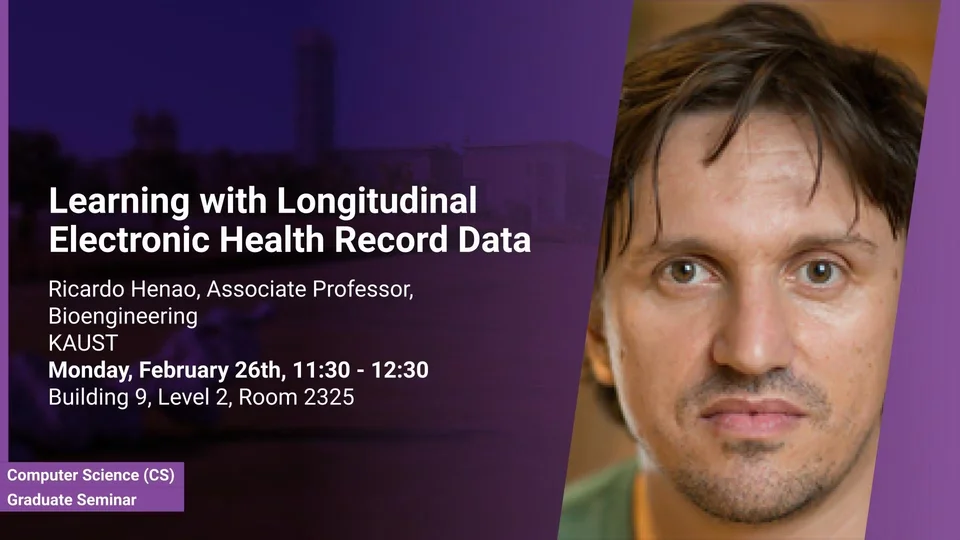
Learning with Longitudinal Electronic Health Record Data Ricardo Henao, Associate Professor (former), Bioengineering Feb 26, 11:30 - 12:30 B9 L2 H2 Abstract Longitudinal data extracted from electronic health record (EHR) data presents numerous opportunities for the development methodology of clinical decision support tools aimed at improving the delivery of healthcare. However, EHR data also pose many modeling challenges due to the intrinsic nature of such data, for instance, incompleteness, (not at random) missingness, temporal scale resolution, etc. Though all of these make it difficult to directly apply existing machine learning methodology to address problems of representation, identification, and prediction, we can leverage recent
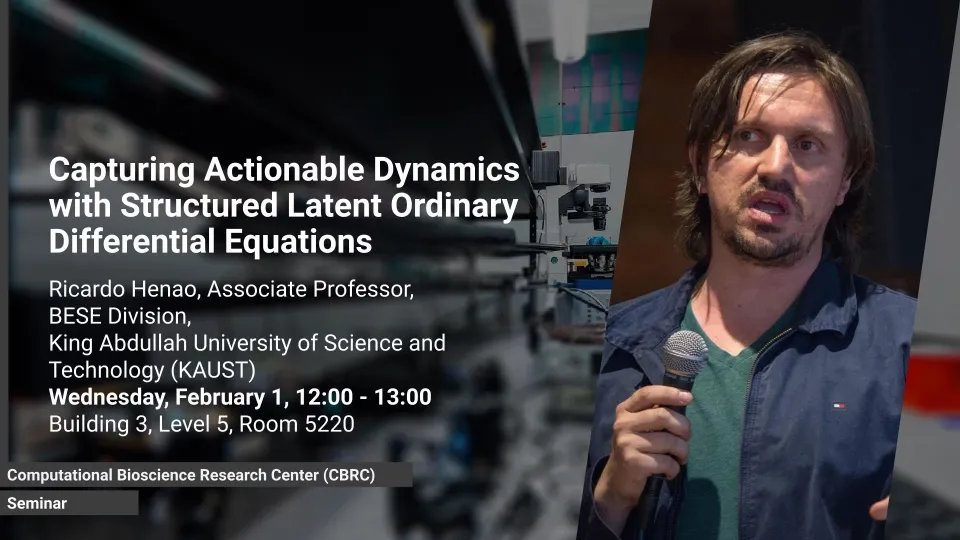
Capturing Actionable Dynamics with Structured Latent Ordinary Differential Equations Ricardo Henao, Associate Professor (former), Bioengineering Feb 1, 12:00 - 13:00 B3 L5 R5220 bioinformatics We propose a structured latent ODE model that explicitly captures system input variations within its latent representation. Building on a static latent variable specification, our model learns (independent) stochastic factors of variation for each input to the system, thus separating the effects of the system inputs in the latent space. This approach provides actionable modeling through the controlled generation of time-series data for novel input combinations (or perturbations). Additionally, we propose a flexible approach for quantifying uncertainties, leveraging a quantile regression formulation.
Related Sites Biological and Environmental Science and Engineering (BESE) Bioengineering (BioE) Computer Science (CS) Related Content Events 2 Related Links View Publications in Google Scholar View Publications in DBLP View Publications in Semantic Scholar View Publications in PubMed KAUST Official profile ORCID, 0000-0003-4980-845X