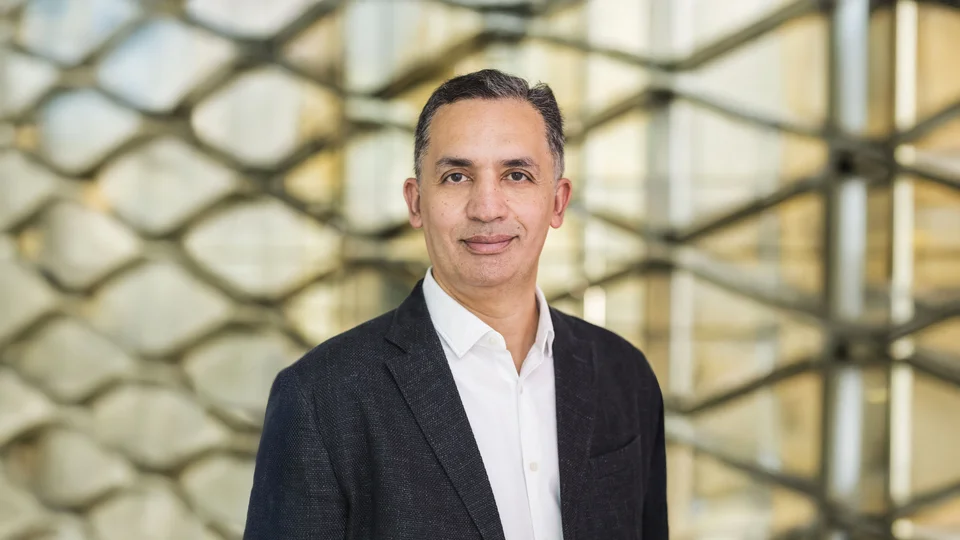
About Tareq Al-Naffouri Tareq Al-Naffouri Professor, Electrical and Computer Engineering statistical signal processing communications tracking wireless networks Localization Professor Al-Naffouri's research focuses on designing and analyzing wireless communication systems, particularly spectrum sharing, cognitive radio, energy efficiency and security within the context of advanced technologies like 5G. Events Presented Events Mar 28 - Apr 3, 2021 Towards Robust and Accurate Navigation: Theory, Applications, and Future Directions Tareq Al-Naffouri, Professor, Electrical and Computer Engineering Mar 28, 12:00 - 13:00 KAUST Towards Robust Navigation theory Applications Future Directions Navigation is an essential requirement for many applications (commercial, retail, military, scientific, ...etc) and in a variety of environments (in-doors, outdoors, space, underwater, and even underground). In this talk, I will overview some of my group's work in localization and navigation focusing on indoor and satellite positioning. The talk will demonstrate how the structure or constraints of the problem can help achieve very accurate localization (e.g. millimeter level indoors) that is robust to Doppler, multipath, and shadowing. The talk will also touch upon various related applications that the group is pursuing in smart health and smart cities. The talk will end with future directions for localization in extreme environments and in the TeraHertz spectrum where localization, environment sensing, and communication converge. Mar 21 - Mar 27, 2021 The Convex Gaussian Min-Max Theorem: A Powerful Tool for the Analysis of Regularized Convex Optimization Problems Tareq Al-Naffouri, Professor, Electrical and Computer Engineering Mar 25, 12:00 - 13:00 KAUST In modern large-scale inference problems, the dimension of the signal to be estimated is comparable or even larger than the number of available observations. Yet the signal of interest lies in some low-dimensional structure, due to sparsity, low-rankness, finite alphabet, ... etc. Non-smooth regularized convex optimization are powerful tools for the recovery of such structured signals from noisy linear measurements. Research has shifted recently to the performance analysis of these optimization tools and optimal turning of their hyper-parameters in high dimensional settings. One powerful performance analysis framework is the Convex Gaussian Min-max Theorem (CGMT). The CGMT is based on Gaussian process methods and is a strong and tight version of the classical Gordon comparison inequality. In this talk, we review the CGMT and illustrate its application to the error analysis of some convex regularized optimization problems. Apr 26 - May 2, 2020 On Optimal Regularization in Estimation, Detection, and Classification Tareq Al-Naffouri, Professor, Electrical and Computer Engineering Apr 30, 12:00 - 13:00 KAUST linear systems computational Complexity Convex Gaussian Min-max theorem In many problems in statistical signal processing, regularization is employed to deal with uncertainty, ill-posedness, and insufficiency of training data. It is possible to tune these regularizers optimally asymptotically, i.e. when the dimension of the problem becomes very large, by using tools from random matrix theory and Gauss Process Theory. In this talk, we demonstrate the optimal turning of regularization for three problems : i) Regularized least squares for solving ill-posed and/or uncertain linear systems, 2) Regularized least squares for signal detection in multiple antenna communication systems and 3) Regularized linear and quadratic discriminant binary classifiers. Mar 8 - Mar 14, 2020 Sensing, Localization, and Communications to Enable Future IoT Systems Tareq Al-Naffouri, Professor, Electrical and Computer Engineering Mar 12, 16:00 - 17:00 KAUST IoT Sensor array processing In this talk, Tareq will present his research contributions and future directions to advance some critical IoT-enabling technologies: sensing, localization, and communications. He will demonstrate how we take advantage of structure in sensed-data and sensor arrays. This structure can help mitigate sensing uncertainties, improve localization accuracy, and enhance the performance of communication systems, all while reducing the computational overhead. The Internet of Things (IoT) has ushered a new era in many fields including retail, medicine, agriculture, and the automotive industry. In fact, it is projected that by 2025, one trillion IoT devices will be deployed worldwide: the equivalent of 1000 devices per person. To reach such a scale, major advancements are needed in various IoT-enabling technologies. Nov 10 - Nov 16, 2019 EE 398 Graduate Seminar Tareq Al-Naffouri, Professor, Electrical and Computer Engineering Nov 10, 12:00 - 13:00 B9 L2 H1 R2322 Tareq Al-Naffouri is a professor of Electrical Engineering (EE) and Principale investigator of the Information System Lab (ISL). He is also an active member of the Sensor Initiative (SI) at the King Abdullah University of Sciences and Technology, Saudi Arabia.
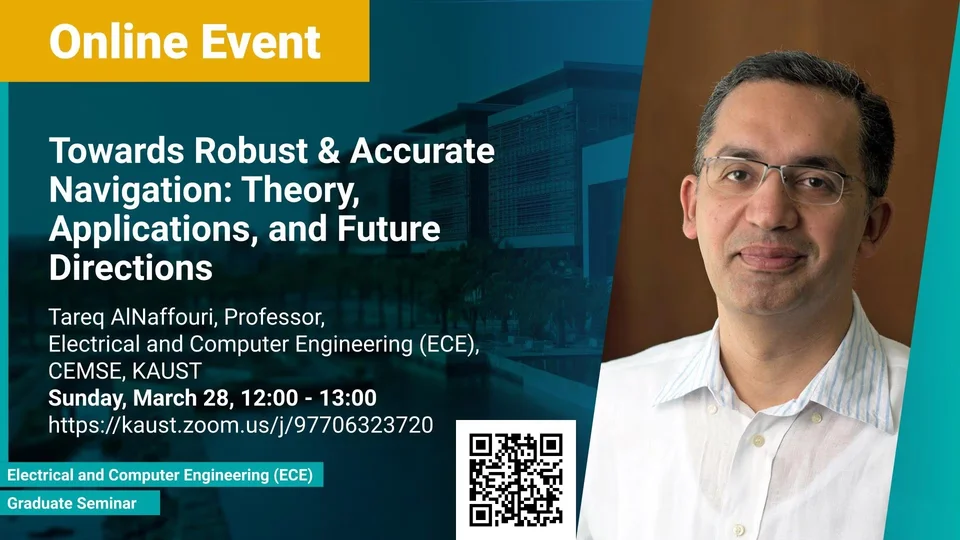
Towards Robust and Accurate Navigation: Theory, Applications, and Future Directions Tareq Al-Naffouri, Professor, Electrical and Computer Engineering Mar 28, 12:00 - 13:00 KAUST Towards Robust Navigation theory Applications Future Directions Navigation is an essential requirement for many applications (commercial, retail, military, scientific, ...etc) and in a variety of environments (in-doors, outdoors, space, underwater, and even underground). In this talk, I will overview some of my group's work in localization and navigation focusing on indoor and satellite positioning. The talk will demonstrate how the structure or constraints of the problem can help achieve very accurate localization (e.g. millimeter level indoors) that is robust to Doppler, multipath, and shadowing. The talk will also touch upon various related applications that the group is pursuing in smart health and smart cities. The talk will end with future directions for localization in extreme environments and in the TeraHertz spectrum where localization, environment sensing, and communication converge.
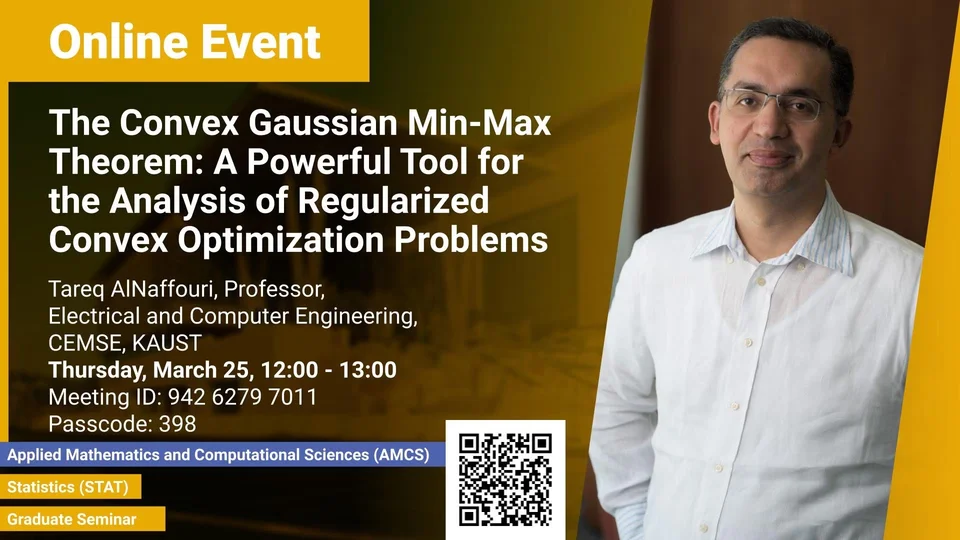
The Convex Gaussian Min-Max Theorem: A Powerful Tool for the Analysis of Regularized Convex Optimization Problems Tareq Al-Naffouri, Professor, Electrical and Computer Engineering Mar 25, 12:00 - 13:00 KAUST In modern large-scale inference problems, the dimension of the signal to be estimated is comparable or even larger than the number of available observations. Yet the signal of interest lies in some low-dimensional structure, due to sparsity, low-rankness, finite alphabet, ... etc. Non-smooth regularized convex optimization are powerful tools for the recovery of such structured signals from noisy linear measurements. Research has shifted recently to the performance analysis of these optimization tools and optimal turning of their hyper-parameters in high dimensional settings. One powerful performance analysis framework is the Convex Gaussian Min-max Theorem (CGMT). The CGMT is based on Gaussian process methods and is a strong and tight version of the classical Gordon comparison inequality. In this talk, we review the CGMT and illustrate its application to the error analysis of some convex regularized optimization problems.
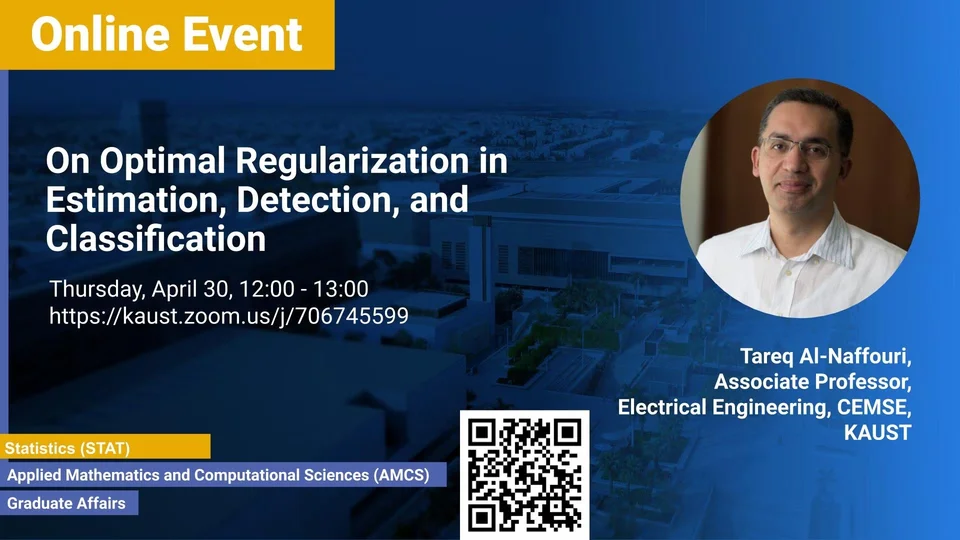
On Optimal Regularization in Estimation, Detection, and Classification Tareq Al-Naffouri, Professor, Electrical and Computer Engineering Apr 30, 12:00 - 13:00 KAUST linear systems computational Complexity Convex Gaussian Min-max theorem In many problems in statistical signal processing, regularization is employed to deal with uncertainty, ill-posedness, and insufficiency of training data. It is possible to tune these regularizers optimally asymptotically, i.e. when the dimension of the problem becomes very large, by using tools from random matrix theory and Gauss Process Theory. In this talk, we demonstrate the optimal turning of regularization for three problems : i) Regularized least squares for solving ill-posed and/or uncertain linear systems, 2) Regularized least squares for signal detection in multiple antenna communication systems and 3) Regularized linear and quadratic discriminant binary classifiers.
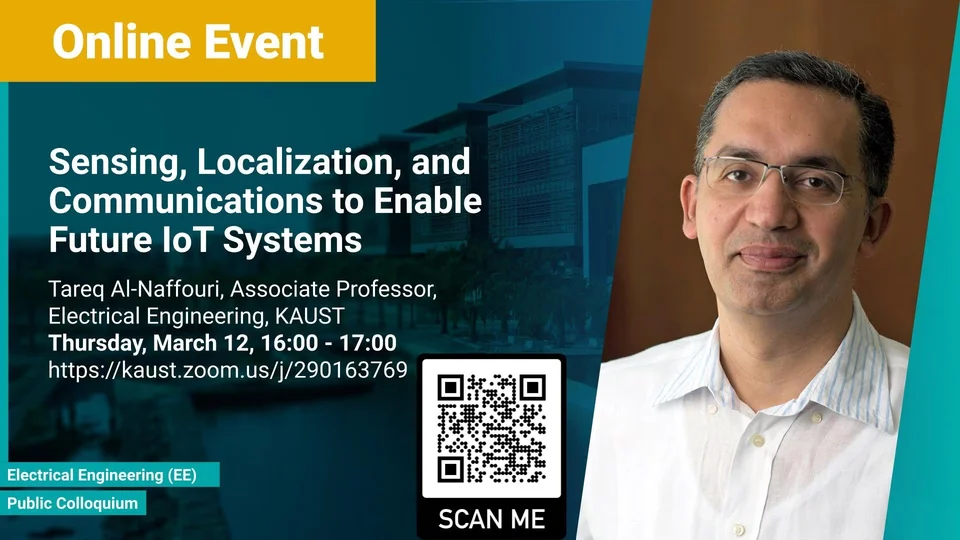
Sensing, Localization, and Communications to Enable Future IoT Systems Tareq Al-Naffouri, Professor, Electrical and Computer Engineering Mar 12, 16:00 - 17:00 KAUST IoT Sensor array processing In this talk, Tareq will present his research contributions and future directions to advance some critical IoT-enabling technologies: sensing, localization, and communications. He will demonstrate how we take advantage of structure in sensed-data and sensor arrays. This structure can help mitigate sensing uncertainties, improve localization accuracy, and enhance the performance of communication systems, all while reducing the computational overhead. The Internet of Things (IoT) has ushered a new era in many fields including retail, medicine, agriculture, and the automotive industry. In fact, it is projected that by 2025, one trillion IoT devices will be deployed worldwide: the equivalent of 1000 devices per person. To reach such a scale, major advancements are needed in various IoT-enabling technologies.
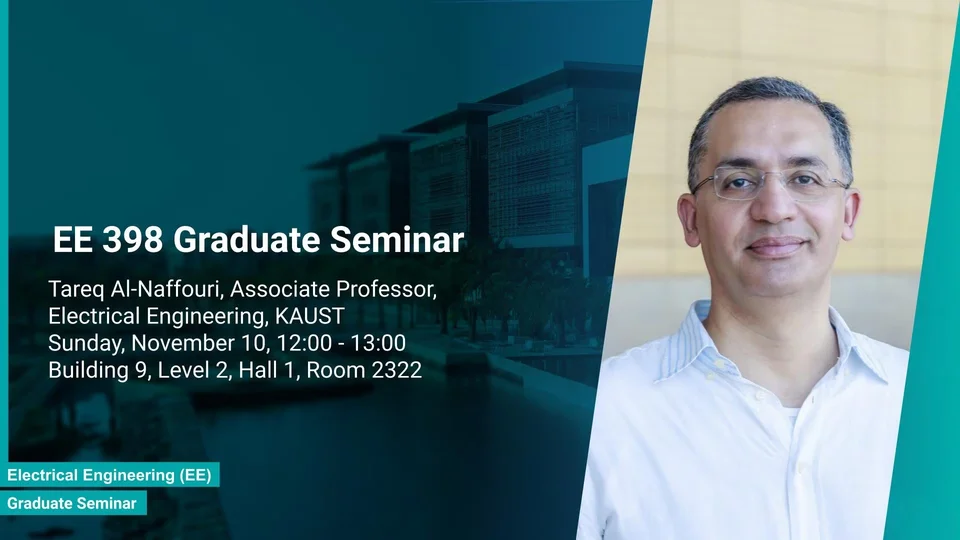
EE 398 Graduate Seminar Tareq Al-Naffouri, Professor, Electrical and Computer Engineering Nov 10, 12:00 - 13:00 B9 L2 H1 R2322 Tareq Al-Naffouri is a professor of Electrical Engineering (EE) and Principale investigator of the Information System Lab (ISL). He is also an active member of the Sensor Initiative (SI) at the King Abdullah University of Sciences and Technology, Saudi Arabia.
Engage ORCID KAUST Repository KAUST Academic Portal Scopus LinkedIn IEEE Xplore ShareClipboard Related Sites Electrical and Computer Engineering (ECE) Statistics (STAT) Information Science Lab (ISL) Related Content Articles 88 Projects 8 Events 5 Related Links Google Scholar Profile Tarig AlNaffouri Personal Page Research gate Profile