About Trisevgeni Rapakoulia Trisevgeni Rapakoulia Ph.D., Computer Science bioinformatics machine learning Drug Combinations Trisevgeni Rapakoulia obtained her Ph.D. degree (2016-2019) in Computer Science under the supervision of Professor Xin Gao at structural and Functional Bioinformatics Group (SFB) at King Abdullah University of Science and Technology (KAUST). Research Interests Trisevgeni's research interests include bioinformatics, System Biology, Prediction of harmful SNPs, Genome-Wide Association Studies and Artificial Intelligence, Machine Learning Approaches, Evolutionary Algorithms, Feature Selection Techniques. Research field: study the effects of drugs and drug combinations in the transcriptome level Events Presented Events Jul 14 - Jul 20, 2019 Computational Analysis of Transcriptional Regulation after Single and Multiple Drug Administration. Trisevgeni Rapakoulia, Ph.D., Computer Science Jul 17, 10:00 - 12:00 B3 L5 R5209 Transcriptomics RNA genes drug effects breast cancer cell conversion With the advances in transcriptomic analysis, the monitoring of genome-wide gene expression provides a powerful approach for determining the action of drugs. In this thesis, we analyzed the transcriptional responses of cells treated with drugs either alone or in combinations to explore their effects in two different applications: breast cancer therapy and cell conversion. Nov 4 - Nov 10, 2018 AI4GH Seminar Series - Genome-scale Regression Analysis Reveals a Linear Relationship for Promoters and Enhancers After Combinatorial Drug Treatment Trisevgeni Rapakoulia, Ph.D., Computer Science Nov 7, 12:00 - 13:00 B2 R5220 machine learning bioinformatics Drug Combinations drug effects cancer Drug combination therapy for the treatment of cancers and other multifactorial diseases has the potential of increasing the therapeutic effect while reducing the likelihood of drug resistance. In order to reduce the time and cost spent on comprehensive screens, methods are needed which can model additive effects of possible drug combinations.
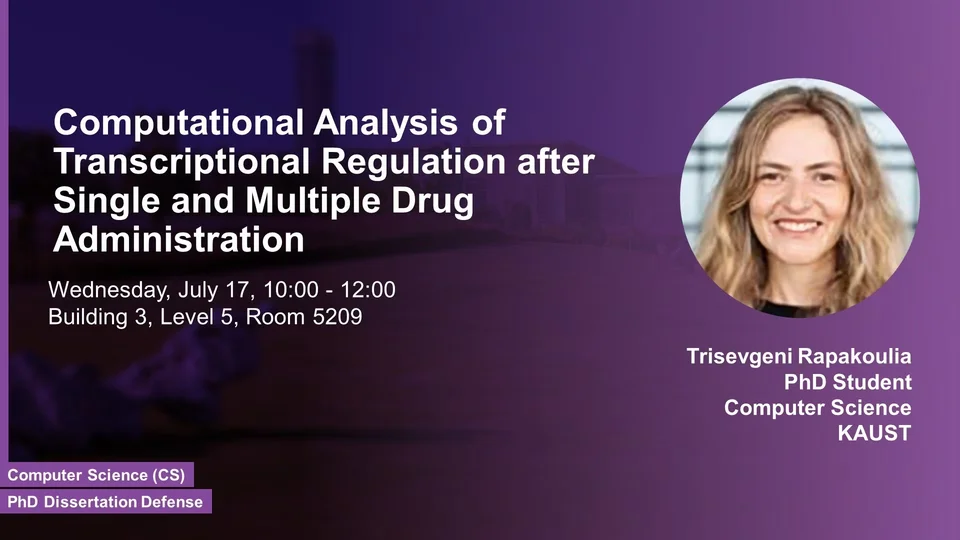
Computational Analysis of Transcriptional Regulation after Single and Multiple Drug Administration. Trisevgeni Rapakoulia, Ph.D., Computer Science Jul 17, 10:00 - 12:00 B3 L5 R5209 Transcriptomics RNA genes drug effects breast cancer cell conversion With the advances in transcriptomic analysis, the monitoring of genome-wide gene expression provides a powerful approach for determining the action of drugs. In this thesis, we analyzed the transcriptional responses of cells treated with drugs either alone or in combinations to explore their effects in two different applications: breast cancer therapy and cell conversion.
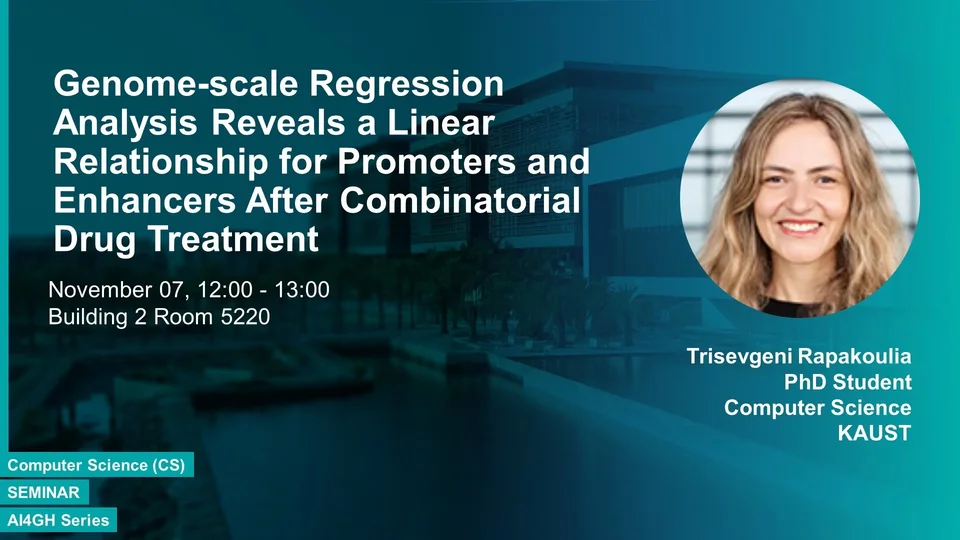
AI4GH Seminar Series - Genome-scale Regression Analysis Reveals a Linear Relationship for Promoters and Enhancers After Combinatorial Drug Treatment Trisevgeni Rapakoulia, Ph.D., Computer Science Nov 7, 12:00 - 13:00 B2 R5220 machine learning bioinformatics Drug Combinations drug effects cancer Drug combination therapy for the treatment of cancers and other multifactorial diseases has the potential of increasing the therapeutic effect while reducing the likelihood of drug resistance. In order to reduce the time and cost spent on comprehensive screens, methods are needed which can model additive effects of possible drug combinations.
Engage ORCID ShareClipboard Related Sites Structural and Functional Bioinformatics (SFB) Computer Science (CS) Related Content Articles 1 Events 2 Related Links Publications on Google Scholar Dblp Computer science bibliography Publications on KAUST Repository