About Wedyan Babatain Wedyan Babatain Ibn Rushd Assistant Professor, Electrical and Computer Engineering sensors Actuators flexible electronics stretchable electronics wearables Human-Machine Interfaces microfabrication Professor Babatain’s research focuses on developing soft electronic interfaces through innovations in sensing, actuation, and additive manufacturing for wearable technologies, human-machine interfaces and reconfigurable electronics. Events Presented Events Sep 6 - Sep 12, 2026 Manufacturing and Integration Strategies for Flexible Electronics Across Form Factors Wedyan Babatain, Ibn Rushd Assistant Professor, Electrical and Computer Engineering Sep 6, 12:00 - 13:00 B9 R2325 advanced manufacturing high-density Circuits circuit design Fabrication Methods fabrication This talk presents manufacturing and integration strategies for flexible electronics across form factors, from E-LIG, a laser-enabled additive process for functional flexible printed circuit boards, to FiberCircuits, which embed complete circuits within fibers for interactive textiles. Jul 17 - Jul 23, 2022 Liquid Metal-Based Inertial Sensors for Motion Monitoring and Human Machine Interfaces Wedyan Babatain, Ibn Rushd Assistant Professor, Electrical and Computer Engineering Jul 19, 15:00 - 16:00 B2 B3 A0215 nanofabrication flexible electronics wearable devices sensors In this dissertation, the development of novel practical resistive and capacitive-type inertial sensors using liquid metal as a functional proof mass material is presented. Utilizing the unique electromechanical properties of liquid metal, the novel inertial sensor design confines a graphene-coated liquid metal droplet inside tubular and 3D architectures, enabling motion sensing in single and multiple directions. Combining the graphene-coated liquid metal droplet with printed sensing elements offers a robust fatigue-free alternative material for rigid, proof mass-based accelerometers. Resistive and capacitive sensing mechanisms were both developed, characterized, and evaluated. Emerging rapid fabrication technologies such as direct laser writing and 3D printing were mainly adopted, offering a scalable fabrication strategy independent of advanced microfabrication facilities. The developed inertial sensor was integrated with a programmable system on a chip (PSoC) to function as a stand-alone system and demonstrate its application for real-time- monitoring of human health/ physical activity and for soft human-machine interfaces. The developed inertial sensor architecture and materials in this work offer a new paradigm for manufacturing these widely used sensors that have the potential to complement the performance of their silicon counterparts and extend their applications.
Manufacturing and Integration Strategies for Flexible Electronics Across Form Factors Wedyan Babatain, Ibn Rushd Assistant Professor, Electrical and Computer Engineering Sep 6, 12:00 - 13:00 B9 R2325 advanced manufacturing high-density Circuits circuit design Fabrication Methods fabrication This talk presents manufacturing and integration strategies for flexible electronics across form factors, from E-LIG, a laser-enabled additive process for functional flexible printed circuit boards, to FiberCircuits, which embed complete circuits within fibers for interactive textiles.
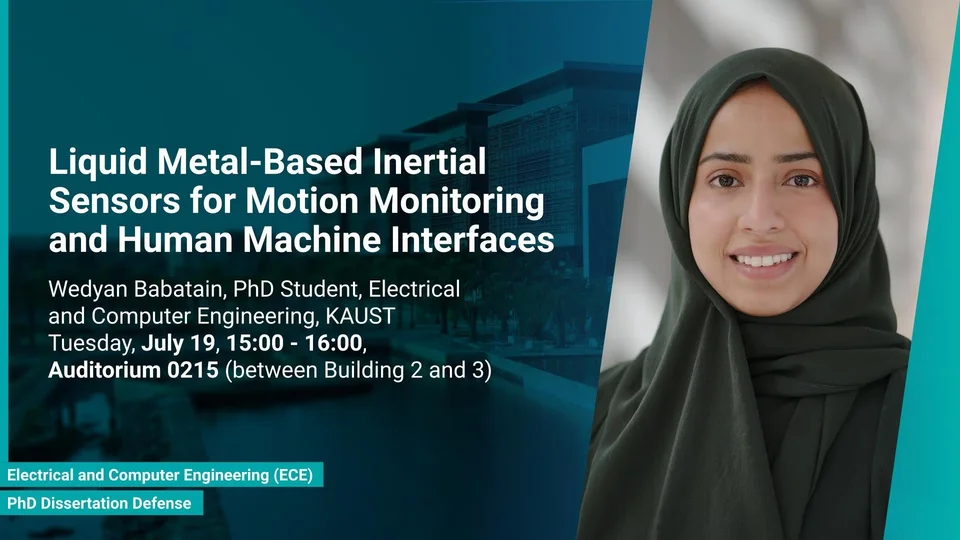
Liquid Metal-Based Inertial Sensors for Motion Monitoring and Human Machine Interfaces Wedyan Babatain, Ibn Rushd Assistant Professor, Electrical and Computer Engineering Jul 19, 15:00 - 16:00 B2 B3 A0215 nanofabrication flexible electronics wearable devices sensors In this dissertation, the development of novel practical resistive and capacitive-type inertial sensors using liquid metal as a functional proof mass material is presented. Utilizing the unique electromechanical properties of liquid metal, the novel inertial sensor design confines a graphene-coated liquid metal droplet inside tubular and 3D architectures, enabling motion sensing in single and multiple directions. Combining the graphene-coated liquid metal droplet with printed sensing elements offers a robust fatigue-free alternative material for rigid, proof mass-based accelerometers. Resistive and capacitive sensing mechanisms were both developed, characterized, and evaluated. Emerging rapid fabrication technologies such as direct laser writing and 3D printing were mainly adopted, offering a scalable fabrication strategy independent of advanced microfabrication facilities. The developed inertial sensor was integrated with a programmable system on a chip (PSoC) to function as a stand-alone system and demonstrate its application for real-time- monitoring of human health/ physical activity and for soft human-machine interfaces. The developed inertial sensor architecture and materials in this work offer a new paradigm for manufacturing these widely used sensors that have the potential to complement the performance of their silicon counterparts and extend their applications.
Engage ORCID ShareClipboard Related Sites Electrical and Computer Engineering (ECE) Integrated Interfaces Lab (I2) Related Content Articles 2 Events 2 Related Links Wedyan Babatain list of publications on KAUST Repository Wedyan Babatain list of publications on Google Scholar Wedyan Babatain list of publications on personal website Wedyan Babatain profile on ResearchGate Wedyan Babatain personal website