
Tapping Into the Full Potential of the Stratosphere
This talk examines how High-Altitude Platform Stations (HAPS) leverage intelligent beam management and optical links to democratize broadband access and provide resilient solutions for disaster recovery.
Overview
High-Altitude Platform Stations (HAPS) are emerging as a key complement to LEO satellite mega-constellations, offering a scalable solution for global connectivity and bridging digital divides where terrestrial and satellite networks fall short. Operating from the stratosphere, HAPS leverage advanced beamforming and free-space optics (FSO) to deliver high-capacity and low-latency communications across diverse geographical areas. This talk explores the technological connectivity advancements driving HAPS by highlighting how intelligent beam management and optical feeder and inter-HAPS links can democratize broadband access and provide also unique solutions for disaster recovery, paving the way for a more connected world.
Presenters
Brief Biography
Throughout his 30-year academic career, Professor Mohamed-Slim Alouini, an IEEE, OPTICA, and SPIE Fellow, has developed analytical and simulation tools for evaluating the performance of radio-frequency and optical wireless communication systems. He has also designed and optimized innovative technologies for emerging wireless networks.
Professor Alouini, a co-founder of KAUST's ECE program, inspires future engineers through his pioneering work in wireless communications. His integrated space-air-ground networks, spectrum sharing schemes, and optical wireless communication systems research shape connectivity's future and embody KAUST's scientific excellence and global impact.
Professor Alouini has published numerous conference and journal papers and co-authored the textbook Digital Communication over Fading Channels, published by Wiley Interscience. A former editor of IEEE Transactions on Communications and IEEE Transactions on Wireless Communication, he also served as an editor for IEEE Transactions on Mobile Computing and the Wireless Communications and Mobile Computing journal. He was also a series editor for the IEEE Communication Magazine's Optical Communication and Networks Special Series and the founding field chief editor for the Frontiers in Communications and Networks journal. He is now the Founding Editor-in-Chief for the Nature Partnership Journal (npj) on Wireless Technologies (since 2025) and an editor for the IEEE Transactions on Aerospace and Electronics Systems (since 2022).
Professor Alouini has been an IEEE Distinguished Lecturer for the IEEE Communication Society (2016-2017), the IEEE Vehicular Technology Society (2018-2022), the IEEE Aerospace and Electronic Systems Society (2023-2024), the IEEE Photonics Society (2025), and the IEEE Society on Social Implications of Technology (2026-Present).
Related People
Related Researchers
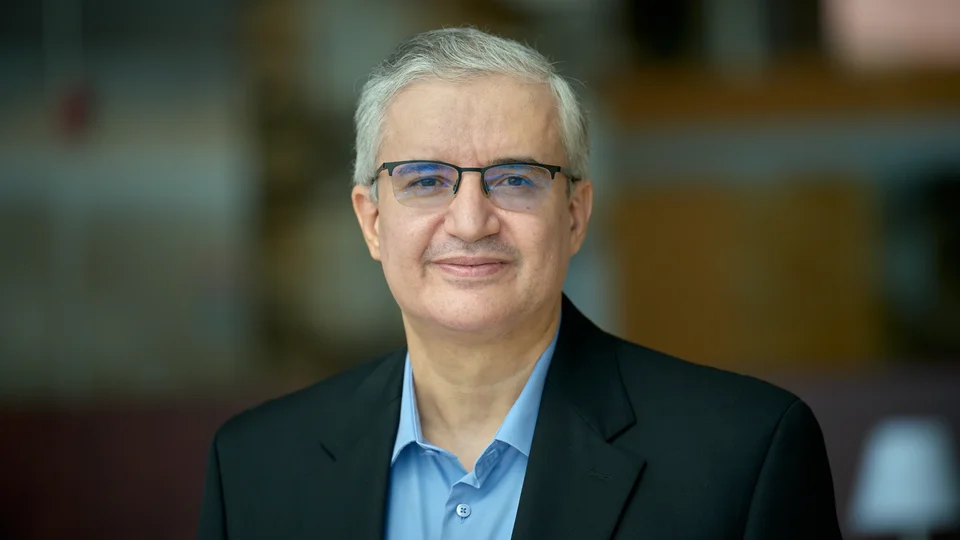
Mohamed-Slim Alouini
- Al-Khawarzmi Distinguished Professor, Electrical and Computer Engineering