About Alexandre de Bustamante Simas Alexandre de Bustamante Simas Senior Research Scientist, Statistics stochastic processes statistical inference Partial Differential Equations spatial statistics probability theory Alexandre Simas is an expert on stochastic processes and spatial statistics, with a focus on stochastic partial differential equations and random fields on metric graphs. Articles Related News August 2026 Smoothing the math of spatial networks 1 min read · Sun, Aug 23 2026 News Clip News spatial statistics stochastic processes A new statistical approach could make modeling spatial networks more accurate and efficient. July 2025 Mapping risk on networks: A scalable model for spatial point processes earns international recognition 2 min read · Mon, Jul 28 2025 Awards News spatial statistics Gaussian processes R-INLA KAUST Ph.D. student Damilya Saduakhas wins Best Paper Award for a new model mapping accident risk on complex road networks. Damilya Saduakhas wins Best Paper Award at Spatial Statistics 2025 in The Netherlands 1 min read · Sun, Jul 20 2025 Awards News spatial statistics Damilya Saduakhas, a KAUST Ph.D. candidate in statistics, has received the Best Paper Award at the Spatial Statistics 2025: At the Dawn of AI Conference, held from July 15 to 18 in Noordwijk, The Netherlands. June 2025 Efficient and Accurate Inference for Matérn Gaussian Processes on Intervals 1 min read · Mon, Jun 16 2025 News Gaussian processes statistical inference A new study by researchers at KAUST introduces a breakthrough method for statistical modeling with Matérn Gaussian processes, a popular tool in spatial statistics, machine learning, and the natural sciences. While Gaussian processes with stationary Matérn covariance functions (Matérn processes) are valued for their flexibility, their use with large datasets has been severely limited by the high computational cost of standard methods. The team has developed the first generally applicable approach that enables fast, linear-cost inference and prediction for Matérn processes on bounded intervals May 2025 Mastering Network Spatial Statistics with the MetricGraph R Package 1 min read · Sat, May 24 2025 News spatial statistics applied statistics Bayesian Statistics Log-Gaussian Cox process Gaussian processes latent Gaussian models A new open-access mini-course is expanding access to advanced network spatial statistics through practical training with the MetricGraph package R, a powerful tool developed by David Bolin (KAUST), Alexandre B. Simas (KAUST), and Jonas Wallin (Lund University) for modeling data on network structures such as road systems and river basins. Presented by Bolin and Simas at the University of Glasgow during the “ INLA: Past, Present, and Future” workshop, the mini-course provides step-by-step tutorials, real datasets, and comprehensive R code, all freely available online, opening new avenues for July 2023 MetricGraph: New R package for statistical analysis of data on networks 1 min read · Wed, Jul 5 2023 News The newly developed MetricGraph package is now available on CRAN. The package facilitates creation and manipulation of metric graphs, such as street or river networks. Further facilitates operations and visualizations of data on metric graphs, and the creation of a large class of random fields and stochastic partial differential equations on such spaces. These random fields can be used for simulation, prediction and inference. In particular, linear mixed effects models including random field components can be fitted to data based on computationally efficient sparse matrix representations
Smoothing the math of spatial networks 1 min read · Sun, Aug 23 2026 News Clip News spatial statistics stochastic processes A new statistical approach could make modeling spatial networks more accurate and efficient.
Mapping risk on networks: A scalable model for spatial point processes earns international recognition 2 min read · Mon, Jul 28 2025 Awards News spatial statistics Gaussian processes R-INLA KAUST Ph.D. student Damilya Saduakhas wins Best Paper Award for a new model mapping accident risk on complex road networks.
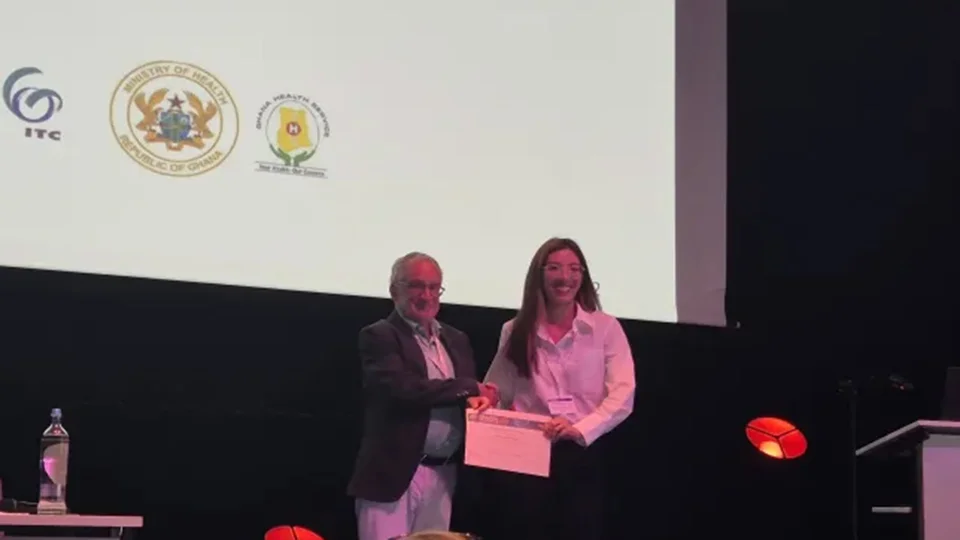
Damilya Saduakhas wins Best Paper Award at Spatial Statistics 2025 in The Netherlands 1 min read · Sun, Jul 20 2025 Awards News spatial statistics Damilya Saduakhas, a KAUST Ph.D. candidate in statistics, has received the Best Paper Award at the Spatial Statistics 2025: At the Dawn of AI Conference, held from July 15 to 18 in Noordwijk, The Netherlands.
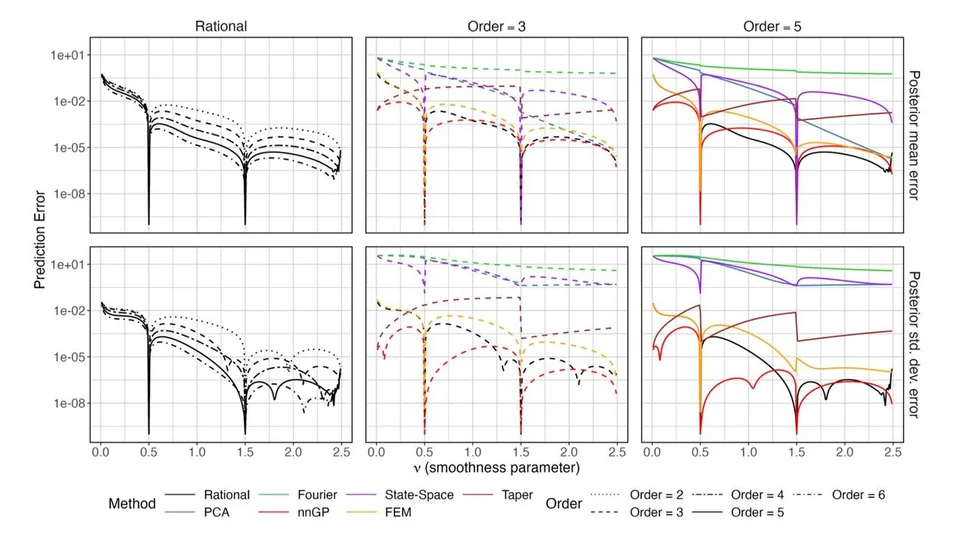
Efficient and Accurate Inference for Matérn Gaussian Processes on Intervals 1 min read · Mon, Jun 16 2025 News Gaussian processes statistical inference A new study by researchers at KAUST introduces a breakthrough method for statistical modeling with Matérn Gaussian processes, a popular tool in spatial statistics, machine learning, and the natural sciences. While Gaussian processes with stationary Matérn covariance functions (Matérn processes) are valued for their flexibility, their use with large datasets has been severely limited by the high computational cost of standard methods. The team has developed the first generally applicable approach that enables fast, linear-cost inference and prediction for Matérn processes on bounded intervals
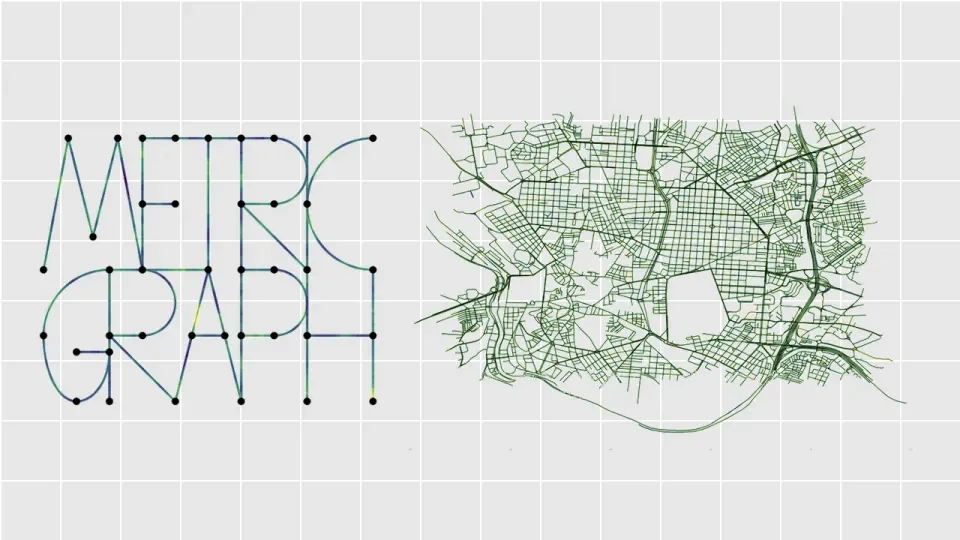
Mastering Network Spatial Statistics with the MetricGraph R Package 1 min read · Sat, May 24 2025 News spatial statistics applied statistics Bayesian Statistics Log-Gaussian Cox process Gaussian processes latent Gaussian models A new open-access mini-course is expanding access to advanced network spatial statistics through practical training with the MetricGraph package R, a powerful tool developed by David Bolin (KAUST), Alexandre B. Simas (KAUST), and Jonas Wallin (Lund University) for modeling data on network structures such as road systems and river basins. Presented by Bolin and Simas at the University of Glasgow during the “ INLA: Past, Present, and Future” workshop, the mini-course provides step-by-step tutorials, real datasets, and comprehensive R code, all freely available online, opening new avenues for
MetricGraph: New R package for statistical analysis of data on networks 1 min read · Wed, Jul 5 2023 News The newly developed MetricGraph package is now available on CRAN. The package facilitates creation and manipulation of metric graphs, such as street or river networks. Further facilitates operations and visualizations of data on metric graphs, and the creation of a large class of random fields and stochastic partial differential equations on such spaces. These random fields can be used for simulation, prediction and inference. In particular, linear mixed effects models including random field components can be fitted to data based on computationally efficient sparse matrix representations
Engage ORCID Scopus DBLP LinkedIn GitHub ShareClipboard Related Sites Stochastic Processes and Mathematical Statistics (StochProc) Statistics (STAT) Related Content Articles 6 Events 1 Related Links Alexandre de Bustamante Simas profile on Google Scholar