About Andrea Fratalocchi Andrea Fratalocchi Professor, Electrical and Computer Engineering photonics energy harvesting imaging apparatus intelligent lasers Professor Fratalocchi is a pioneer in complex systems and sustainable technologies, focused on addressing critical global challenges. His groundbreaking research has led to innovative solutions in areas such as energy harvesting, clean water production and smart materials. As a founder of the ECE program at KAUST and co-founder of Pixeltra, Professor Fratalocchi is a proven leader and entrepreneur, successfully translating his research into real-world impact. Events Presented Events Sep 17 - Sep 23, 2023 Universal light encoders: artificial intelligent optical hardware for real-time hyperspectral imaging and ultrasensitive detection Andrea Fratalocchi, Professor, Electrical and Computer Engineering Sep 17, 12:00 - 13:00 B9 L2 H2 Metasurfaces machine learning In this talk, I will review the fundamentals and application of this technology in various areas, ranging from the inverse design of ultra-flat optical components to HyplexTM, an innovative camera for acquiring and processing high-resolution hyperspectral videos in real-time at 30 frames per second. Nov 27 - Dec 3, 2022 A journey in applied complexity: pioneering record-performing technologies in clean energy harvesting, machine vision, and smart materials - Graduate Seminar Andrea Fratalocchi, Professor, Electrical and Computer Engineering Nov 27, 12:00 - 13:00 B9 L2 R2322 H1 Applied complexity Complexity studies physical processes that are generally unpredictable or difficult to predict and depend on many degrees of freedom. In this talk, I will summarize my group's recent research, discussing present results and future challenges of Applied complexity both as a science and engineering. Oct 23 - Oct 29, 2022 A journey in applied complexity: pioneering record-performing technologies in clean energy harvesting, machine vision, and smart materials - Public Colloquium Andrea Fratalocchi, Professor, Electrical and Computer Engineering Oct 25, 14:00 - 16:00 B9 L2 R2322 Applied complexity artificial intelligence information security biomedical applications Applied Complexity aims to understand the physical origin of these behaviors and transform them into sustainable technologies that tackle global problems of global interest. These range from energy harvesting to clean water production, the design of smart materials, biomedical applications, information security, artificial intelligence, and global warming. In this talk, I will summarize my group's recent research, discussing present results and future challenges of Applied complexity both as a science and engineering. Nov 21 - Nov 27, 2021 Harnessing complexity for technological applications Andrea Fratalocchi, Professor, Electrical and Computer Engineering Nov 21, 12:00 - 13:00 KAUST Harnessing complexity for technological applications This talk will give an overview of research activity of engineering different types of complex systems into technological applications in energy harvesting, material science, artificial intelligence and bio-imaging. Apr 25 - May 1, 2021 Applied Complexity: Ultra-flat AI materials for different applications Andrea Fratalocchi, Professor, Electrical and Computer Engineering Apr 25, 12:00 - 13:00 KAUST We review our recent results on artificial-intelligent designed ultra-flat materials that embeds "physical" neural networks for different application in biomedical imaging, optics, displays, and structural color generation. Apr 12 - Apr 18, 2020 Evolutionary science via nonlinear orthography Andrea Fratalocchi, Professor, Electrical and Computer Engineering Apr 12, 12:00 - 13:00 KAUST Evolutionary science nonlinear orthography The goal of our research is to understand the physical origin of these behaviors and trasform them into sustainable technologies that tackle contemporary problem of global interest, ranging from energy harvesting to clean water production, design of smart materials, biomedical applications, information security, artificial intelligence, global warming, and so on. Creating technologies from complex natural systems is a modern interdisciplinary research field that permeates many different scientific areas, ranging from physics to mathematics, to engineering and the theory of linguistics. This is a very challenging, yet very promising research. It involves the understanding of what we consider complex, which translates as something “involved, intricate, complicated, not easily understood or analyzed”. This sets the challenge of being able to understand the mechanisms of these systems and cross many different disciplines in order to constructively harness their properties into reproducible applications.
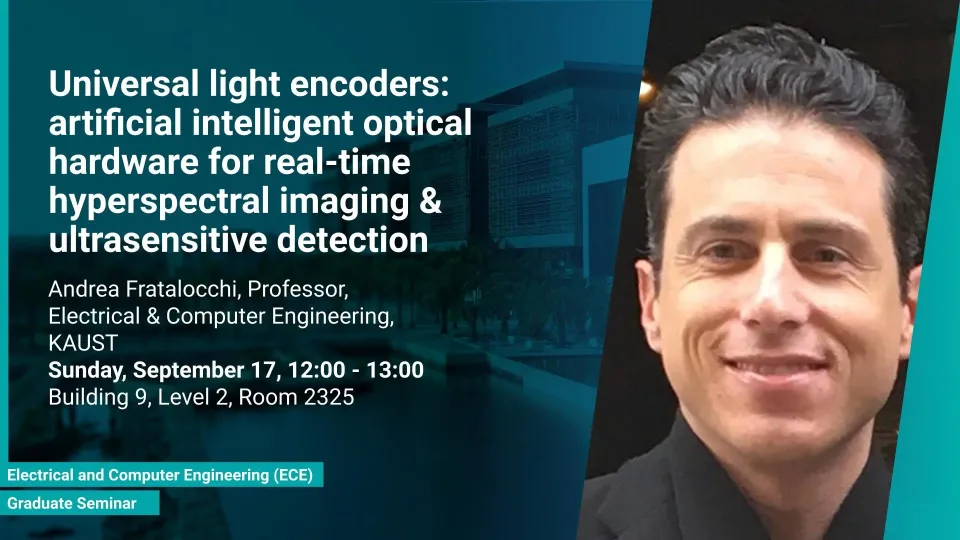
Universal light encoders: artificial intelligent optical hardware for real-time hyperspectral imaging and ultrasensitive detection Andrea Fratalocchi, Professor, Electrical and Computer Engineering Sep 17, 12:00 - 13:00 B9 L2 H2 Metasurfaces machine learning In this talk, I will review the fundamentals and application of this technology in various areas, ranging from the inverse design of ultra-flat optical components to HyplexTM, an innovative camera for acquiring and processing high-resolution hyperspectral videos in real-time at 30 frames per second.
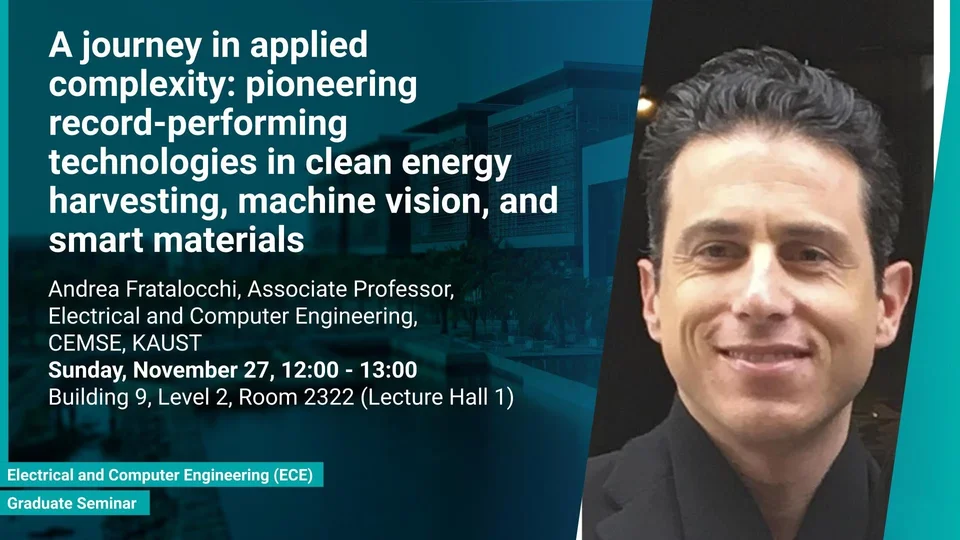
A journey in applied complexity: pioneering record-performing technologies in clean energy harvesting, machine vision, and smart materials - Graduate Seminar Andrea Fratalocchi, Professor, Electrical and Computer Engineering Nov 27, 12:00 - 13:00 B9 L2 R2322 H1 Applied complexity Complexity studies physical processes that are generally unpredictable or difficult to predict and depend on many degrees of freedom. In this talk, I will summarize my group's recent research, discussing present results and future challenges of Applied complexity both as a science and engineering.
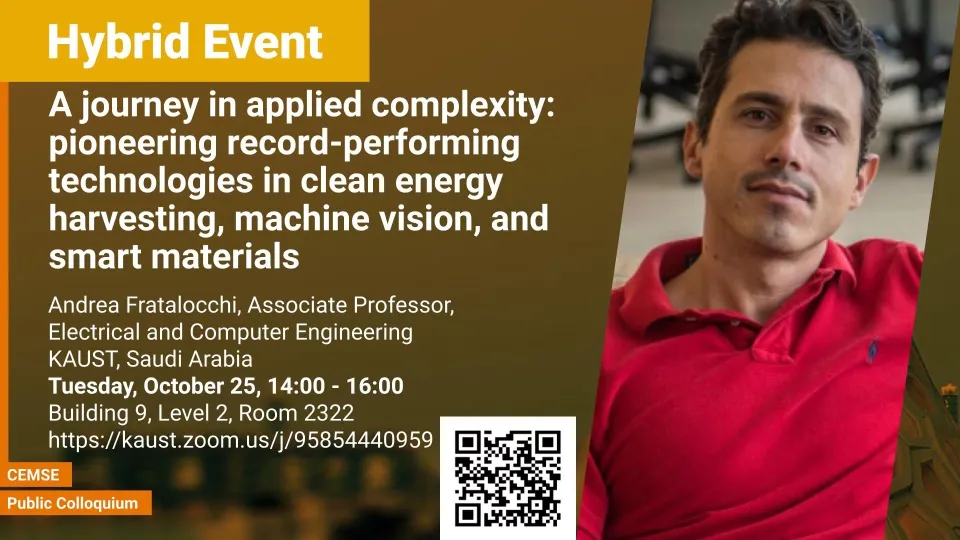
A journey in applied complexity: pioneering record-performing technologies in clean energy harvesting, machine vision, and smart materials - Public Colloquium Andrea Fratalocchi, Professor, Electrical and Computer Engineering Oct 25, 14:00 - 16:00 B9 L2 R2322 Applied complexity artificial intelligence information security biomedical applications Applied Complexity aims to understand the physical origin of these behaviors and transform them into sustainable technologies that tackle global problems of global interest. These range from energy harvesting to clean water production, the design of smart materials, biomedical applications, information security, artificial intelligence, and global warming. In this talk, I will summarize my group's recent research, discussing present results and future challenges of Applied complexity both as a science and engineering.
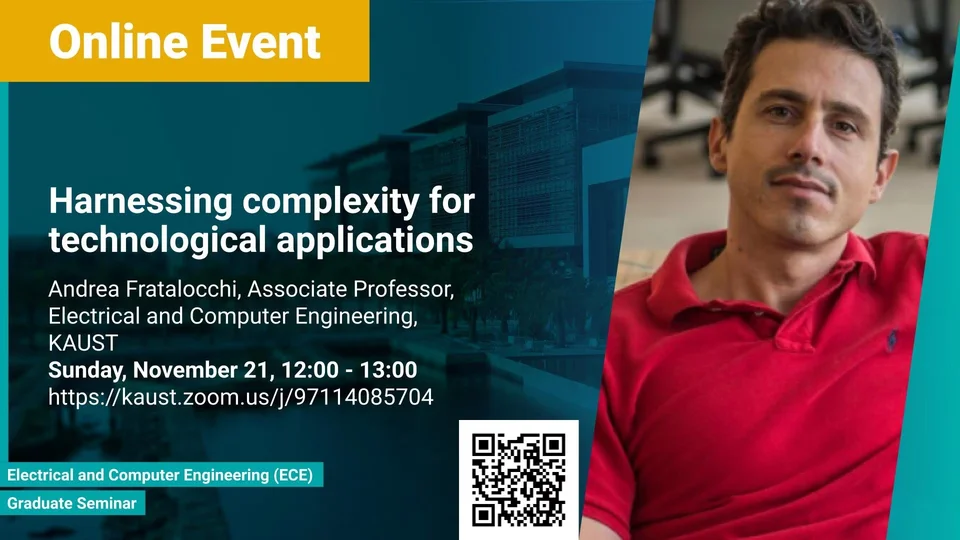
Harnessing complexity for technological applications Andrea Fratalocchi, Professor, Electrical and Computer Engineering Nov 21, 12:00 - 13:00 KAUST Harnessing complexity for technological applications This talk will give an overview of research activity of engineering different types of complex systems into technological applications in energy harvesting, material science, artificial intelligence and bio-imaging.
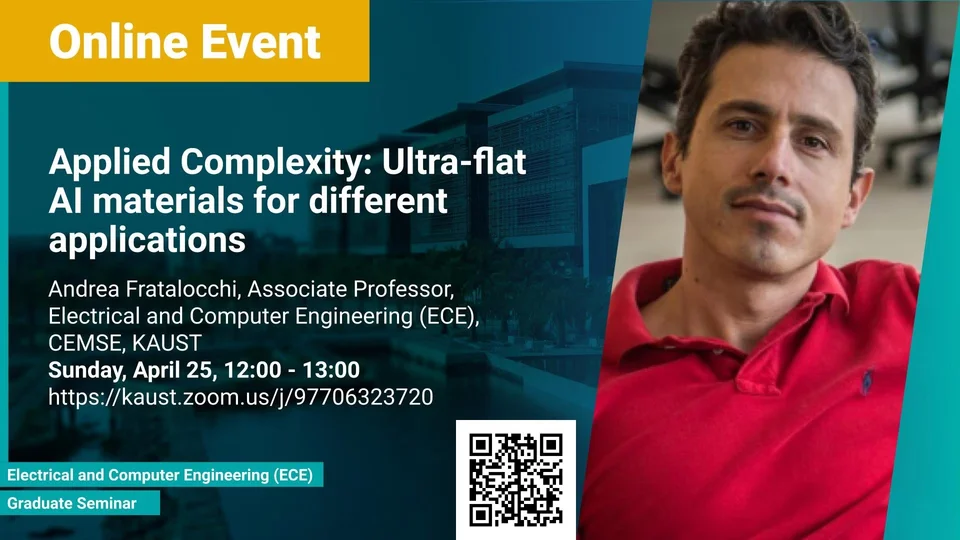
Applied Complexity: Ultra-flat AI materials for different applications Andrea Fratalocchi, Professor, Electrical and Computer Engineering Apr 25, 12:00 - 13:00 KAUST We review our recent results on artificial-intelligent designed ultra-flat materials that embeds "physical" neural networks for different application in biomedical imaging, optics, displays, and structural color generation.
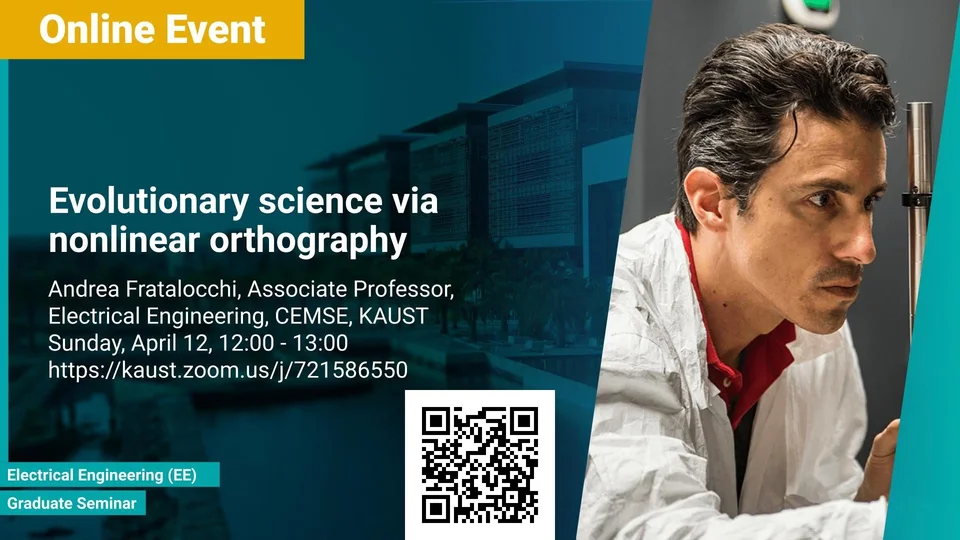
Evolutionary science via nonlinear orthography Andrea Fratalocchi, Professor, Electrical and Computer Engineering Apr 12, 12:00 - 13:00 KAUST Evolutionary science nonlinear orthography The goal of our research is to understand the physical origin of these behaviors and trasform them into sustainable technologies that tackle contemporary problem of global interest, ranging from energy harvesting to clean water production, design of smart materials, biomedical applications, information security, artificial intelligence, global warming, and so on. Creating technologies from complex natural systems is a modern interdisciplinary research field that permeates many different scientific areas, ranging from physics to mathematics, to engineering and the theory of linguistics. This is a very challenging, yet very promising research. It involves the understanding of what we consider complex, which translates as something “involved, intricate, complicated, not easily understood or analyzed”. This sets the challenge of being able to understand the mechanisms of these systems and cross many different disciplines in order to constructively harness their properties into reproducible applications.
Engage ORCID KAUST Repository KAUST Academic Portal Scopus ShareClipboard Related Sites Electrical and Computer Engineering (ECE) Applied Mathematics and Computational Science (AMCS) Center of Excellence for Generative AI (GenAI) Primalight Laboratory (Primalight) Related Content Articles 23 Events 6