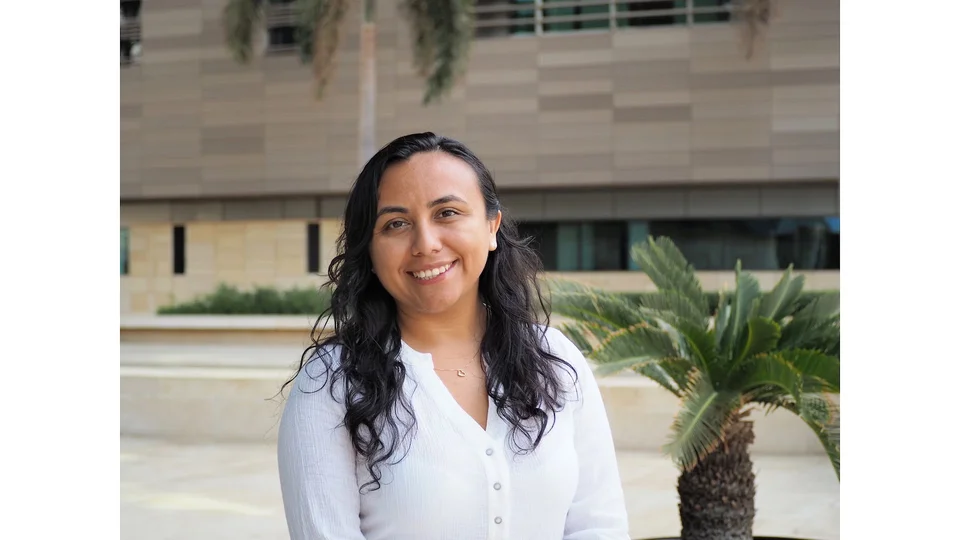
About Carolina D. Euan Campos Carolina D. Euan Campos Postdoctoral Research Fellow, Statistics Environmental Statistics High dimensional Time Series computational statistics Dr. Carolina Euan is a postdoctoral fellow at the Environmental Statistics Research Group at King Abdullah University of Science and Technology (KAUST). Education and Early Career Carolina Euan received her Ph.D. degree in Probability and Statistics from the Center for Research in Mathematics (CIMAT), Mexico, in 2016. She joined KAUST as a Postdoctoral Research Fellow in October 2016. Research Interest High dimensional Time Series, Spatio-Temporal Models, Non-Stationary Processes, Complex Data Visualization, Computational Statistics. Awards and Distinctions Sylvia Esterby Presentation Award Events Presented Events Nov 24 - Nov 30, 2019 Statistical Analysis of Multi-day Solar Irradiance using a Threshold Time Series model Carolina D. Euan Campos, Postdoctoral Research Fellow, Statistics Nov 28, 12:00 - 13:00 B9 H2 R2325 solar energy solar irradiance analysis nonlinearity TAR model statistical analysis forecasting Abstract The analysis of solar irradiance has important applications in predicting solar energy production from solar power plants. Although the sun provides every day more energy than we need, the variability caused by environmental conditions affects electricity production. Most of the existing statistical models to forecast solar irradiance are linear and highly depend on normality assumptions. However, solar irradiance shows strong non-linearity and is only measured during the day time. Thus, we propose a new multi-day threshold autoregressive (TAR) model to quantify the variability of the
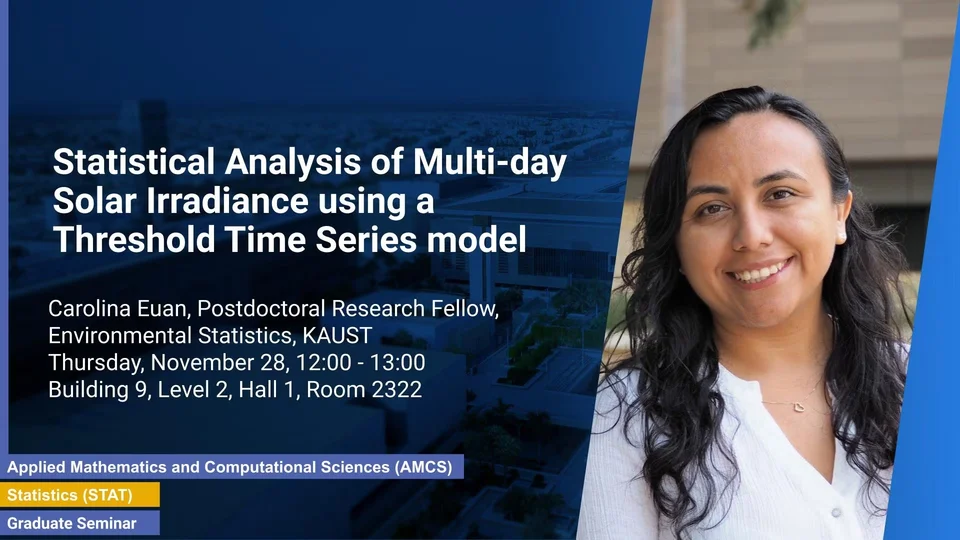
Statistical Analysis of Multi-day Solar Irradiance using a Threshold Time Series model Carolina D. Euan Campos, Postdoctoral Research Fellow, Statistics Nov 28, 12:00 - 13:00 B9 H2 R2325 solar energy solar irradiance analysis nonlinearity TAR model statistical analysis forecasting Abstract The analysis of solar irradiance has important applications in predicting solar energy production from solar power plants. Although the sun provides every day more energy than we need, the variability caused by environmental conditions affects electricity production. Most of the existing statistical models to forecast solar irradiance are linear and highly depend on normality assumptions. However, solar irradiance shows strong non-linearity and is only measured during the day time. Thus, we propose a new multi-day threshold autoregressive (TAR) model to quantify the variability of the
Engage ORCID ShareClipboard Related Sites Environmental Statistics (ES) Statistics (STAT) Related Content Articles 2 Events 1 Related Links Environmental Statistics Research Group Carolina's Webpage