About Daniele Boffi Daniele Boffi Associate Dean for Faculty, Computer, Electrical and Mathematical Sciences and Engineering mixed finite elements fluid dynamics eigenvalue approximation numerical PDEs Finite elements Professor Boffi is a leading international expert in mixed finite elements and the approximation of eigenvalue problems arising from partial differential equations. Events Presented Events Nov 23 - Nov 29, 2025 Finite Element Approximation of Eigenvalue Problems in Mixed Form Daniele Boffi, Associate Dean for Faculty, Computer, Electrical and Mathematical Sciences and Engineering Nov 27, 12:00 - 13:00 B9 L2 R2325 This talk will discuss the finite element approximation of the eigenvalues associated with the Maxwell system. Nov 12 - Nov 18, 2023 Tensor-train Methods for Partial Differential Equations and its application to a Neutron Transport Problem Daniele Boffi, Associate Dean for Faculty, Computer, Electrical and Mathematical Sciences and Engineering Nov 14, 15:30 - 17:00 B9 L4 R4225 Partial Differential Equations Tensor network techniques are known for their ability to approximate low-rank structures and beat the curse of dimensionality. They are also increasingly acknowledged as fundamental mathematical tools for efficiently solving high-dimensional Partial Differential Equations (PDEs). In this talk, we present a novel method that incorporates the Tensor Train (TT) and Quantized Tensor Train (QTT) formats for the computational resolution of time-independent Boltzmann Neutron Transport equations (BNTEs) in Cartesian coordinates. Oct 9 - Oct 15, 2022 Finite element approximation of parameter dependent eigenvalue problems Daniele Boffi, Associate Dean for Faculty, Computer, Electrical and Mathematical Sciences and Engineering Oct 11, 12:00 - 13:00 B9 L2 R2322 Finite element approximation of parameter dependent eigenvalue problems Eigenvalue problems arising from partial differential equations are used to model several applications in science and engineering, ranging from vibrations of structures, industrial microwaves, photonic crystals, and waveguides, to particle accelerators. Nov 7 - Nov 13, 2021 Compatibility conditions for finite element approximations Daniele Boffi, Associate Dean for Faculty, Computer, Electrical and Mathematical Sciences and Engineering Nov 11, 12:00 - 13:00 KAUST In the classical theory of the finite element approximation of elliptic partial differential equations, based on standard Galerkin schemes, the energy norm of the error decays with the same rate of convergence as the best finite element approximation, without any additional requirements on the involved spaces. Oct 25 - Oct 31, 2020 On the approximation of the spectrum of differential operators Daniele Boffi, Associate Dean for Faculty, Computer, Electrical and Mathematical Sciences and Engineering Oct 29, 12:00 - 13:00 KAUST Eigenvalue problems associated with partial differential equations are key ingredients for the modeling and simulation of a variety of real world applications, ranging from fluid-dynamics, structural mechanics, acoustics, to electromagnetism and medical problems. We review some properties related to the approximation of eigenvalue problems. Starting from matrix algebraic problems, we present a series of examples and counterexamples showing that even extremely simple situations can produce unexpected results.
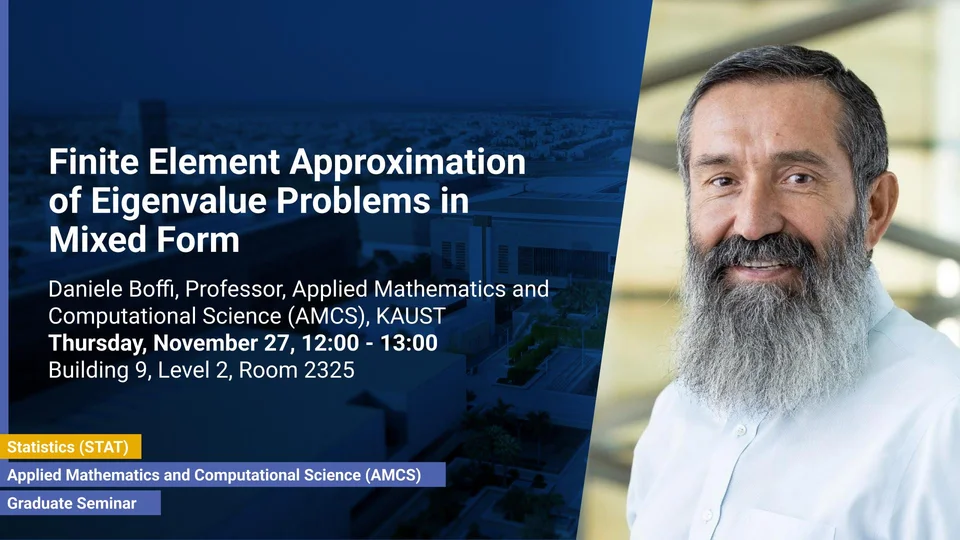
Finite Element Approximation of Eigenvalue Problems in Mixed Form Daniele Boffi, Associate Dean for Faculty, Computer, Electrical and Mathematical Sciences and Engineering Nov 27, 12:00 - 13:00 B9 L2 R2325 This talk will discuss the finite element approximation of the eigenvalues associated with the Maxwell system.
Daniele Boffi, Associate Dean for Faculty, Computer, Electrical and Mathematical Sciences and Engineering
Tensor-train Methods for Partial Differential Equations and its application to a Neutron Transport Problem Daniele Boffi, Associate Dean for Faculty, Computer, Electrical and Mathematical Sciences and Engineering Nov 14, 15:30 - 17:00 B9 L4 R4225 Partial Differential Equations Tensor network techniques are known for their ability to approximate low-rank structures and beat the curse of dimensionality. They are also increasingly acknowledged as fundamental mathematical tools for efficiently solving high-dimensional Partial Differential Equations (PDEs). In this talk, we present a novel method that incorporates the Tensor Train (TT) and Quantized Tensor Train (QTT) formats for the computational resolution of time-independent Boltzmann Neutron Transport equations (BNTEs) in Cartesian coordinates.
Daniele Boffi, Associate Dean for Faculty, Computer, Electrical and Mathematical Sciences and Engineering
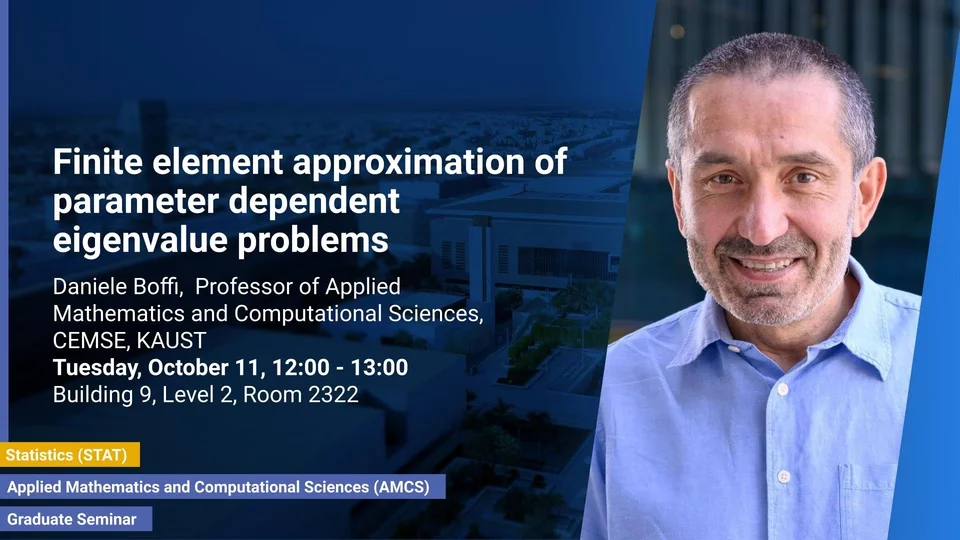
Finite element approximation of parameter dependent eigenvalue problems Daniele Boffi, Associate Dean for Faculty, Computer, Electrical and Mathematical Sciences and Engineering Oct 11, 12:00 - 13:00 B9 L2 R2322 Finite element approximation of parameter dependent eigenvalue problems Eigenvalue problems arising from partial differential equations are used to model several applications in science and engineering, ranging from vibrations of structures, industrial microwaves, photonic crystals, and waveguides, to particle accelerators.
Daniele Boffi, Associate Dean for Faculty, Computer, Electrical and Mathematical Sciences and Engineering
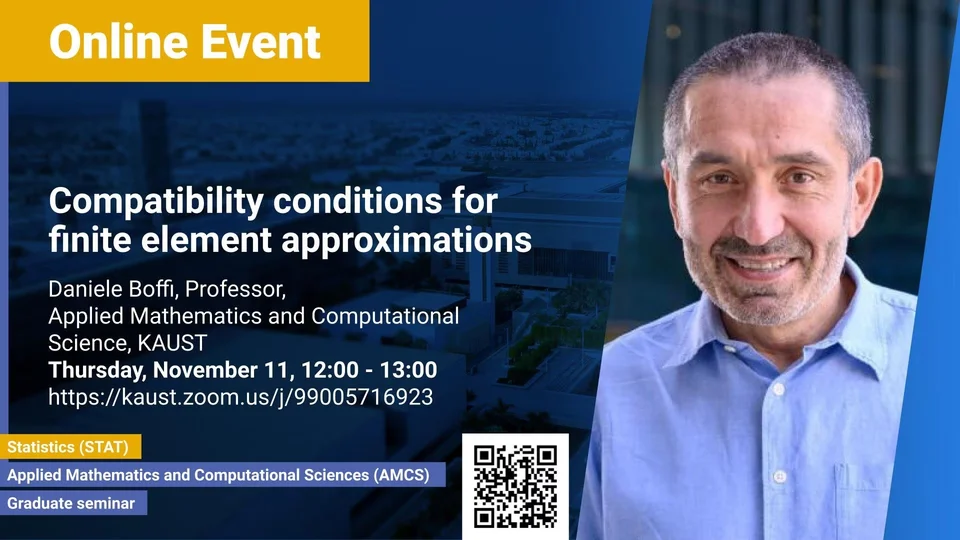
Compatibility conditions for finite element approximations Daniele Boffi, Associate Dean for Faculty, Computer, Electrical and Mathematical Sciences and Engineering Nov 11, 12:00 - 13:00 KAUST In the classical theory of the finite element approximation of elliptic partial differential equations, based on standard Galerkin schemes, the energy norm of the error decays with the same rate of convergence as the best finite element approximation, without any additional requirements on the involved spaces.
Daniele Boffi, Associate Dean for Faculty, Computer, Electrical and Mathematical Sciences and Engineering
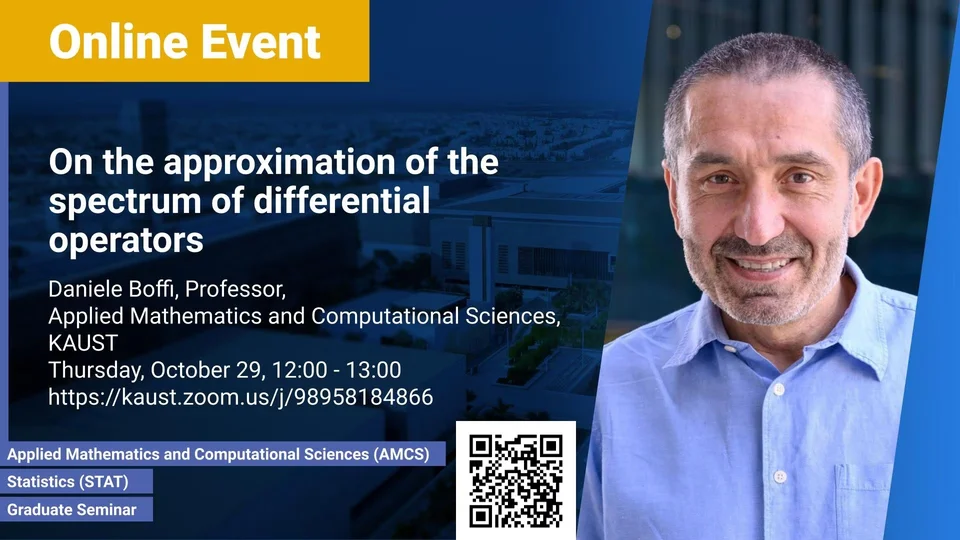
On the approximation of the spectrum of differential operators Daniele Boffi, Associate Dean for Faculty, Computer, Electrical and Mathematical Sciences and Engineering Oct 29, 12:00 - 13:00 KAUST Eigenvalue problems associated with partial differential equations are key ingredients for the modeling and simulation of a variety of real world applications, ranging from fluid-dynamics, structural mechanics, acoustics, to electromagnetism and medical problems. We review some properties related to the approximation of eigenvalue problems. Starting from matrix algebraic problems, we present a series of examples and counterexamples showing that even extremely simple situations can produce unexpected results.
Daniele Boffi, Associate Dean for Faculty, Computer, Electrical and Mathematical Sciences and Engineering
Engage KAUST Repository KAUST Academic Portal ORCID Scopus ShareClipboard Related Sites Applied Mathematics and Computational Science (AMCS) Numerical Methods for PDEs (NumPDE) Related Content Articles 12 Events 5