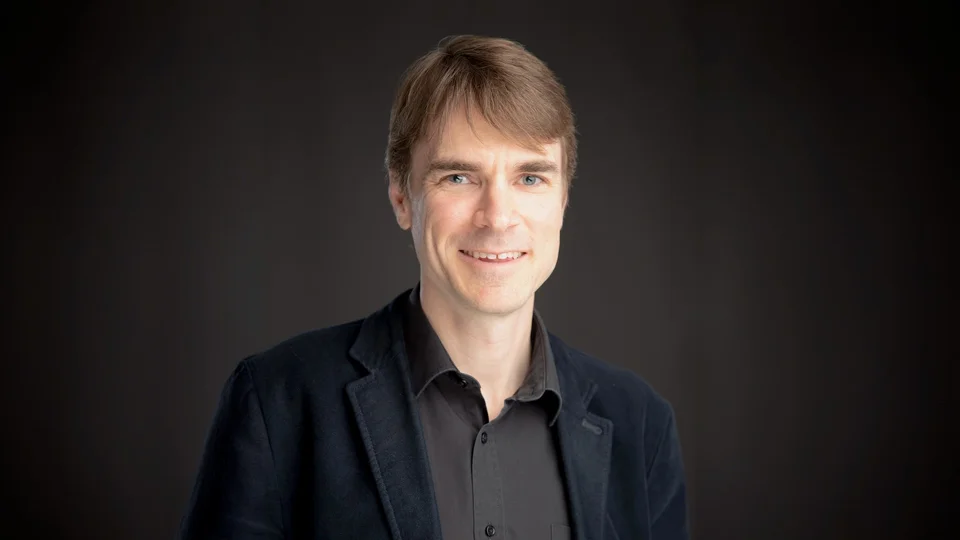
About David Ketcheson David Ketcheson Professor, Applied Mathematics and Computational Science numerical methods numerical analysis PDE nonlinear waves heterogenouse media dispersive waves optimization software development Professor Ketcheson is an expert in numerical analysis and computational science, specializing in the study of numerical methods for differential equations and the modeling and analysis of time-dependent nonlinear wave phenomena. Events Presented Events Nov 12 - Nov 18, 2023 How do periodic structures affect nonlinear waves? David Ketcheson, Professor, Applied Mathematics and Computational Science Nov 16, 12:00 - 13:00 B9 L2 H2 We are all familiar with the tendency of water waves to break in shallow water, for instance at the beach. Indeed, breaking is a universal behavior of solutions to first-order nonlinear hyperbolic PDEs, and manifests itself in phenomena ranging from traffic jams to shock waves. Nov 6 - Nov 12, 2022 Modeling water waves: from tsunamis to the kitchen sink David Ketcheson, Professor, Applied Mathematics and Computational Science Nov 8, 12:00 - 13:00 B9 L2 R2322 water waves Tsunamis Statistical Modelling Surface water waves are a physically important phenomenon with which we all have some experience. They are also surprisingly complex and interesting from a mathematical perspective. I will discuss two recent projects in water wave modeling. The first deals with ocean waves, such as tsunamis, passing over the continental slope. It has long been known that the amplification of such waves is greater than what the traditional transmission coefficient would predict. Feb 27 - Mar 5, 2022 Modelling waves with structure-preserving numerical discretizations David Ketcheson, Professor, Applied Mathematics and Computational Science Feb 27, 14:00 - 16:00 B9 L2 H2 Models of physical phenomena include important qualitative properties, and any useful approximate solution of the model must respect these properties. Such properties include conservation or dissipation of energy, as well as positivity of quantities like mass, probability, or concentration. Preservation of these properties in computationally affordable numerical solutions of complex physical models remains a major challenge today. I will describe some recent advances in numerical methods for general dynamical systems that enable preservation of system dynamics and of bounds on the state, in the context of high-order accurate and efficient discretizations. The power of these methods will be demonstrated through applications in the area of surface water waves. Dec 5 - Dec 11, 2021 Backward Error Analysis for Nonlinear Differential Equations David Ketcheson, Professor, Applied Mathematics and Computational Science Dec 9, 12:00 - 13:00 KAUST Backward error analysis is a tool that allows us to understand the effect of errors without knowing exact solutions. Oct 11 - Oct 17, 2020 Epidemiological modeling and optimal control David Ketcheson, Professor, Applied Mathematics and Computational Science Oct 15, 12:00 - 13:00 KAUST optimal control optimal control theory Compartmental epidemiological models are one of the simplest models for the spread of a disease. They are based on statistical models of interactions in large populations and can be effective in the appropriate circumstances. Their application historically and in the present pandemic has sometimes been successful and sometimes spectacularly wrong. In this talk I will review some of these models and their application. I will also discuss the behavior of the corresponding dynamical systems, and discuss how the theory of optimal control can be applied to them. I will describe some of the challenges in using such a theory to make decisions about public policy. Oct 27 - Nov 2, 2019 Energy-conserving and energy-stable discretizations of differential equations David Ketcheson, Professor, Applied Mathematics and Computational Science Oct 31, 12:00 - 13:00 B9 L2 H1 R2322 numerical discretization energy stability energy conservation Runge-Kutta methods Abstract Many physical models are characterized by the property that some measure of energy is conserved or is non-increasing in time. This property may be challenging to guarantee in numerical discretizations; often it requires the use of costly implicit methods. I will review some approaches to energy stability and describe a new approach that guarantees energy stability with a general class of explicit schemes that are a simple modification of standard Runge-Kutta methods. Brief Biography David Ketcheson is an Associate Professor of Applied Mathematics and Computational Science (AMCS) and
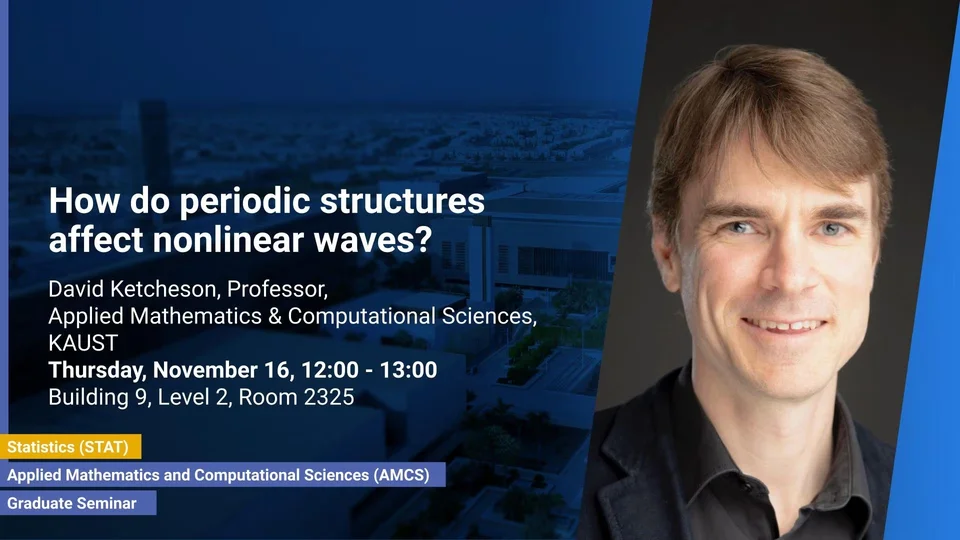
How do periodic structures affect nonlinear waves? David Ketcheson, Professor, Applied Mathematics and Computational Science Nov 16, 12:00 - 13:00 B9 L2 H2 We are all familiar with the tendency of water waves to break in shallow water, for instance at the beach. Indeed, breaking is a universal behavior of solutions to first-order nonlinear hyperbolic PDEs, and manifests itself in phenomena ranging from traffic jams to shock waves.
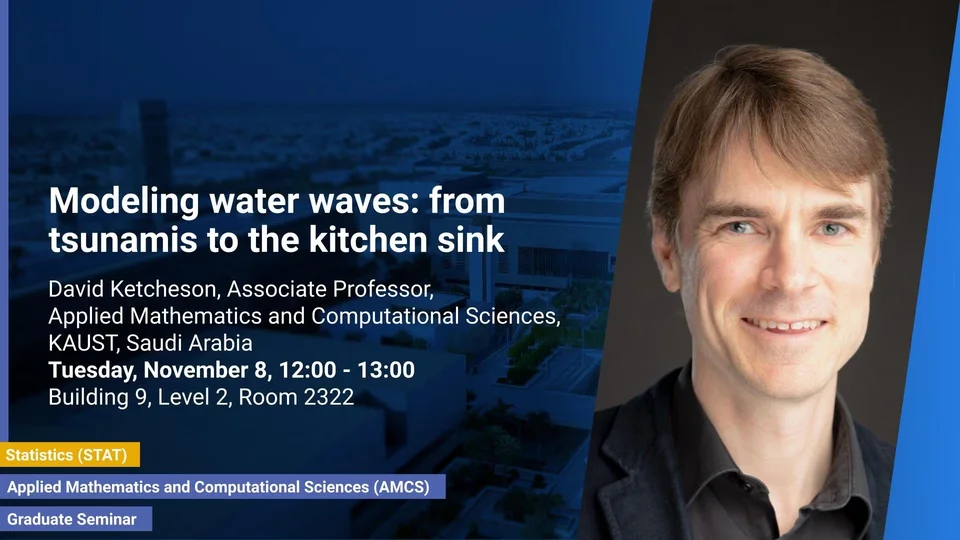
Modeling water waves: from tsunamis to the kitchen sink David Ketcheson, Professor, Applied Mathematics and Computational Science Nov 8, 12:00 - 13:00 B9 L2 R2322 water waves Tsunamis Statistical Modelling Surface water waves are a physically important phenomenon with which we all have some experience. They are also surprisingly complex and interesting from a mathematical perspective. I will discuss two recent projects in water wave modeling. The first deals with ocean waves, such as tsunamis, passing over the continental slope. It has long been known that the amplification of such waves is greater than what the traditional transmission coefficient would predict.
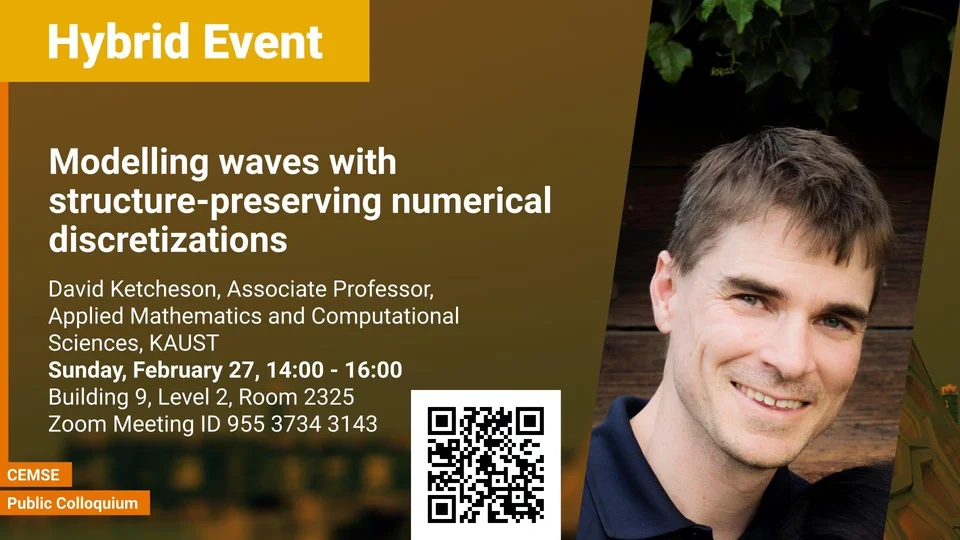
Modelling waves with structure-preserving numerical discretizations David Ketcheson, Professor, Applied Mathematics and Computational Science Feb 27, 14:00 - 16:00 B9 L2 H2 Models of physical phenomena include important qualitative properties, and any useful approximate solution of the model must respect these properties. Such properties include conservation or dissipation of energy, as well as positivity of quantities like mass, probability, or concentration. Preservation of these properties in computationally affordable numerical solutions of complex physical models remains a major challenge today. I will describe some recent advances in numerical methods for general dynamical systems that enable preservation of system dynamics and of bounds on the state, in the context of high-order accurate and efficient discretizations. The power of these methods will be demonstrated through applications in the area of surface water waves.
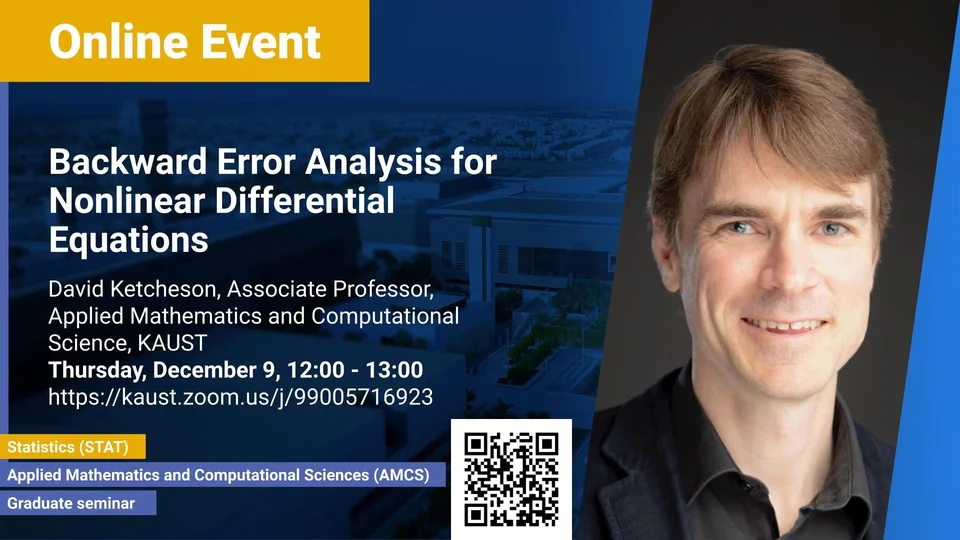
Backward Error Analysis for Nonlinear Differential Equations David Ketcheson, Professor, Applied Mathematics and Computational Science Dec 9, 12:00 - 13:00 KAUST Backward error analysis is a tool that allows us to understand the effect of errors without knowing exact solutions.
Epidemiological modeling and optimal control David Ketcheson, Professor, Applied Mathematics and Computational Science Oct 15, 12:00 - 13:00 KAUST optimal control optimal control theory Compartmental epidemiological models are one of the simplest models for the spread of a disease. They are based on statistical models of interactions in large populations and can be effective in the appropriate circumstances. Their application historically and in the present pandemic has sometimes been successful and sometimes spectacularly wrong. In this talk I will review some of these models and their application. I will also discuss the behavior of the corresponding dynamical systems, and discuss how the theory of optimal control can be applied to them. I will describe some of the challenges in using such a theory to make decisions about public policy.
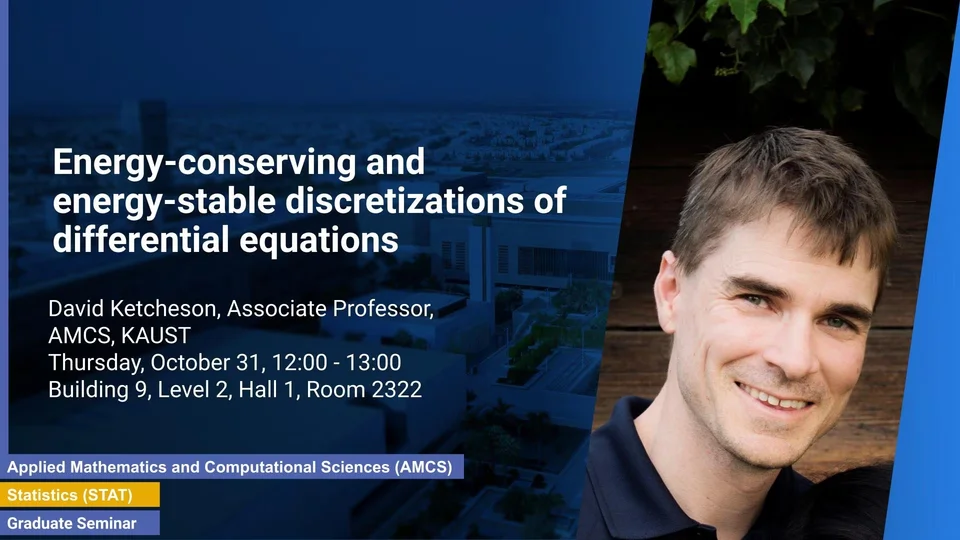
Energy-conserving and energy-stable discretizations of differential equations David Ketcheson, Professor, Applied Mathematics and Computational Science Oct 31, 12:00 - 13:00 B9 L2 H1 R2322 numerical discretization energy stability energy conservation Runge-Kutta methods Abstract Many physical models are characterized by the property that some measure of energy is conserved or is non-increasing in time. This property may be challenging to guarantee in numerical discretizations; often it requires the use of costly implicit methods. I will review some approaches to energy stability and describe a new approach that guarantees energy stability with a general class of explicit schemes that are a simple modification of standard Runge-Kutta methods. Brief Biography David Ketcheson is an Associate Professor of Applied Mathematics and Computational Science (AMCS) and
Engage ORCID Scopus KAUST Academic Portal KAUST Repository ShareClipboard Related Sites Applied Mathematics and Computational Science (AMCS) Numerical Mathematics (Numerics) Related Content Articles 7 Projects 4 Events 6 Related Links Personal website