About David Ketcheson David Ketcheson Professor, Applied Mathematics and Computational Science numerical methods numerical analysis PDE nonlinear waves heterogenouse media dispersive waves optimization software development Professor Ketcheson is an expert in numerical analysis and computational science, specializing in the study of numerical methods for differential equations and the modeling and analysis of time-dependent nonlinear wave phenomena. Articles Related News March 2021 Meet KAUST New Student: Carlos Andrés Muñoz Moncayo 2 min read · Wed, Mar 31 2021 News Carlos Andrés Muñoz Moncayo is a mathematics graduate from Yachay Tech University, Ecuador, who joined KAUST in February 2021. Carlos believes that KAUST’s renowned faculty, unique facilities and diverse community make the University the best environment for him to develop high-quality and impactful research. February 2021 ECRC contributions to SIAM CSE21 4 min read · Sat, Feb 27 2021 News research conference HPC computational science and engineering ECRC @ SIAM CSE21! Follow us @KAUST_ECRC As in previous SIAM conferences on Parallel Processing (PP) and Computational Science and Engineering (CSE), ECRC members and their collaborators will have a strong presence at SIAM CSE21, nominally in Fort Worth, Texas, but held virtually due to the pandemic. ************************************************** SIAM CSE21 will run virtually with live sessions. ************************************************** Registration to SIAM CSE is required to gain access to the online platform and attend live sessions. Once registered, please use your personal July 2020 A shock to the system 3 min read · Wed, Jul 22 2020 News Spectral Analysis numerical analysis COVID-19 research The global, multifarious challenge posed by the COVID-19 pandemic has scientists tapping their wide-ranging fields of expertise to attack the problem on many fronts. Answering the call from KAUST President Tony Chan, and coordinated by the University's leadership team, KAUST researchers making up the Rapid Research Response Team (R3T) are turning this crisis into an opportunity to innovate. April 2020 Understanding the COVID wave 1 min read · Thu, Apr 16 2020 News numerical analysis numerical methods As countries around the world work to "flatten the curve," a reference to slowing the progression of COVID-19 cases, David Ketcheson is putting mathematical modeling to work to understand how transmission is playing out. Unlocking coronavirus' secrets through cellphone data and social media 1 min read · Sun, Apr 12 2020 News Dr. Paula Moraga is part of a multidisciplinary KAUST research team that applies models to COVID-19. She has worked on projects examining malaria in Africa and leptospirosis in Brazil, and the models she develops rely on in-depth knowledge about each disease. "With malaria, for example, we know that it's transmitted by mosquitoes," said Moraga. "So, if some regions have a high density of mosquitoes, are close to bodies of water or have a lot of humidity, we know that we are going to probably see a high risk of this disease." Into the unknown In many places, malaria and leptospirosis January 2020 Steep learning in mathematics of big waves 1 min read · Sun, Jan 19 2020 News extreme weather A better mathematical understanding of how big waves form could lead to better prediction of tsunami impacts. April 2017 KAUST Research Conference: Predictive Complex Computational Fluid Dynamics 2017 2 min read · Mon, Apr 3 2017 News computational fluid dynamics multi-scale complex flow simulations KAUST will host the 2017 Research Conference "Predictive Complex Computational Fluid Dynamics " on May 22-24, 2017. The Research Conference aims to gather international top scientists of all ages from academia and industry and will focus on cutting-edge research in the field of algorithmic development for CFD and multi-scale complex flow simulations. Although CFD is arguably the oldest area of computational science, it is a very challenging and active one, due to to the fact that worldwide research centers, in the private and public sector, are still actively working on the development and application of CFD algorithms to supplement experiment and to interpolate between experimental scenarios. CFD is currently being applied to scenarios where physical experiments are not feasible due to prohibitive costs, and ethical concerns, or where reproducibility is impossible to achieve.
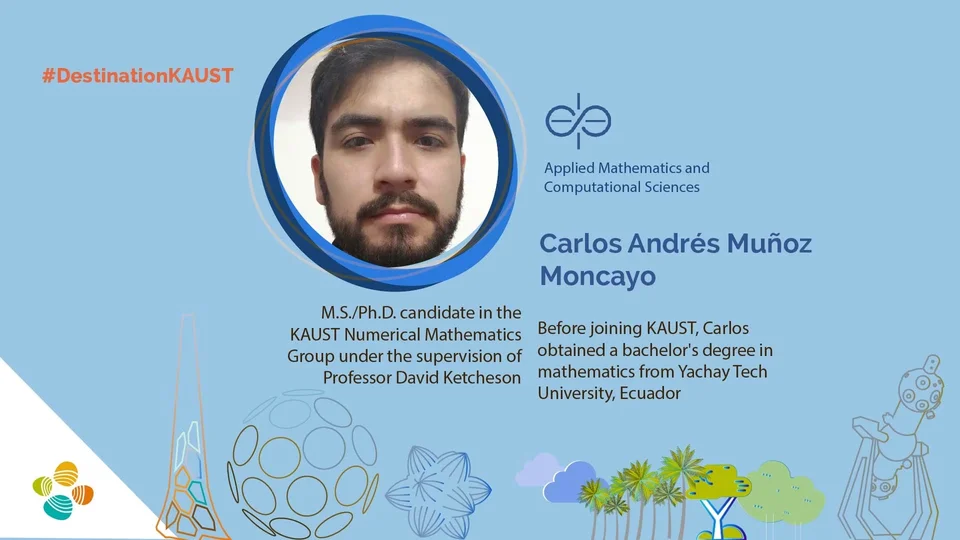
Meet KAUST New Student: Carlos Andrés Muñoz Moncayo 2 min read · Wed, Mar 31 2021 News Carlos Andrés Muñoz Moncayo is a mathematics graduate from Yachay Tech University, Ecuador, who joined KAUST in February 2021. Carlos believes that KAUST’s renowned faculty, unique facilities and diverse community make the University the best environment for him to develop high-quality and impactful research.
ECRC contributions to SIAM CSE21 4 min read · Sat, Feb 27 2021 News research conference HPC computational science and engineering ECRC @ SIAM CSE21! Follow us @KAUST_ECRC As in previous SIAM conferences on Parallel Processing (PP) and Computational Science and Engineering (CSE), ECRC members and their collaborators will have a strong presence at SIAM CSE21, nominally in Fort Worth, Texas, but held virtually due to the pandemic. ************************************************** SIAM CSE21 will run virtually with live sessions. ************************************************** Registration to SIAM CSE is required to gain access to the online platform and attend live sessions. Once registered, please use your personal
A shock to the system 3 min read · Wed, Jul 22 2020 News Spectral Analysis numerical analysis COVID-19 research The global, multifarious challenge posed by the COVID-19 pandemic has scientists tapping their wide-ranging fields of expertise to attack the problem on many fronts. Answering the call from KAUST President Tony Chan, and coordinated by the University's leadership team, KAUST researchers making up the Rapid Research Response Team (R3T) are turning this crisis into an opportunity to innovate.
Understanding the COVID wave 1 min read · Thu, Apr 16 2020 News numerical analysis numerical methods As countries around the world work to "flatten the curve," a reference to slowing the progression of COVID-19 cases, David Ketcheson is putting mathematical modeling to work to understand how transmission is playing out.
Unlocking coronavirus' secrets through cellphone data and social media 1 min read · Sun, Apr 12 2020 News Dr. Paula Moraga is part of a multidisciplinary KAUST research team that applies models to COVID-19. She has worked on projects examining malaria in Africa and leptospirosis in Brazil, and the models she develops rely on in-depth knowledge about each disease. "With malaria, for example, we know that it's transmitted by mosquitoes," said Moraga. "So, if some regions have a high density of mosquitoes, are close to bodies of water or have a lot of humidity, we know that we are going to probably see a high risk of this disease." Into the unknown In many places, malaria and leptospirosis
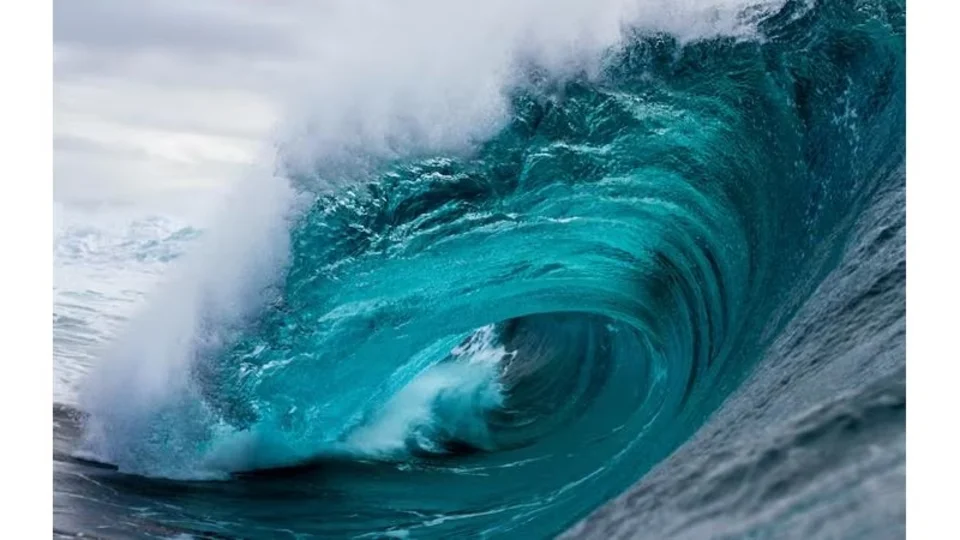
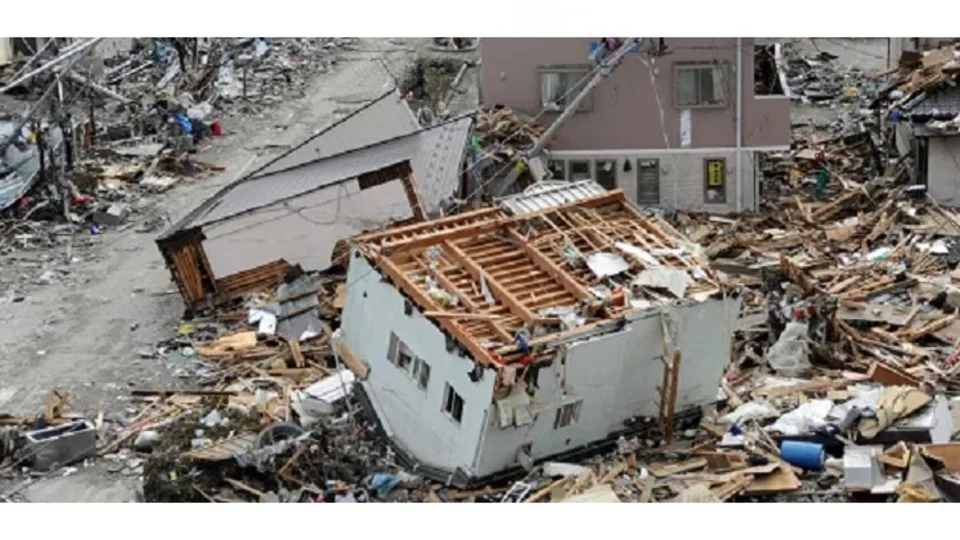
Steep learning in mathematics of big waves 1 min read · Sun, Jan 19 2020 News extreme weather A better mathematical understanding of how big waves form could lead to better prediction of tsunami impacts.
KAUST Research Conference: Predictive Complex Computational Fluid Dynamics 2017 2 min read · Mon, Apr 3 2017 News computational fluid dynamics multi-scale complex flow simulations KAUST will host the 2017 Research Conference "Predictive Complex Computational Fluid Dynamics " on May 22-24, 2017. The Research Conference aims to gather international top scientists of all ages from academia and industry and will focus on cutting-edge research in the field of algorithmic development for CFD and multi-scale complex flow simulations. Although CFD is arguably the oldest area of computational science, it is a very challenging and active one, due to to the fact that worldwide research centers, in the private and public sector, are still actively working on the development and application of CFD algorithms to supplement experiment and to interpolate between experimental scenarios. CFD is currently being applied to scenarios where physical experiments are not feasible due to prohibitive costs, and ethical concerns, or where reproducibility is impossible to achieve.
Engage ORCID Scopus KAUST Academic Portal KAUST Repository ShareClipboard Related Sites Applied Mathematics and Computational Science (AMCS) Numerical Mathematics (Numerics) Related Content Articles 7 Projects 4 Events 6 Related Links Personal website