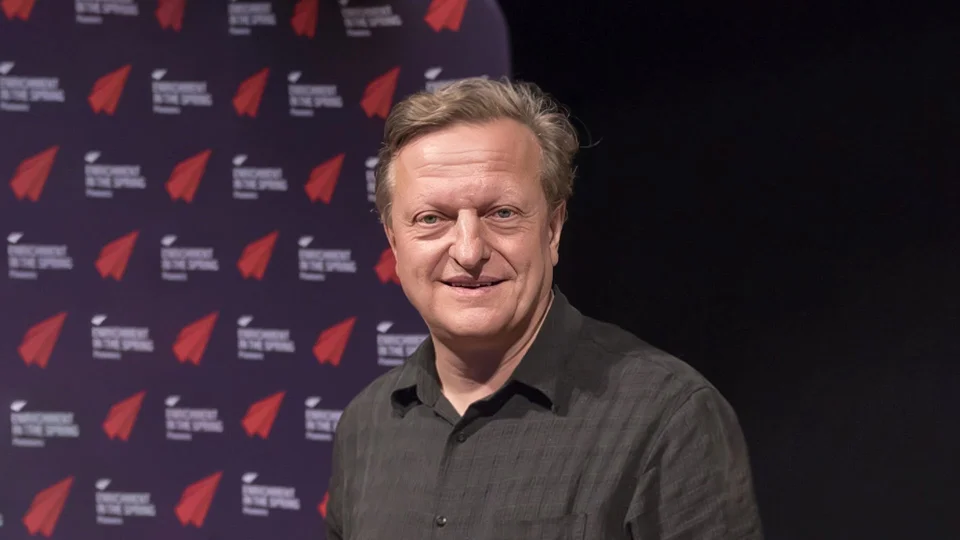
About Gabriel Wittum Gabriel Wittum Professor (former), Applied Mathematics and Computational Science numerical methods computational fluid dynamics neuroscience environmental research Dr. Gabriel Wittum, professor of applied mathematics and computational science at KAUST, is an expert in modelling and simulating problems in empirical science. Events Presented Events May 5 - May 11, 2024 Intracellular "in silico microscopes" - Fully 3D Spatio-Temporal Virus Replication Model Simulations Gabriel Wittum, Professor (former), Applied Mathematics and Computational Science May 9, 12:00 - 13:00 B9 L2 H2 H2 Despite being small and simple structured in comparison to their victims, virus particles have the potential to harm severly and even kill highly developed species such as humans. To face upcoming virus pandemics, detailed quantitative biophysical understanding of intracellular virus replication mechanisms is crucial. Apr 14 - Apr 20, 2024 Intracellular "in silico microscopes" - Fully 3D Spatio-Temporal Virus Replication Model Simulations Gabriel Wittum, Professor (former), Applied Mathematics and Computational Science Apr 15, 11:30 - 12:30 B9 L2 H2 Despite being small and simple structured in comparison to their victims, virus particles have the potential to harm severly and even kill highly developed species such as humans. To face upcoming virus pandemics, detailed quantitative biophysical un- derstanding of intracellular virus replication mechanisms is crucial. Unveiling the relationship of form and function will allow to determine putative attack points relevant for the systematic development of direct antiviral agents (DAA) and potent vacci- nes. Biophysical investigations of spatio-temporal dynamics of intracellular virus replication so far are rare. Dec 4 - Dec 10, 2022 Modelling and Simulation of Biological Systems - 2022-12-06 Gabriel Wittum, Professor (former), Applied Mathematics and Computational Science Dec 6, 12:00 - 13:00 B9 L2 R2322 Biological systems Biological systems are distinguished by their enormous complexity and variability. That is why mathematical modelling and computational simulation of those systems is very difficult, in particular thinking of detailed models which are based on first principles. The difficulties start with geometric modelling which needs to extract basic structures from highly complex and variable phenotypes, on the other hand also has to take the statistic variability into account. Nov 27 - Dec 3, 2022 Modelling and Simulation of Biological Systems - 2022-11-28 Gabriel Wittum, Professor (former), Applied Mathematics and Computational Science Nov 28, 12:00 - 13:00 B2 L5 R5209 applied mathematics bioengineering Biological systems are distinguished by their enormous complexity and variability. That is why mathematical modelling and computational simulation of those systems is very difficult, in particular thinking of detailed models which are based on first principles. The difficulties start with geometric modelling which needs to extract basic structures from highly complex and variable phenotypes, on the other hand also has to take the statistic variability into account. Aug 28 - Sep 3, 2022 Introduction to AMCS / STAT Graduate Seminar 398 Gabriel Wittum, Professor (former), Applied Mathematics and Computational Science Aug 30, 12:00 - 13:00 B9 L2 R2322 In this section, prof. Gabriel will be introducing the graduate seminar and its requirements. Feb 13 - Feb 19, 2022 Modelling and Simulation of Biological Systems - 2022-02-17 Gabriel Wittum, Professor (former), Applied Mathematics and Computational Science Feb 17, 12:00 - 13:00 B9 L2 H2 Biological systems are distinguished by their enormous complexity and variability. That is why mathematical modelling and computational simulation of those systems is very difficult, in particular thinking of detailed models which are based on first principles. The difficulties start with geometric modelling which needs to extract basic structures from highly complex and variable phenotypes, on the other hand also has to take the statistic variability into account. Nov 14 - Nov 20, 2021 Double Enriched Finite Volume Spaces for the DNS of fluid-Particle Interaction - Scientific Conference Gabriel Wittum, Professor (former), Applied Mathematics and Computational Science Nov 17, 14:00 - 14:40 KAUST Plenary Sessions Abstract We present double enriched finite volume spaces for the simulation of free particles in a fluid. This involves forces being exchanged between the particles and the fluid at the interface. In an earlier work we derived a monolithic scheme which includes the interaction forces into the Navier-Stokes equations by direct coupling. In multiphase flows oscillations and spurious velocities are a common issue. The surface force term yields a jump in the pressure and therefore the oscillations are usually resolved by extending the spaces on cut elements in order to resolve the discontinuity Nov 29 - Dec 5, 2020 Modelling and Simulation of Biological Systems - 2020-12-03 Gabriel Wittum, Professor (former), Applied Mathematics and Computational Science Dec 3, 12:00 - 13:00 KAUST Biological systems are distinguished by their enormous complexity and variability. That is why mathematical modeling and computational simulation of those systems is very difficult, in particular thinking of detailed models which are based on first principles. The difficulties start with geometric modeling which needs to extract basic structures from highly complex and variable phenotypes, on the other hand also has to take the statistic variability into account. Moreover, the models of the processes running on these geometries are not yet well established, since these are equally complex and often couple many scales in space and time. Thus, simulating such systems always means to put the whole frame to test, from modelling to the numerical methods and software tools used for simulation. These need to be advanced in connection with validating simulation results by comparing them to experiments. Apr 19 - Apr 25, 2020 Simulation of Neuronal Signal Processing - 2020-04-20 Gabriel Wittum, Professor (former), Applied Mathematics and Computational Science Apr 20, 12:00 - 13:00 KAUST Neuronal ensembles In the lecture, we present a three-dimensional model for the simulation of signal processing in neurons. Part of this approach is a method to reconstruct the geometric structure of neurons from data measured by 2-photon microscopy. Being able to reconstruct neural geometries and network connectivities from measured data is the basis of understanding coding of motoric perceptions and long term plasticity which is one of the main topics of neuroscience. Other issues are compartment models and upscaling. Mar 1 - Mar 7, 2020 Simulation of Neuronal Signal Processing - 2020-03-05 Gabriel Wittum, Professor (former), Applied Mathematics and Computational Science Mar 5, 12:00 - 13:00 B9 L2 R2322 Neuronal ensembles Stochastiic Variability neuroscience In the lecture we present a three dimensional mdoel for the simulation of signal processing in neurons. To handle problems of this complexity, new mathematical methods and software tools are required. In recent years, new approaches such as parallel adaptive multigrid methods and corresponding software tools have been developed allowing to treat problems of huge complexity. Part of this approach is a method to reconstruct the geometric structure of neurons from data measured by 2-photon microscopy. Being able to reconstruct neural geometries and network connectivities from measured data is the basis of understanding coding of motoric perceptions and long term plasticity which is one of the main topics of neuroscience. Other issues are compartment models and upscaling.
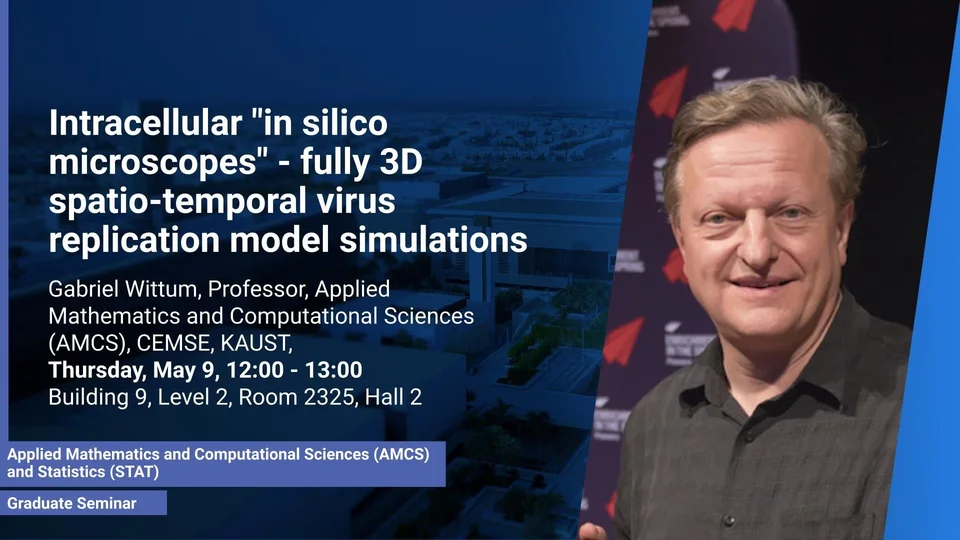
Intracellular "in silico microscopes" - Fully 3D Spatio-Temporal Virus Replication Model Simulations Gabriel Wittum, Professor (former), Applied Mathematics and Computational Science May 9, 12:00 - 13:00 B9 L2 H2 H2 Despite being small and simple structured in comparison to their victims, virus particles have the potential to harm severly and even kill highly developed species such as humans. To face upcoming virus pandemics, detailed quantitative biophysical understanding of intracellular virus replication mechanisms is crucial.
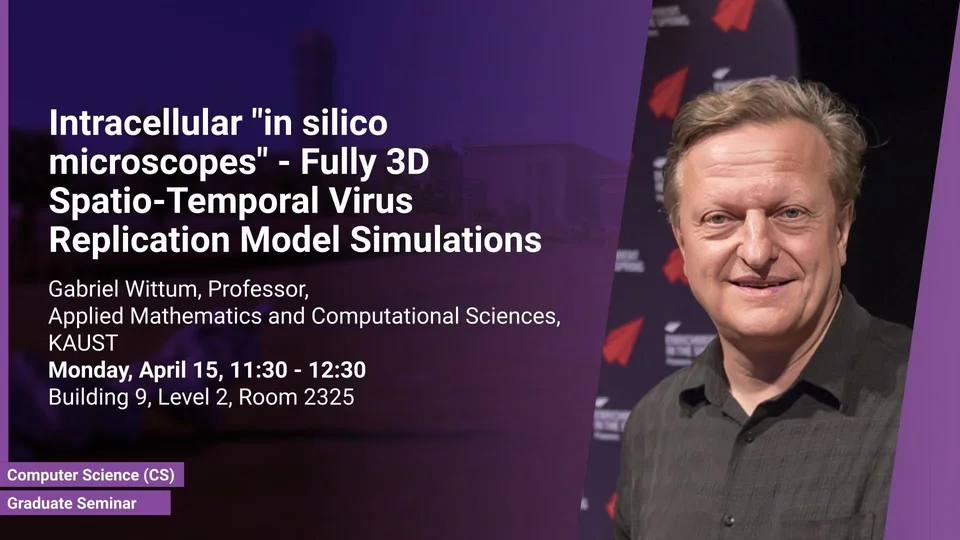
Intracellular "in silico microscopes" - Fully 3D Spatio-Temporal Virus Replication Model Simulations Gabriel Wittum, Professor (former), Applied Mathematics and Computational Science Apr 15, 11:30 - 12:30 B9 L2 H2 Despite being small and simple structured in comparison to their victims, virus particles have the potential to harm severly and even kill highly developed species such as humans. To face upcoming virus pandemics, detailed quantitative biophysical un- derstanding of intracellular virus replication mechanisms is crucial. Unveiling the relationship of form and function will allow to determine putative attack points relevant for the systematic development of direct antiviral agents (DAA) and potent vacci- nes. Biophysical investigations of spatio-temporal dynamics of intracellular virus replication so far are rare.
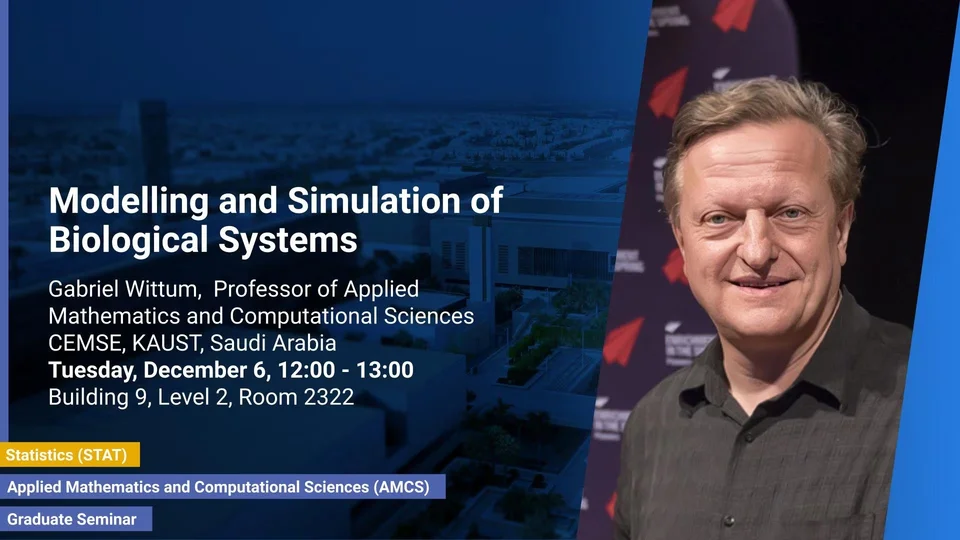
Modelling and Simulation of Biological Systems - 2022-12-06 Gabriel Wittum, Professor (former), Applied Mathematics and Computational Science Dec 6, 12:00 - 13:00 B9 L2 R2322 Biological systems Biological systems are distinguished by their enormous complexity and variability. That is why mathematical modelling and computational simulation of those systems is very difficult, in particular thinking of detailed models which are based on first principles. The difficulties start with geometric modelling which needs to extract basic structures from highly complex and variable phenotypes, on the other hand also has to take the statistic variability into account.
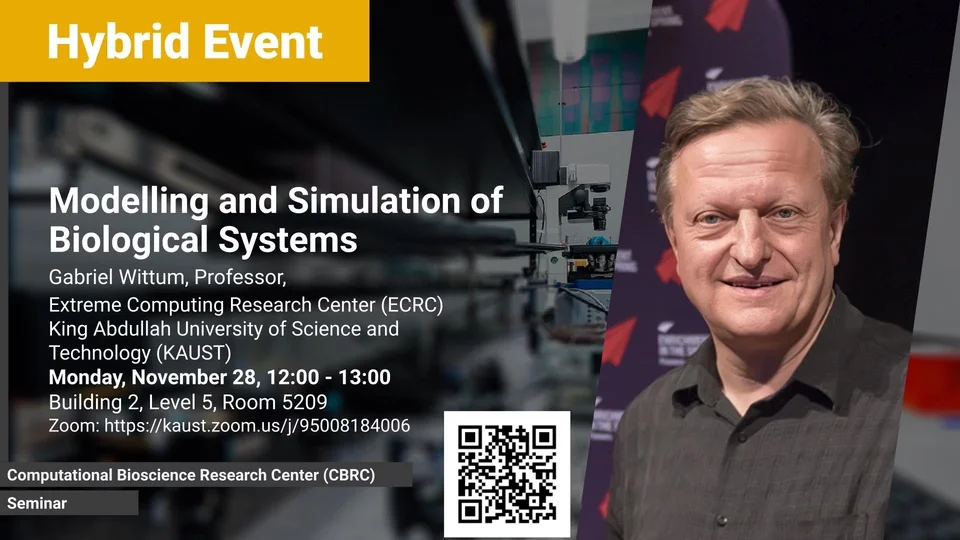
Modelling and Simulation of Biological Systems - 2022-11-28 Gabriel Wittum, Professor (former), Applied Mathematics and Computational Science Nov 28, 12:00 - 13:00 B2 L5 R5209 applied mathematics bioengineering Biological systems are distinguished by their enormous complexity and variability. That is why mathematical modelling and computational simulation of those systems is very difficult, in particular thinking of detailed models which are based on first principles. The difficulties start with geometric modelling which needs to extract basic structures from highly complex and variable phenotypes, on the other hand also has to take the statistic variability into account.
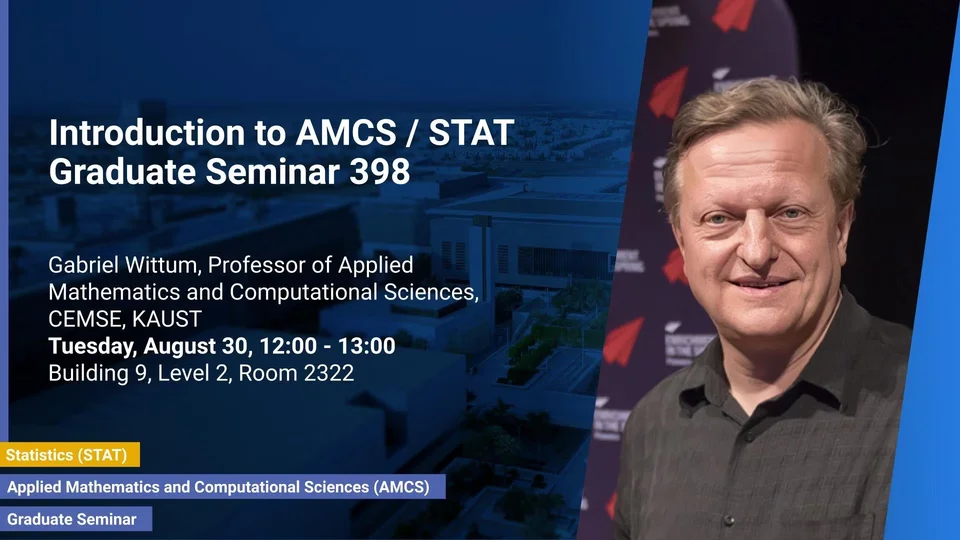
Introduction to AMCS / STAT Graduate Seminar 398 Gabriel Wittum, Professor (former), Applied Mathematics and Computational Science Aug 30, 12:00 - 13:00 B9 L2 R2322 In this section, prof. Gabriel will be introducing the graduate seminar and its requirements.
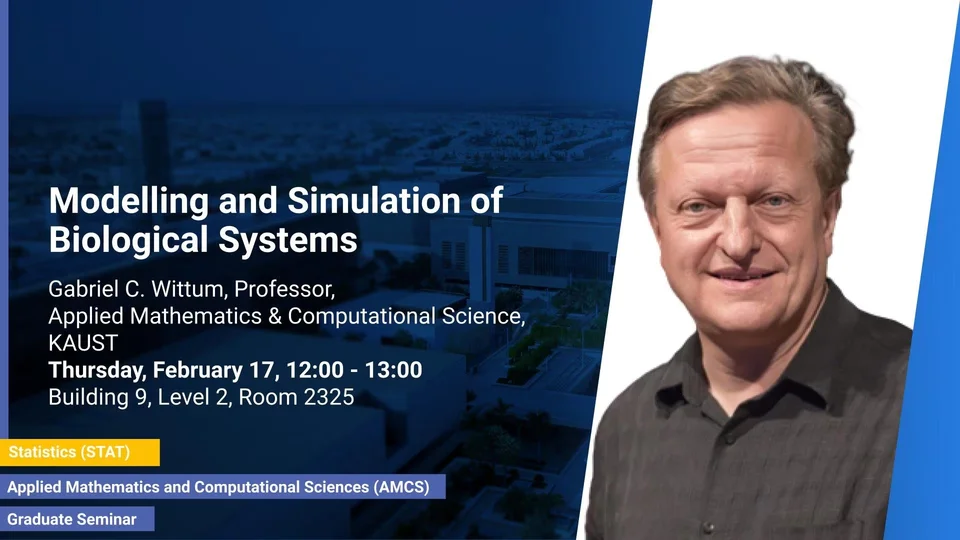
Modelling and Simulation of Biological Systems - 2022-02-17 Gabriel Wittum, Professor (former), Applied Mathematics and Computational Science Feb 17, 12:00 - 13:00 B9 L2 H2 Biological systems are distinguished by their enormous complexity and variability. That is why mathematical modelling and computational simulation of those systems is very difficult, in particular thinking of detailed models which are based on first principles. The difficulties start with geometric modelling which needs to extract basic structures from highly complex and variable phenotypes, on the other hand also has to take the statistic variability into account.
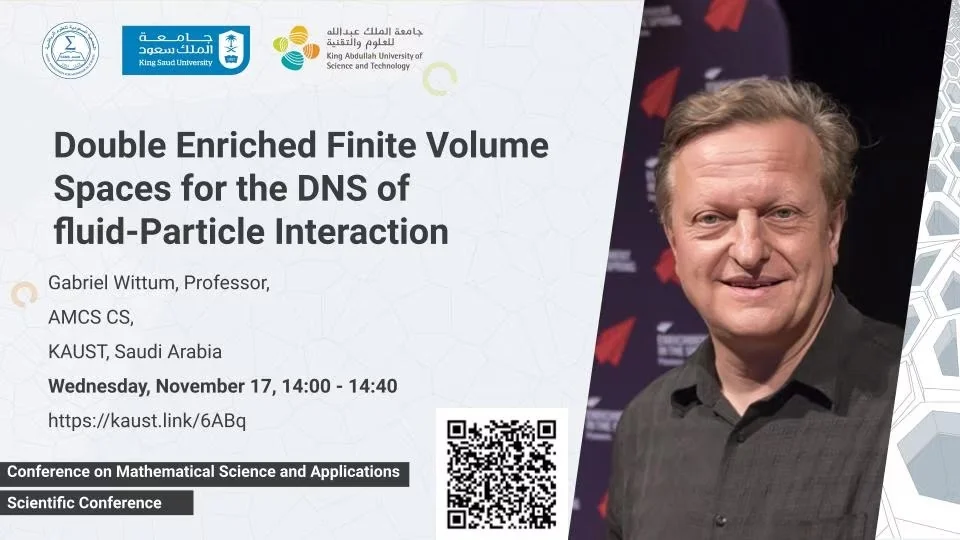
Double Enriched Finite Volume Spaces for the DNS of fluid-Particle Interaction - Scientific Conference Gabriel Wittum, Professor (former), Applied Mathematics and Computational Science Nov 17, 14:00 - 14:40 KAUST Plenary Sessions Abstract We present double enriched finite volume spaces for the simulation of free particles in a fluid. This involves forces being exchanged between the particles and the fluid at the interface. In an earlier work we derived a monolithic scheme which includes the interaction forces into the Navier-Stokes equations by direct coupling. In multiphase flows oscillations and spurious velocities are a common issue. The surface force term yields a jump in the pressure and therefore the oscillations are usually resolved by extending the spaces on cut elements in order to resolve the discontinuity
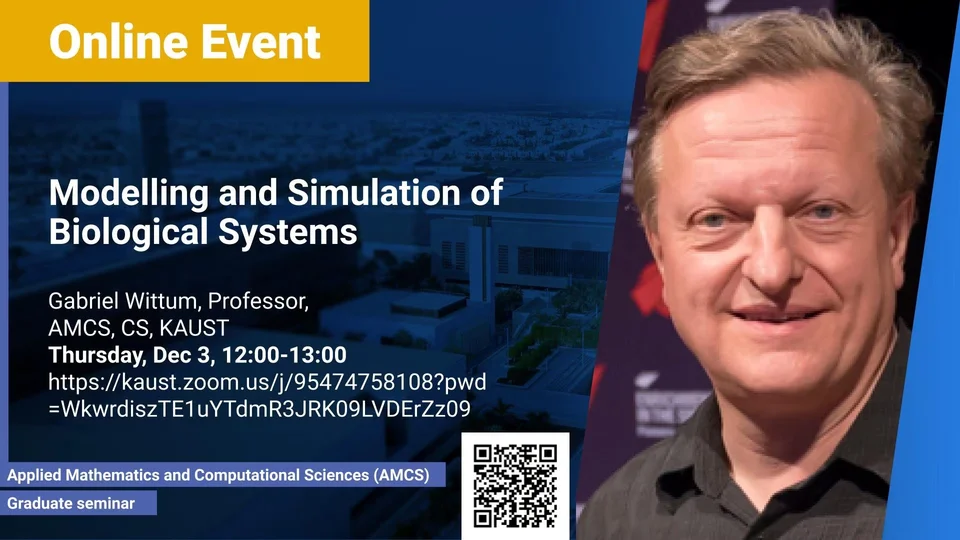
Modelling and Simulation of Biological Systems - 2020-12-03 Gabriel Wittum, Professor (former), Applied Mathematics and Computational Science Dec 3, 12:00 - 13:00 KAUST Biological systems are distinguished by their enormous complexity and variability. That is why mathematical modeling and computational simulation of those systems is very difficult, in particular thinking of detailed models which are based on first principles. The difficulties start with geometric modeling which needs to extract basic structures from highly complex and variable phenotypes, on the other hand also has to take the statistic variability into account. Moreover, the models of the processes running on these geometries are not yet well established, since these are equally complex and often couple many scales in space and time. Thus, simulating such systems always means to put the whole frame to test, from modelling to the numerical methods and software tools used for simulation. These need to be advanced in connection with validating simulation results by comparing them to experiments.
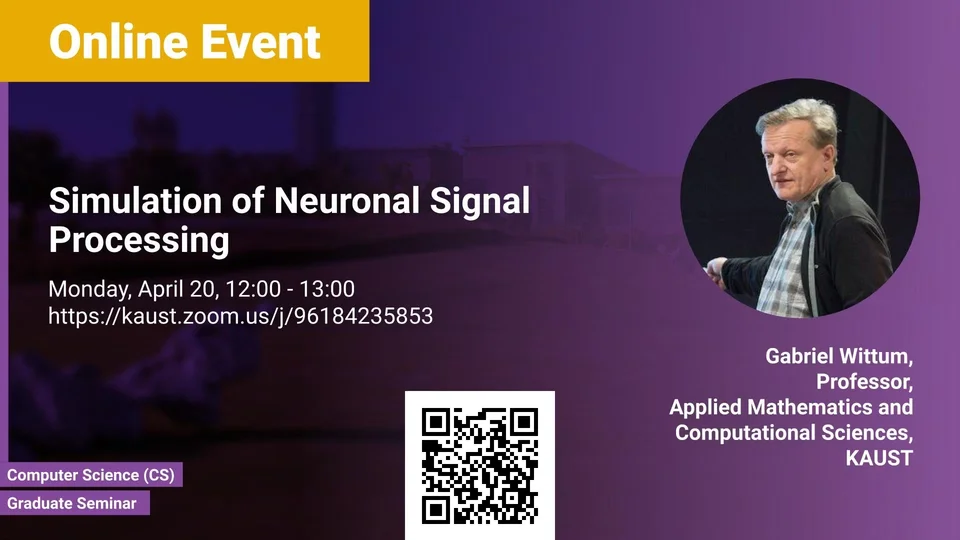
Simulation of Neuronal Signal Processing - 2020-04-20 Gabriel Wittum, Professor (former), Applied Mathematics and Computational Science Apr 20, 12:00 - 13:00 KAUST Neuronal ensembles In the lecture, we present a three-dimensional model for the simulation of signal processing in neurons. Part of this approach is a method to reconstruct the geometric structure of neurons from data measured by 2-photon microscopy. Being able to reconstruct neural geometries and network connectivities from measured data is the basis of understanding coding of motoric perceptions and long term plasticity which is one of the main topics of neuroscience. Other issues are compartment models and upscaling.
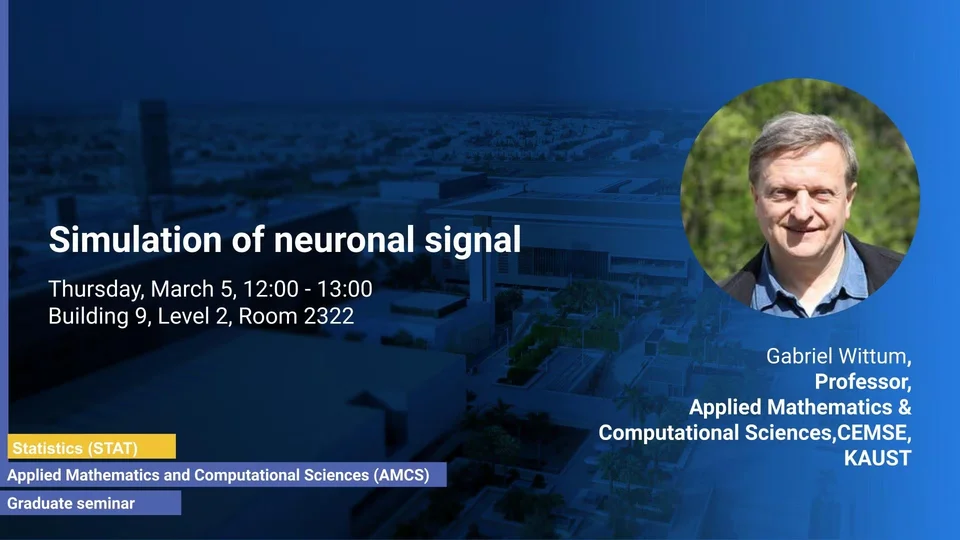
Simulation of Neuronal Signal Processing - 2020-03-05 Gabriel Wittum, Professor (former), Applied Mathematics and Computational Science Mar 5, 12:00 - 13:00 B9 L2 R2322 Neuronal ensembles Stochastiic Variability neuroscience In the lecture we present a three dimensional mdoel for the simulation of signal processing in neurons. To handle problems of this complexity, new mathematical methods and software tools are required. In recent years, new approaches such as parallel adaptive multigrid methods and corresponding software tools have been developed allowing to treat problems of huge complexity. Part of this approach is a method to reconstruct the geometric structure of neurons from data measured by 2-photon microscopy. Being able to reconstruct neural geometries and network connectivities from measured data is the basis of understanding coding of motoric perceptions and long term plasticity which is one of the main topics of neuroscience. Other issues are compartment models and upscaling.
Related Sites Applied Mathematics and Computational Science (AMCS) Computer Science (CS) Center of Excellence for Generative AI (GenAI) Applied Mathematics School (AMS) Conference on Mathematical Science and Applications (CMSA) Flow Simulation at the Exascale (Exaflow) Modelling and Simulation (MaS) Related Content Articles 1 Events 10