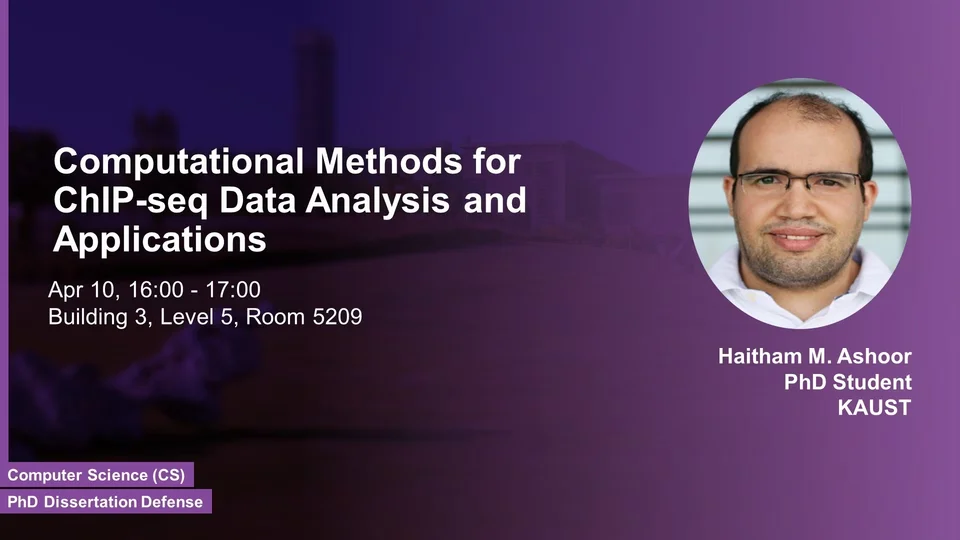
About Haitham M. Ashoor Haitham M. Ashoor Ph.D., Computer Science computational methods machine learning bioinformatics data analysis Research Interests Haitham Ashoor is a Ph.D. candidate in the Computer Science program at King Abdullah University of Science and Technology (KAUST). He is working under the supervision of Prof. Vladimir Bajic. He has obtained his BSc degree in Computer Engineering from the University of Jordan, Amman Jordan in 2008. He joined KAUST as an MSc student in 2009. In 2011, He finished his master studies under the supervision of Prof. Vladimir Bajic. His main research interests are developing computational methods for next-generation sequencing data analysis and applications of machine learning in Events Presented Events Apr 9 - Apr 15, 2017 Computational Methods for ChIP-seq Data Analysis and Applications Haitham M. Ashoor, Ph.D., Computer Science Apr 10, 16:00 - 17:30 B3 L5 5209 computation techniques machine learning bioinformatics data analysis Abstract The development of Chromatin immunoprecipitation followed by sequencing (ChIP-seq) technology has enabled the construction of genome-wide maps of protein-DNA interaction. Such maps provide information about transcriptional regulation at the epigenetic level (histone modifications and histone variants) and at the level of transcription factor (TF) activity. This dissertation presents novel computational methods for ChIP-seq data analysis and applications. The work of this dissertation addresses four main challenges. First, I address the problem of detecting histone modifications from
Computational Methods for ChIP-seq Data Analysis and Applications Haitham M. Ashoor, Ph.D., Computer Science Apr 10, 16:00 - 17:30 B3 L5 5209 computation techniques machine learning bioinformatics data analysis Abstract The development of Chromatin immunoprecipitation followed by sequencing (ChIP-seq) technology has enabled the construction of genome-wide maps of protein-DNA interaction. Such maps provide information about transcriptional regulation at the epigenetic level (histone modifications and histone variants) and at the level of transcription factor (TF) activity. This dissertation presents novel computational methods for ChIP-seq data analysis and applications. The work of this dissertation addresses four main challenges. First, I address the problem of detecting histone modifications from
Related Sites Computer Science (CS) Related Content Articles 1 Events 1 Related Links Publications on Google Scholar Dblp Computer science bibliography